Will NVDA Stock Fall Below $190 as 4-Hour Moving Averages Turn Bearish?
Nvidia stock NVDA slips below key 4-hour averages as AI memory costs, RTX 3060 restock and Corning deal shape the next move.
Quick overview
- Nvidia shares have dropped 13% over the past month, falling below the $200 mark as investors reassess AI valuations and memory costs.
- The stock's technical indicators show weakening momentum, with immediate resistance near $196.50 and a critical support level at $190.
- Despite the recent decline, Nvidia continues to invest in AI infrastructure, including funding Corning's expansion for optical connectivity.
- The outlook remains uncertain as the stock's pullback may attract long-term investors, but a break below $190 could lead to further declines.
Nvidia shares remain under pressure after sliding 13% over the past month, with technical indicators now showing weakening momentum as investors reassess AI valuations, memory costs, and the next phase of infrastructure demand.
Nvidia Pullback Tests Investor Confidence
Nvidia stock has lost momentum after its recent record-setting rally, slipping back below the $200 level as traders take profits across high-growth semiconductor names. While the company remains the dominant force in AI accelerators, the latest technical setup suggests NVDA may need to defend the $190 region before buyers regain control.
NVDA Slips Below $200 as AI Valuation Concerns Return
Nvidia Corporation shares closed at $194.83 on July 2, down 1.39% on the session, while after-hours trading showed another modest decline to $194.44.
The pullback follows a broader cooling in AI-related stocks after months of powerful gains. Investors are becoming more selective as questions grow over whether the AI infrastructure boom can keep supporting elevated valuations across the semiconductor sector.
Nvidia remains the largest beneficiary of the AI cycle, but its recent decline shows that even market leaders are not immune when traders begin reducing exposure to momentum-driven technology names.
Technical Breakdown Shows Sellers Still in Control
From a technical perspective, Nvidia’s 4-hour chart has weakened considerably.
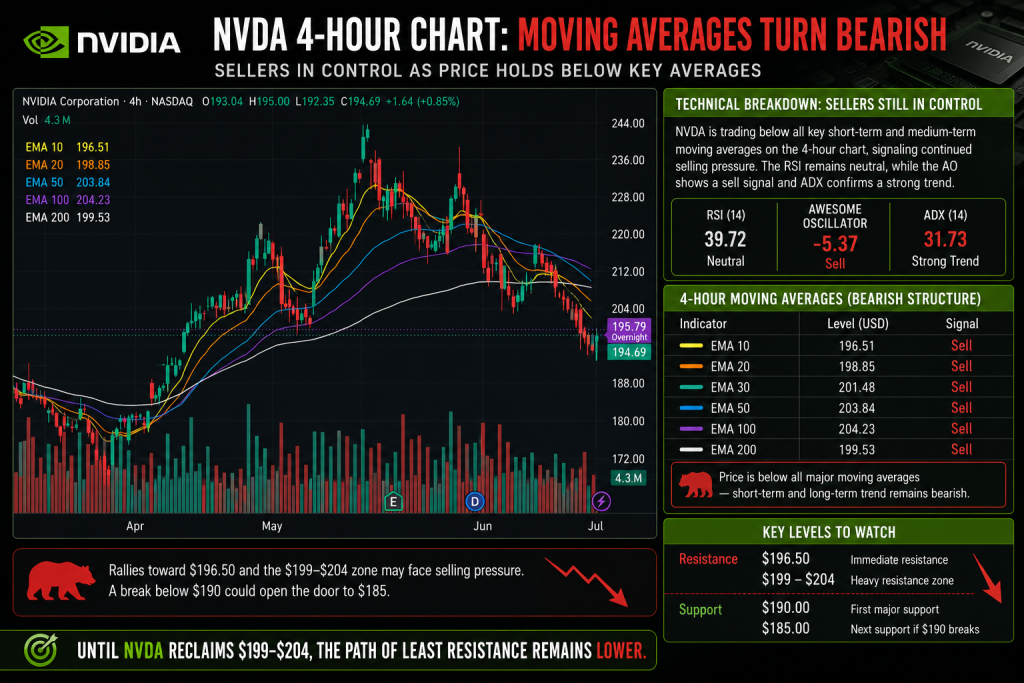
The stock is trading below its short-term and medium-term moving averages, with the 10-period EMA at $196.51, the 20-period EMA at $198.85, and the 50-period EMA at $203.84 all acting as resistance. The broader trend also looks heavy, with the 100-period EMA at $204.23 and the 200-period EMA at $199.53 sitting above the current price.
That structure suggests rallies may face selling pressure unless NVDA can reclaim the $199-$204 zone.
The RSI at 39.72 remains neutral, meaning the stock is not yet deeply oversold. However, the Awesome Oscillator shows a sell signal at -5.37, while the ADX at 31.73 indicates that the current trend has meaningful strength.
NVDA Chart 4H – Moving Averages Turn Bearish
The moving-average picture is clearly bearish on the 4-hour chart. Nvidia is trading below the 10, 20, 30, 50, 100, and 200-period moving averages, showing that sellers have controlled the recent price action.
Immediate resistance now sits near $196.50, followed by the heavier $199-$204 zone. A clean recovery above that area would be needed to shift short-term sentiment back in favor of buyers.
On the downside, the first major level to watch is $190. If that breaks, NVDA could extend the correction toward $185, where dip buyers may attempt to defend the broader uptrend.
RTX 3060 Restock Highlights Memory Pressure
Nvidia has also brought back its older RTX 3060 graphics card as rising memory costs continue to distort the consumer GPU market.
The move is designed to ease pressure in the lower-end graphics card segment, where buyers are facing higher prices and limited attractive options. However, the card’s return at elevated pricing has raised questions about affordability, especially with newer GPUs available near similar price points.
For investors, the move highlights a larger issue: AI demand is consuming enormous amounts of memory and data-center capacity, creating ripple effects across consumer hardware markets.
That dynamic supports Nvidia’s long-term pricing power, but it also reinforces concerns that supply-chain strain could keep hardware costs elevated.
Corning Deal Reinforces AI Infrastructure Buildout
Despite near-term weakness in NVDA stock, Nvidia continues investing aggressively in the physical infrastructure needed to support AI growth.
The company has helped fund Corning’s expansion of U.S. optical connectivity capacity, including new factories tied to data-center demand. Optical networking is becoming increasingly important as AI clusters require faster and more efficient data movement between chips, servers, and facilities.
This shows Nvidia is no longer just selling GPUs into the AI boom. It is also helping shape the supply chain around AI factories, networking, memory, and data-center performance.
Outlook: Can NVDA Hold $190?
Nvidia’s long-term growth story remains intact, but the short-term technical picture has deteriorated.
As long as NVDA remains below the $199-$204 resistance zone, sellers may continue targeting the $190 level. A break below that area could open the door toward $185, especially if broader semiconductor sentiment remains weak.
However, the stock’s pullback may also attract long-term investors who still view Nvidia as the core holding in AI infrastructure. The key question now is whether buyers step in before the correction becomes a deeper technical reset.
- Check out our free forex signals
- Follow the top economic events on FX Leaders economic calendar
- Trade better, discover more Forex Trading Strategies
- Open a FREE Trading Account
- Read our latest reviews on: Avatrade, Exness, HFM and XM

Related Articles



Sidebar rates

Related Posts
 Save
Save