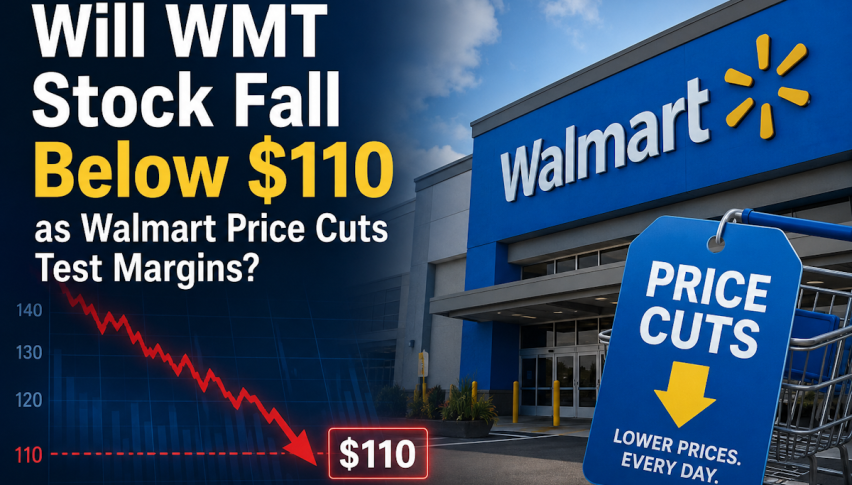
Will WMT Stock Fall Below $110 as Walmart Price Cuts Test Margins?
Walmart stock WMT slips below key daily averages as price cuts pressure margins, while ad growth keeps bulls focused on $115.
Quick overview
- Walmart shares declined as investors reacted to aggressive grocery price cuts and concerns over profit margins.
- The retailer announced significant price reductions on summer staples, including beef, to address consumer stress amid high food inflation.
- Walmart's advertising and membership businesses are becoming crucial for profitability, contributing significantly to operating income.
- The stock's performance is under pressure, with $110 identified as a key support level ahead of the upcoming earnings release.
Walmart shares slipped despite broader market strength as investors weighed aggressive grocery price cuts, consumer stress, and the retailer’s fast-growing advertising and membership businesses.
Walmart Drops as Investors Watch Margins
Walmart shares moved lower as the market reacted to a mix of affordability headlines and margin concerns. The company is leaning into price cuts at a politically sensitive moment for U.S. consumers, but investors are asking whether lower shelf prices could pressure profitability.
Walmart Cuts Beef and Grocery Prices
Walmart announced lower prices across summer staples, including meat, beverages, snacks, produce, toys, apparel, and household goods.
The most visible cut was on a one-pound roll of 73% ground beef, reduced to $5.94 from $6.74, a decline of about 12%. Sam’s Club also cut the price of Member’s Mark 88/12 ground beef to $5.97 per pound, down from $6.17.
President Donald Trump praised the move and urged other retailers to follow Walmart’s lead, framing the price cuts as part of a broader push to ease pressure on households.
For Walmart, the move reinforces its value-focused brand at a time when consumers remain sensitive to food inflation. However, investors may worry that deeper discounts could limit margin expansion if supplier costs remain elevated.
Beef Inflation Keeps Consumer Pressure High
The timing matters because beef prices remain a major pain point for U.S. shoppers.
Drought, higher feed costs, smaller cattle herds, and restricted cattle imports have kept supply tight. Economists have warned that rebuilding U.S. cattle inventories could take years, meaning beef prices may stay elevated even if retailers temporarily absorb some of the pressure.
That makes Walmart’s pricing strategy important. The company can use its scale to win traffic and market share, but the trade-off is that aggressive price cuts can raise questions about margins, especially when investors already view the stock as expensive.
Advertising Business Becomes Walmart’s Hidden Profit Engine
The bullish case for Walmart is no longer just about groceries.
Walmart’s higher-margin businesses are becoming increasingly important. Its advertising, marketplace, and membership operations now represent roughly one-third of operating income, according to recent company commentary.
Walmart U.S. advertising grew 36% in the latest quarter, while U.S. marketplace sales rose nearly 50%. Membership fee revenue also climbed about 17% enterprise-wide.
The Vizio acquisition has strengthened Walmart’s connected-TV advertising strategy, giving the company another way to monetize shopper data and household reach. This retail media business changes the investment story because it provides a higher-margin growth engine beyond traditional low-margin retail.
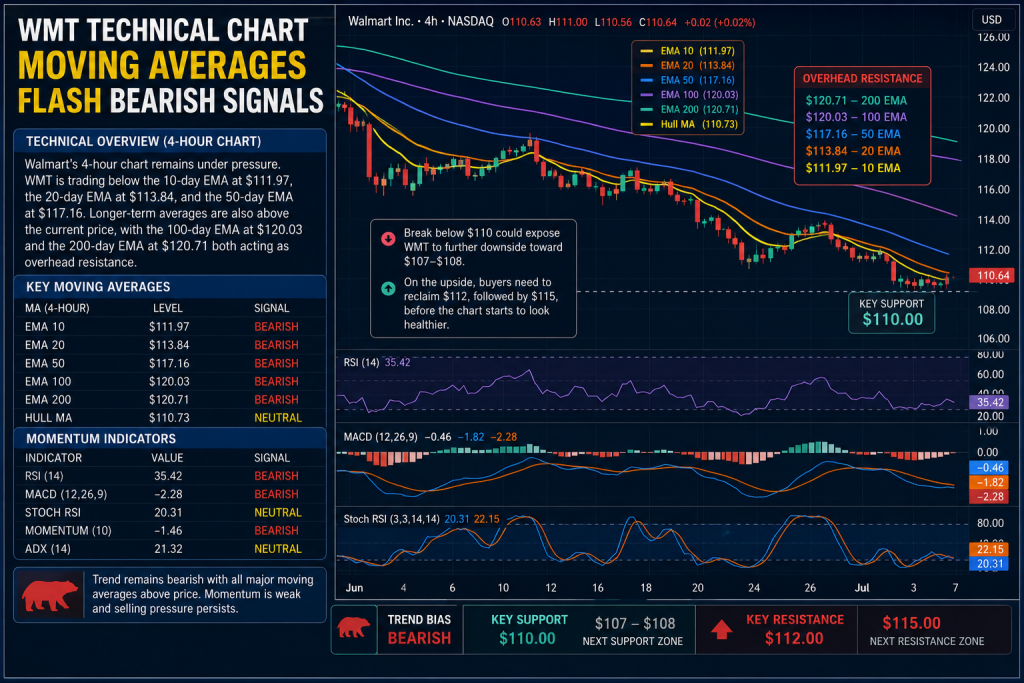
WMT Technical Chart: Moving Averages Flash Bearish Signals
From a technical perspective, Walmart’s 4-hour chart remains under pressure.
WMT is trading below the 10-day EMA at $111.97, the 20-day EMA at $113.84, and the 50-day EMA at $117.16. Longer-term averages are also above the current price, with the 100-day EMA at $120.03 and the 200-day EMA at $120.71 both acting as overhead resistance.
Momentum is weak but not deeply oversold. The RSI sits at 35.42, while MACD remains bearish at -2.28. The Hull Moving Average at $110.73 is nearly in line with the current price, making the $110 zone especially important.
A break below $110 could expose WMT to further downside toward $107-$108. On the upside, buyers need to reclaim $112, followed by $115, before the chart starts to look healthier.
Walmart Earnings Could Decide the Next Move
Walmart’s next major catalyst is its upcoming earnings release on August 20, 2026.
Analysts expect quarterly EPS of $0.74, up about 8.8% year over year, with revenue projected near $186.4 billion, up roughly 5.1%.
For the full year, consensus estimates point to EPS of $2.89 and revenue near $750 billion. Those numbers suggest steady growth, but valuation remains a concern, with WMT trading at a premium forward earnings multiple.
Can WMT Defend $110?
Walmart’s long-term story remains strong, especially as advertising, memberships, marketplace growth, and delivery scale improve the company’s profit mix.
However, the short-term chart is weak. The stock remains below key daily moving averages, and the market may stay cautious until investors see whether price cuts drive stronger traffic without damaging margins.
For now, $110 is the key support level. If Walmart holds that area, buyers may attempt a rebound toward $115. If it breaks, the stock could face another leg lower before earnings reset the narrative.
- Check out our free forex signals
- Follow the top economic events on FX Leaders economic calendar
- Trade better, discover more Forex Trading Strategies
- Open a FREE Trading Account
- Read our latest reviews on: Avatrade, Exness, HFM and XM

Related Articles

Sidebar rates

Related Posts
 Save
Save