WTI Crude Oil Price Forecast: $68.71 Upward Trendline Under Siege as Post-Treaty Iranian Shipments Mount
The global energy complex’s physical and structural architecture has now accelerated into a major downward repricing cycle, as the paper...
Quick overview
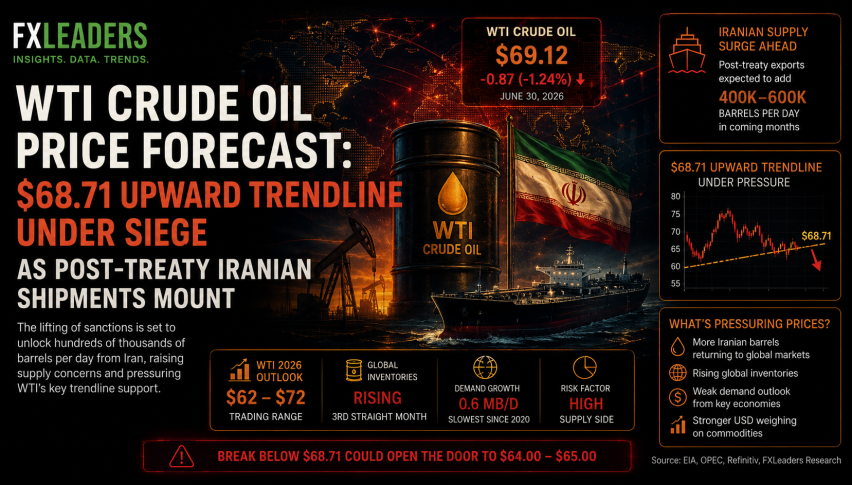
- The global energy market is experiencing a significant downward repricing cycle, with WTI Crude Oil closing at $68.71 per barrel due to increased physical supply and institutional selling.
- A recent U.S.-Iran peace settlement has alleviated fears of supply disruptions, leading to a resumption of oil tanker traffic through the Strait of Hormuz.
- OPEC+ is preparing to increase production amid rising Iranian supply, while U.S. oil production remains at record levels, complicating the market dynamics.
- Despite a potential recovery in oil prices, high interest rates and a strong U.S. dollar are constraining demand and complicating crude procurement for non-USD entities.
The global energy complex’s physical and structural architecture has now accelerated into a major downward repricing cycle, as the paper market flushes out the last of its remaining risk allocations. On Sunday July 5, 2026, West Texas Intermediate (WTI) Crude Oil (USOIL) endured continuous institutional desk distribution, closing out the post-holiday week down towards $68.71 per barrel.
Commodity index managers and commercial trading desks have been quickly realigning their portfolios in the process, driving major oil indices below cyclical resistance levels in response to an imminent wave of tangible multi million barrel physical supply entering the market at the onset of the new quarter.
Swiss Accord Reopens Hormuz Corridor and Deflates the War-Risk Premium
The leading fundamental driver behind crude benchmarks’ continued near-term decline is the perfect execution of the U.S. and Iran interim peace settlement, also referred to as the Islamabad Memorandum of Understanding (US-Iran MoU).
The U.S. and Iran reached a diplomatic settlement on the issue on June 19th via the mediation of Pakistani interests, in a final accord signed in Switzerland, which has now served to undo market fears surrounding a global supply disruption from the region that has dominated the energy market throughout the last quarter of oil derivatives.
This supply-side reorganization has been driven by the comprehensive end to the U.S. naval blockade on Iran as well as the reinstatement of access to the Strait of Hormuz, the world’s most critical shipping choke point, to Iranian vessels.
Maritime tracking data shows that the Strait of Hormuz has been opened to commercial vessels, with approximately 85% of normal seasonal oil tanker traffic resuming in recent days. Data on tanker movements and on-the-ground industry reports also indicate that Iranian cargoes have already begun to lift from floating storage at the beginning of July, after the deal was concluded with diplomatic oversight, and that these loads are flowing directly back into the refinery systems in Europe and Asia.
OPEC+ Voluntary Cut Rollbacks Intersect Record Non-OPEC Production Buffers
In addition to this Iranian supply surge, the timing of OPEC+ supply growth is becoming increasingly unwelcoming. While some members of the alliance have been very disciplined on output, others were positioned to begin raising production volumes in the coming months as part of the alliance’s previously agreed voluntary cuts schedule.
As Iranian barrels re-enter the market, OPEC+ is moving towards a July production schedule growth of +188,000 BPD as part of this gradual cut rollback.
This potential future expansion from the group comes at a bad time and will likely prompt the group to closely monitor the output compliance of other members at their next meeting, so as to forestall a supply build that could get out of hand in global oil inventories, as non-OPEC supplies continue to expand at record levels. U.S. oil production sits at record output levels due to sustained drilling activity alongside aggressive output growth in other countries like Guyana, Brazil, and Canada.
OPEC has maintained a moderate demand outlook for oil, at 1.2 million BPD for the calendar year, as they project demand will continue to be weak in the OECD as a function of the economic weakness and efficiency gains the alliance has been forecasting for the last year or more.
The Warsh Doctrine Extends High Financing Hurdles for Commercial Commodity Desks
A major limiting factor on any demand-side recovery in oil prices, however, has been the restrictive monetary policy that Federal Reserve Chair Kevin Warsh announced in his latest June 16 to 17 Federal Open Market Committee statement.
Citing the persistence of core U.S. inflation at 4.1% and core consumer inflation data at 3.8%, Chair Warsh made a data-dependent, hard-nosed monetarist announcement that removed the near-term expectations for a rate-cut.
In his latest address during the Central Bank Forum in Sintra, Portugal on the ECB forum, Chair Warsh reiterated the Fed’s desire to remain independent and rules-based to its 2% inflation mandate as well as its strong support for a high interest rate environment at these levels for a prolonged period of time, which has kept real U.S. yields and the Dollar at a fresh, multi-year cycle high since the statement was released.
With crude trading priced on an international basis in the US dollar, such strong currency pricing increases the costs for crude procurement for non-USD based sovereign entities and thus constrains the economic incentives for refiners to purchase crude on a global basis and reduces the incentive to buy oil, which has constrained the energy complex in terms of its long exposure to the market since the crisis started.
WTI Crude Oil Technical Analysis: USOIL Slams Into Long-Term Upward Trendline Support Floor
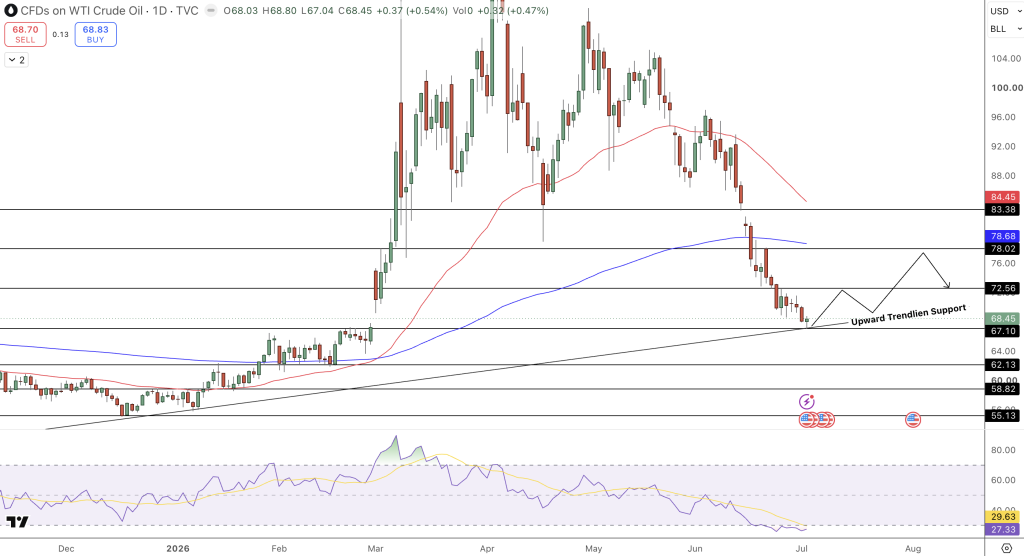
Moving away from the political macro landscape and zooming in on the daily technical chart, WTI Crude Oil has spent the last few months grinding lower from a top of around $112 and is now setting up a small base around critical baseline support.
On the daily timeframe, WTI Crude Oil is now approaching the bottom of its long term daily framework in its current price action at $68.71 to define the first level of its long term Upward Trendline Support Floor. The asset remains capped by a large descending trend line from previous macro trendline highs and is still trading below its daily dynamic ceilings of the daily 200-EMA ($79.53).
The 14-period RSI has now reached the mathematical limits of exhaustion, sitting at 27.33 in extreme oversold territory. This severe contraction in the oscillator suggests that the immediate decline velocity has largely come to a bottom, and the appearance of positive bullish divergence in the MACD Histogram now suggests that the initial post-deal velocity leg in WTI oil is now beginning to encounter support near the $67.10 horizontal pivot line.
Conclusion and Trade Idea
WTI crude oil is now beginning the process of unwinding its war premium, as investors return to the market and allow global supply increases to begin dictating price action. Although Kevin Warsh is still working on an environment where his strong US dollar thesis creates significant headwinds in the financing of US crude futures and oil trading positions, the daily technical structure of a bottom trendline support test on a deeply oversold basis suggests that the initial leg of the correction has likely found some level of immediate bottom.
Tactical Breakout Blueprint
Consider taking long positions in WTI oil only after a confirmed close and breakout above the resistance trendline/horizontal price level support structure at $72.51. Keep a protective hard stop below the invalidation support level at $67.10, with immediate price targets at $74.45, the last major horizontal resistance trendline and potential trendline resistance zone in price action, and then $78.07, as secondary price targets in a reversal rally.
- Check out our free forex signals
- Follow the top economic events on FX Leaders economic calendar
- Trade better, discover more Forex Trading Strategies
- Open a FREE Trading Account
- Read our latest reviews on: Avatrade, Exness, HFM and XM

Related Articles


Sidebar rates

Related Posts
 Save
Save