NVDA Stock Surges 4.3% on $5.7 Trillion Bet, Could Nvidia’s Next Five Days Define the AI Decade?
Quick overview
- NVIDIA is set to release a crucial earnings report on May 20, with expectations at an all-time high following a significant AI-driven market rally.
- The company's fundamentals remain robust, with Q4 FY2026 showing a 73% year-over-year revenue increase and data center revenue making up over 91% of total business.
- China's market remains a major uncertainty for NVIDIA, as current guidance excludes revenue from the region amid export restrictions.
- Analysts predict a strong earnings beat, but there are concerns that merely meeting expectations may not be enough to drive the stock higher.
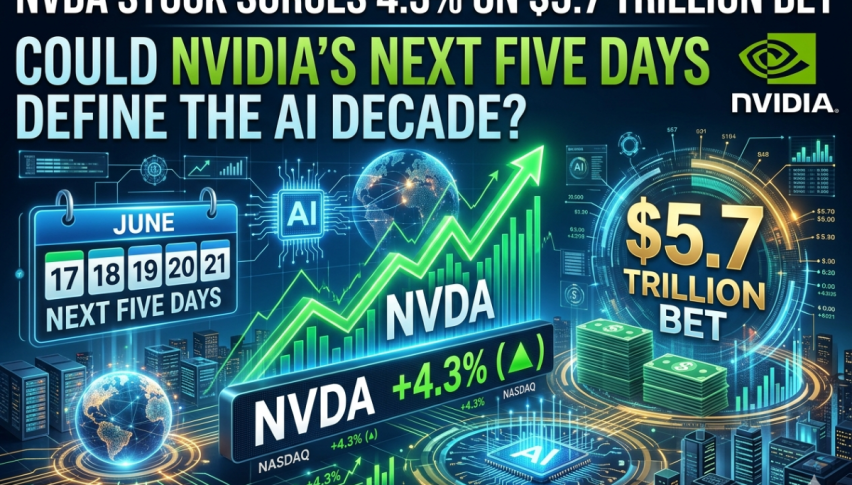
NVIDIA is heading into one of the most important earnings reports in modern market history, with investors now asking whether even Nvidia can continue outperforming expectations after a historic AI-driven rally.
The company’s fundamentals remain extraordinarily strong, but expectations have reached extreme levels ahead of its May 20 earnings release.
Nvidia’s Fundamentals Still Look Remarkably Strong
For a company now valued at roughly $5.7 trillion, Nvidia’s financial growth remains almost unprecedented.
Q4 FY2026 results showed:
- Revenue of $68.1 billion, up 73% year over year
- Data center revenue of $62.3 billion
- GAAP net income of $42.96 billion, up 94%
- Non-GAAP gross margins of 75.2%
The scale of Nvidia’s dominance in AI infrastructure continues widening as hyperscalers aggressively race to build next-generation AI compute capacity.
Data center revenue now accounts for more than 91% of Nvidia’s total business, highlighting how completely the company has transformed into the foundational supplier for the global AI economy.
The AI Spending Cycle Still Looks Early
One reason investors remain aggressively bullish is that AI infrastructure demand still appears far from peaking.
The four largest hyperscaler customers — Microsoft, Amazon, Alphabet, and Meta — are collectively expected to spend more than $720 billion in 2026 capital expenditures.
That figure represents roughly 77% year-over-year growth.
Importantly, many hyperscalers continue signaling that AI infrastructure remains capacity constrained well into 2026.
CEO Jensen Huang has also suggested Nvidia’s Blackwell and Vera Rubin AI processor platforms could eventually generate roughly $1 trillion in combined sales across 2026 and 2027.
Compared to Nvidia’s trailing 12-month revenue base of roughly $216 billion, that projection highlights the sheer scale of the opportunity investors are attempting to price in.
China Remains the Biggest Near-Term Wildcard
The largest uncertainty surrounding Nvidia heading into earnings remains China.
Before U.S. export restrictions tightened, Nvidia reportedly controlled roughly 95% of China’s advanced AI chip market, while China represented about 13% of total company revenue.
Current guidance for fiscal Q1 FY2027 explicitly excludes China data center revenue.
That means investors are essentially assigning zero value to China AI shipments until management provides greater visibility around delivery timing and export restrictions.
Any positive update from management regarding China demand, shipment approvals, or replacement product pathways could become a major upside catalyst for the stock.
Conversely, continued uncertainty may pressure sentiment even if headline earnings remain strong.
NVIDIA’s May 20 Earnings Could Define the Next Major Move
The upcoming May 20 earnings report is now viewed as the event likely to determine Nvidia’s next major directional move.
Consensus expectations currently call for:
- Revenue of roughly $78.8 billion
- EPS of approximately $1.77
Some analysts, including teams at Goldman Sachs, are already projecting revenue roughly $2 billion above consensus.
Prediction markets imply nearly a 90% probability of an earnings beat.
Ironically, that creates risk.
Nvidia has now reached the stage where simply beating expectations may no longer be enough to push the stock materially higher.
The company has beaten estimates repeatedly in recent quarters, yet the stock still declined after three of the last four earnings reports as investors focused on guidance rather than headline numbers.
This time, markets appear especially sensitive to:
- Q2 guidance
- Blackwell shipment commentary
- China delivery timelines
- Gross margin trends
- Hyperscaler demand visibility
Technical Analysis: NVDA Remains Bullish but Extended
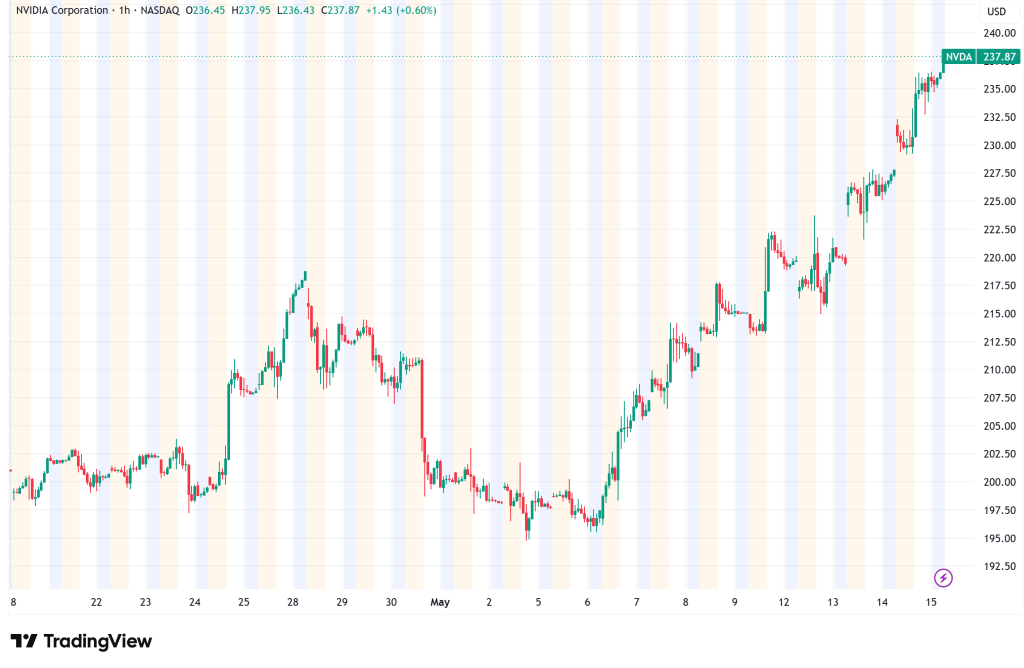
Technically, Nvidia’s chart still strongly favors bulls, although momentum conditions are becoming stretched.
The stock continues trading above all major moving averages:
- 5-day moving average near $227
- 50-day moving average near $214
- 200-day moving average near $201
TradingView’s composite rating remains “strong buy” across daily, weekly, and monthly timeframes.
Key Technical Levels for NVDA Stock
- Immediate resistance: $230-$235
- Breakout zone: above $240
- Near-term support: $209-$210
- Major support: $195-$193
- Long-term structural support: near $185
If the stock experiences a “sell the news” reaction, the $195-$210 range may become the first meaningful support zone for longer-term buyers.
NVDA’s Valuation Debate Intensifies Again
Despite Nvidia’s massive rally, some investors still argue the stock is not excessively expensive relative to its growth profile.
Given the company’s extraordinary revenue growth, expanding margins, and dominant market position, the forward valuation multiple remains lower than many expected for a company growing at this scale.
Still, expectations are now extremely elevated.
The market is effectively pricing Nvidia as the central infrastructure provider for the AI economy over the next decade.
That leaves little room for operational missteps, slower demand growth, or margin disappointments.
Long-Term Outlook Still Looks Exceptional
Long term, Nvidia remains one of the strongest structural AI growth stories in global markets.
The company sits at the center of nearly every major AI spending theme:
- AI training
- Inference infrastructure
- Hyperscaler expansion
- Robotics
- Autonomous systems
- AI software ecosystems
- Enterprise AI deployment
The combination of CUDA software dominance, hardware leadership, and hyperscaler dependency continues giving Nvidia an unusually strong competitive moat.
The primary debate now is no longer whether Nvidia is a great business.
It is whether investor expectations have temporarily moved ahead of what even an extraordinary company can realistically deliver over the next few quarters.
For now, the broader trend still strongly favors Nvidia — but May 20 could determine whether the next move is another breakout or a much-needed consolidation phase.
- Check out our free forex signals
- Follow the top economic events on FX Leaders economic calendar
- Trade better, discover more Forex Trading Strategies
- Open a FREE Trading Account
- Read our latest reviews on: Avatrade, Exness, HFM and XM

Related Articles

Sidebar rates

Related Posts
 Save
Save