Boeing Stock in Freefall Despite China’s 200 Jet Order, Why Is BA Trading Down?
China ordered 200 Boeing jets, not 500. BA dropped 4.7%. We break down the fundamentals, technicals, and what the gap means for investors.

Quick overview
- Boeing shares fell over 4% after President Trump announced a deal for China to buy 200 jets, which was significantly lower than Wall Street's expectations of 500.
- The lack of details regarding the deal, including delivery timelines and aircraft types, has created uncertainty for investors.
- Boeing's financial recovery is evident with a $682 billion backlog and a return to profitability, but concerns about high debt levels and competition from Airbus remain.
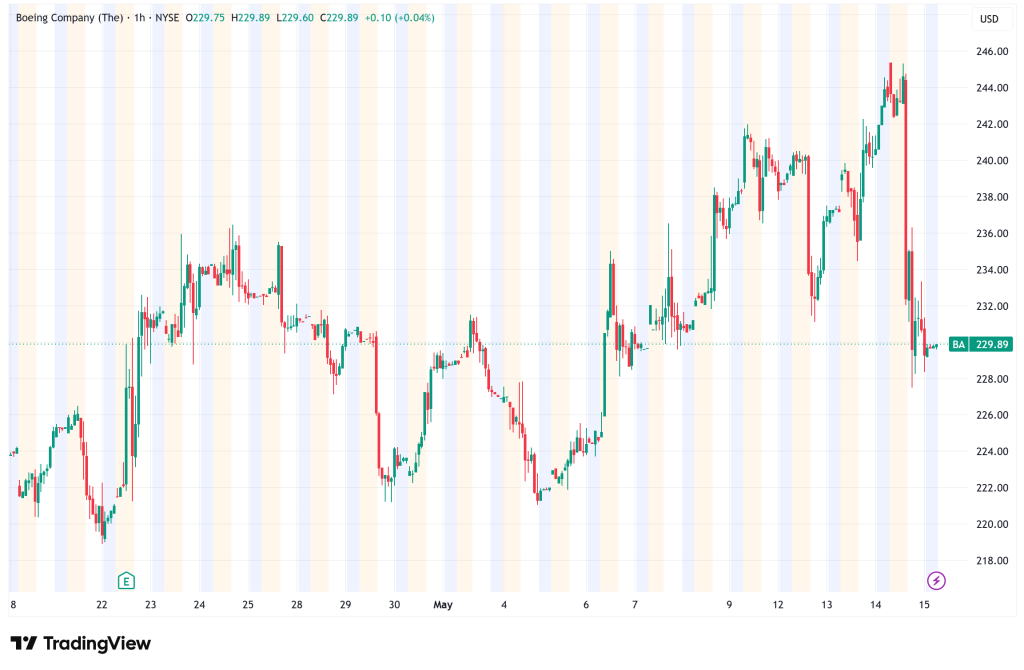
- Technical indicators suggest caution for near-term traders, as momentum is fading and the stock has broken through its rising trend channel.
Boeing shares dropped more than 4% on Thursday after President Trump announced that China had agreed to buy 200 Boeing jets, a number that landed like a dud relative to what Wall Street had been counting on.
Details of the deal were not immediately available, including when and which type of jets would be delivered, but the amount was far smaller than the roughly 500-plane package that sources told Reuters was under discussion ahead of the Trump-Xi summit. The divergence between expectation and reality is stark: analysts from Jefferies had said Boeing was negotiating a mega order with China for up to 500 aircraft.
China has not officially confirmed the deal, and Boeing has released no comment. The ambiguity is itself a problem for investors, and it exposes a structural dynamic that analysts have long flagged: Beijing has a history of using diplomatic summits to make high-profile aircraft order announcements that reflect the political climate at least as much as contractual realities.
Boeing’s Fundamentals Indicate a Fragile But Genuine Recovery
Boeing’s financial story in 2025 is one of dramatic improvement from a deeply troubled baseline. In 2025, Boeing reported revenue of $89.5 billion, a 34% increase, and EPS of $2.48, marking its first profitable year since 2018.
Free cash flow swung from a loss of $12 billion to a positive $1.06 billion, and the company delivered 600 commercial aircraft, its highest annual total since 2018.
The backlog is the most compelling part of the bull thesis. Boeing’s backlog has reached $682 billion, including over 6,100 commercial airplane orders, providing excellent long-term revenue visibility. That is a deep moat of contracted future revenue.
The debt picture, however, remains a serious concern. Total debt at end of Q4 2025 stood at $54.1 billion, up from $53.4 billion at the start of the quarter, primarily reflecting the acquisition of Spirit AeroSystems.
Boeing held just $10.9 billion in cash against that $53.8 billion in long-term debt, with a debt-to-equity ratio of 9.87 — a level that leaves precious little margin for error if revenue stumbles. Gross margins at 4.8% are razor thin for an industrial manufacturer of this scale.
Management forecasts continued improvement in 2026, expecting free cash flow in the $1–3 billion range, with focus on strengthening 737 MAX production and certifying the 777X.
BA Stock Technicals: Constructive But Losing Momentum Near Resistance
The technical picture, before Thursday’s drop, was cautiously bullish but showing signs of fatigue. The daily RSI was around 57, positive without being stretched, signalling healthy momentum rather than an overheated move. However, daily MACD had softened, with the line slightly below the signal and a marginally negative histogram, suggesting upside momentum had cooled.
The stock had been moving within a rectangle formation between support at $191 and resistance at $262, with nearer-term support at $224 and resistance at $236. The 200-day moving average sits at approximately $212–213, offering a medium-term floor that would need to break decisively for the trend to turn genuinely bearish.
Thursday’s 4.7% drop likely pushed price back toward or below the $228–$231 pivot zone. The bearish scenario involves continued failure around the $231.5–$235.7 resistance band; a decisive break below $228 would weaken the bullish structure and raise the risk of a deeper move back toward $226 and the daily middle Bollinger band.
Key watch: does the $224 level hold as support on any further selling?
Boeing has also broken through the floor of its medium-term rising trend channel, indicating either a slower rate of ascent or the beginning of a more horizontal consolidation phase, not necessarily bearish, but a yellow flag for momentum traders. Investtech
The China Context: Diplomatic Theatre vs. Commercial Reality
The geopolitical dimension of this story is essential to understanding why the 200-jet announcement hit so hard. China placed an average of 127 orders per year with Boeing from 2005 through 2017. Since then, Chinese airlines have averaged just 6 airplanes a year. The long drought means any large order is genuinely transformative — which is exactly why the expectation gap mattered so much.
Beijing’s most recent significant purchase from Boeing came during Trump’s 2017 trip to China, covering 300 planes valued at more than $37 billion. Nearly a decade of diplomatic frost followed. Even with the 200-jet announcement, the question of timing, aircraft types, and delivery schedules remains entirely open.
The actual operator is frequently not clear until closer to delivery, according to aerospace investment analyst Matt Akers of BNP Paribas, who noted that “it’s possible we still get more orders this trip, but right now investors are interpreting this as being less than hoped for.”
China needs to order as many as 1,000 new airplanes now to keep up with booming travel demand, and will require at least 9,000 new jetliners by 2045 according to market projections by both Boeing and Airbus. The structural demand is undeniable.
The question is how much of it Boeing captures versus Airbus, which has been steadily gaining Chinese market share since 2018 and already has an A320 assembly plant in Tianjin.
Boeing’s Long-Term Potential Signals Recovery But with Real Risks
Boeing is genuinely a recovery story with a credible path — but one that requires patience, geopolitical calm, and execution that the company has repeatedly struggled to deliver. The $682 billion backlog is a real asset.
The pivot back to profitability after years of losses is meaningful. And a supportive US administration actively pushing Boeing’s case in trade negotiations is a tailwind that’s hard to quantify but real.
The risks, however, are not trivial: the debt load is structurally dangerous if margins don’t expand decisively, the Airbus rivalry in China is intensifying, supply chain integration with Spirit AeroSystems adds execution risk, and tariff re-escalation between the US and China could unwind even the orders that were announced.
Any new safety incident involving the 737 MAX would be catastrophic for sentiment.
For long-term investors, Boeing remains a high-conviction recovery trade with a wide range of outcomes. For near-term traders, the technicals suggest caution: momentum is fading near resistance, the trend channel break deserves respect, and the catalyst that many were counting on, a blockbuster China order, has at least partially disappointed.
The $224 support level is the near-term line in the sand.
- Check out our free forex signals
- Follow the top economic events on FX Leaders economic calendar
- Trade better, discover more Forex Trading Strategies
- Open a FREE Trading Account
- Read our latest reviews on: Avatrade, Exness, HFM and XM

Related Articles



Sidebar rates

Related Posts
 Save
Save