From Detroit to Data Centers: Ford’s Quiet Pivot Into the AI Power Business Drives F Up 13%
Ford Motor (F) beat Q1 by 247%, raised guidance, and launched an energy unit worth up to $31B. The EV writedown just became a pivot.

Quick overview
- Ford Motor's stock surged 13% following a significant Q1 earnings beat, posting an EPS of $0.66 compared to an expected $0.19.
- The company launched Ford Energy, a new subsidiary focused on grid-scale battery energy storage systems, aiming for first customer deliveries by late 2027.
- Ford's strategic pivot away from EV production towards energy storage is supported by a $2 billion investment and partnerships with leading battery manufacturers.
- Analysts suggest that securing contracts with major tech companies could significantly boost Ford's stock value in the near term.
Ford Motor (F) just posted one of its most surprising quarters in years and simultaneously launched a business that could redefine how the market values it. On May 13, 2026, the F stock surged 13%, its biggest single-day gain in roughly six years, driven by a historic earnings beat and a Morgan Stanley note that reframed Ford not as a struggling EV maker, but as a potential AI energy infrastructure play.
Ford Motor’s Q1 Earnings: $0.66 EPS Shows Genuine Strength
The headline numbers are striking. Ford posted Q1 EPS of $0.66 against a Wall Street estimate of $0.19 — a 247% beat that left analysts scrambling to revise models higher. Revenue of $43. billion grew 6% year-over-year, and adjusted EBIT of $3.5 billion was roughly triple the prior year figure. Net income hit $2.5 billion, compared to a mere $473 million a year earlier.
The asterisk is the $1.3 billion one-time tariff refund embedded in the quarter. Strip that out and underlying EBIT is still meaningfully stronger than the prior year, but the gap narrows.
Management was candid about this, and the guidance raise to $8.5–10.5 billion in full-year adjusted EBIT (up $500 million at the midpoint) implies they believe the core business momentum is genuine, not a windfall-driven illusion. That confidence will be tested against Q2 results, due in late July.
Ford Pro, the commercial vehicle division serving contractors, fleet operators, and government buyers, continues to be the most reliable profit engine in the business. Ford Blue, the mainstream ICE vehicle segment, is holding up well on pricing discipline. Together these two segments are funding everything else.
Ford Model e: The Elephant That Won’t Leave the Room
After a $19.5 billion writedown on its EV programs in December 2025, Ford made a consequential pivot: the Kentucky battery plant originally intended for EV production would instead house the new Ford Energy business. The signal was clear: Ford is not willing to keep pouring capital into a price war with Tesla and Chinese automakers on EVs. It is redirecting toward a market where its assets, technology partnerships, and regulatory positioning give it a genuine edge.
The EV segment remains a structural drag, and there is no credible near-term path to profitability there. This is a known, priced-in risk, but it is still a risk that caps how aggressively the market will rerate Ford on pure auto fundamentals.
Ford Energy: The Game-Changer That Doesn’t Exist Yet
This is where the story gets genuinely interesting. Ford launched Ford Energy, a wholly-owned subsidiary focused on grid-scale battery energy storage systems (ESS), targeting data centers, utilities, and AI hyperscalers. The business is directed by Lisa Drake, a key figure in Ford’s EV program, and represents a $2 billion capital commitment toward 20 GWh of annual deployment capacity, with first customer deliveries targeted for late 2027.
The strategic architecture here is smart. Ford has licensed LFP (lithium iron phosphate) prismatic battery technology from CATL, the world’s largest battery manufacturer, and will produce these batteries domestically. This matters enormously for one regulatory reason: FEOC compliance.
By meeting the 55% battery content requirement from FEOC-compliant suppliers, Ford qualifies its customers for the 30% Investment Tax Credit on energy storage installations. In a market where Tesla Energy, LG, and Samsung SDI are all competing for the same hyperscaler deals, that tax credit is a meaningful and structural competitive differentiator.
Morgan Stanley’s Andrew Percoco pegs Ford Energy’s base case value at $10 billion, anchored on roughly $588 million in EBIT at 20 GWh capacity at a 17.5x multiple. The bull case runs to $31 billion. For context, Tesla Energy, the most directly comparable business, is valued by Morgan Stanley at $140 billion on a 30x 2028 EBIT multiple.
Ford Energy is not Tesla Energy, but the addressable market is the same: AI data center buildout is driving a 38% CAGR in domestic energy storage deployments through 2030, reaching an estimated 279 GWh.
The key near-term catalyst that Morgan Stanley is explicitly flagging: supply agreements with large commercial customers and hyperscalers are expected within months. A single signed contract with a Microsoft, Google, or AWS would validate the entire thesis and likely push the stock through the $14 Morgan Stanley price target.
Ford’s Technical Picture: The F Stock Is Waking Up
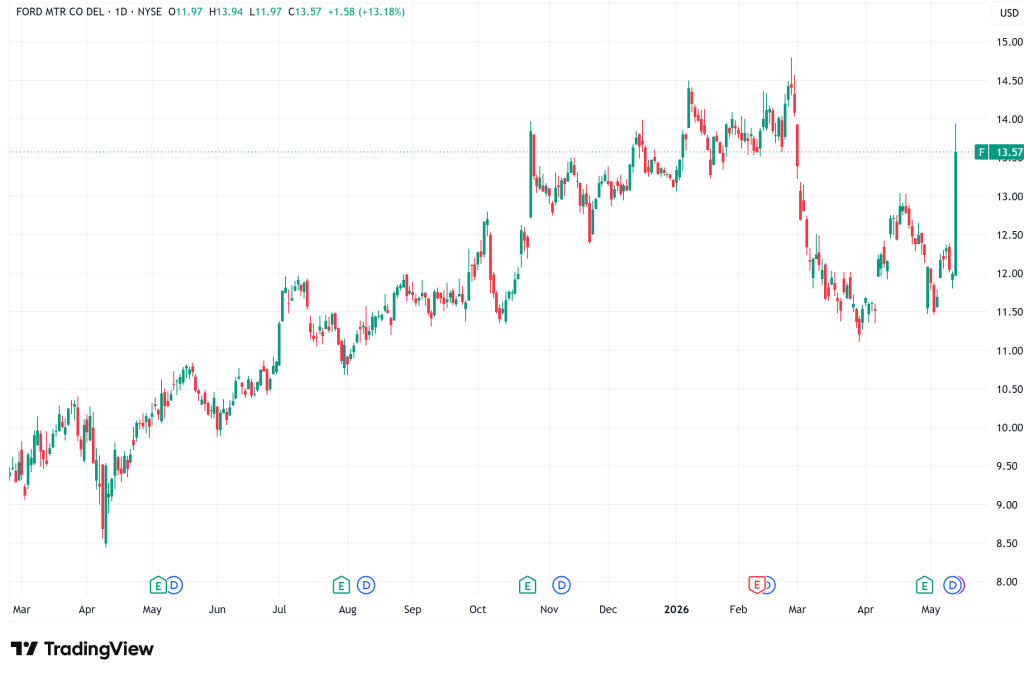
Ford spent most of 2025 trading in the $10–12 range, weighed down by EV anxiety and macro uncertainty. The YTD performance was essentially flat heading into this week. The May 13 surge on massive volume is a technically significant event — it represents a breakout from a prolonged base and a MACD bullish crossover on elevated institutional participation.
Key support is now established at $11.50–$12.00, the prior consolidation zone. The first meaningful resistance is $14.00 — Morgan Stanley’s unchanged price target, which was set before the Energy business became a market story.
If Ford Energy begins signing contracts, that target becomes a floor, not a ceiling. The next resistance band sits at $15.50, which represents the 2024 highs before the EV writedown sell-off.
The RSI is approaching overbought territory on the daily chart after a 13% single-session move. A brief consolidation or pullback to $12.50–$13.00 before the next leg would be technically healthy and not a trend reversal. The 5% dividend yield is a meaningful structural support for institutional income-oriented holders.
Bottom Line for Ford Motor (F) Investors
Ford is a stock in the middle of a narrative transition. The core automotive business, Ford Pro and Ford Blue, is more profitable than the market gave it credit for, and Q1 proves it. The EV pivot was painful but financially it may have been the right call.
And Ford Energy, while pre-revenue, is a legitimately interesting optionality play with a regulatory moat (FEOC/ITC), a best-in-class technology partner (CATL), and a structural demand tailwind with its AI data center buildout.
The risk is execution timing. Ford Energy doesn’t deliver until late 2027. The $1.3 billion tariff refund won’t repeat. And the EV drag continues. For long-term investors, the 5% yield cushions the wait while the Energy thesis builds.
For more aggressive investors, the critical trigger to watch is a hyperscaler contract announcement — that single event has the potential to reprice this stock by $2–4 per share on its own.
Morgan Stanley currently holds a neutral (Equal Weight) rating at a $14 price target. Given the developments of this week, an upgrade and target raise in the coming weeks would not be surprising.
- Check out our free forex signals
- Follow the top economic events on FX Leaders economic calendar
- Trade better, discover more Forex Trading Strategies
- Open a FREE Trading Account
- Read our latest reviews on: Avatrade, Exness, HFM and XM

Related Articles

Sidebar rates

Related Posts
 Save
Save