Cerebras (CBRS) Soars 68% in Blockbuster IPO as AI Chip Rivalry With Nvidia Heats Up
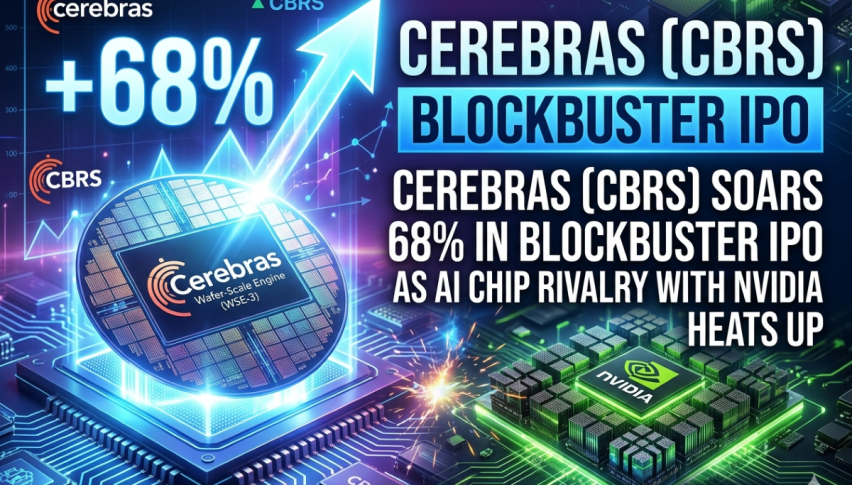
Cerebras Systems (CBRS) stock surged 68% after its IPO as investors bet on its AI chips challenging Nvidia’s dominance.
Quick overview
- Cerebras Systems experienced a dramatic IPO debut in 2026, with shares surging 68% to close at $311.07, driven by strong investor demand and a unique wafer-scale chip architecture.
- The company's technology aims to reduce communication latency in AI workloads, positioning it as a potential alternative to NVIDIA's GPU clusters.
- Cerebras faces significant challenges, including extreme valuation pressures and competition from NVIDIA's established software ecosystem.
- The long-term success of Cerebras will depend on its ability to capture market share in AI inference and develop a robust software ecosystem.
Cerebras Systems made one of the most dramatic public market debuts of 2026 after its Nasdaq IPO triggered a massive surge in investor demand. Shares of CBRS closed at $311.07 on May 14, up 68.15% from the IPO price, after briefly touching an intraday high of $385. The move instantly positioned Cerebras among the most closely watched AI infrastructure companies in the market.
The rally reflects more than IPO momentum. Investors are aggressively searching for alternatives to NVIDIA in the accelerating AI compute race, and Cerebras is entering public markets with a differentiated architecture, strong industry partnerships, and a bold claim: AI workloads need larger chips rather than clusters of smaller GPUs.
Why Cerebras Stock Surged 68% After the IPO
Investor demand for the IPO reportedly exceeded supply by more than 20 times. Cerebras initially targeted a lower range before increasing both the offering size and pricing due to strong institutional interest.
The company opened at $350 versus its $185 IPO price and quickly became the largest IPO of 2026 so far. Its valuation surged toward $70 billion on outstanding shares and roughly $86 billion on a fully diluted basis.
Several catalysts drove the explosive debut:
- Strong market appetite for AI infrastructure plays
- Scarcity of pure-play AI semiconductor IPOs
- Growing demand for alternatives to Nvidia GPUs
- High-profile partnerships with Amazon and OpenAI
- Unique wafer-scale chip technology
- Momentum-driven institutional buying
Cerebras CEO Andrew Feldman emphasized the company’s technological differentiation by highlighting that Cerebras built a chip “58 times larger than any chip previously built,” claiming its systems can process AI workloads more than 15 times faster than competitors in certain applications.
What Makes Cerebras Different From Nvidia?
Unlike traditional GPU clusters, Cerebras uses a wafer-scale architecture. Instead of cutting silicon wafers into smaller chips, Cerebras builds an enormous single processor called the Wafer-Scale Engine (WSE).
This approach attempts to solve one of AI’s biggest bottlenecks: communication latency between thousands of smaller chips.
Traditional AI clusters rely heavily on networking infrastructure to synchronize GPUs. Cerebras instead tries to keep more computation inside one giant processor, potentially reducing latency and increasing inference speed.
The company’s technology is particularly attractive for:
- Large language model inference
- Scientific computing
- Defense AI applications
- High-performance enterprise AI
- Real-time AI processing
However, Nvidia still maintains enormous advantages:
- Mature CUDA software ecosystem
- Broad enterprise adoption
- Massive production scale
- Higher developer familiarity
- Deep cloud integrations
For Cerebras, the challenge is not simply building faster chips — it is creating an ecosystem capable of competing with Nvidia’s entrenched software dominance.
Cerebras Fundamental Analysis: High Growth Potential, High Risk
Cerebras represents a classic high-growth AI infrastructure story rather than a mature semiconductor business.
Key Bullish Factors
1. AI Infrastructure Spending Boom: Global AI spending continues accelerating as hyperscalers, enterprises, and governments race to build AI capabilities. Companies enabling AI compute remain among the market’s strongest growth themes.
2. Technology Differentiation: Cerebras is not another GPU clone. Its wafer-scale approach gives it a unique technological narrative that investors may reward if performance advantages continue proving meaningful.
3. Strategic Partnerships: Collaborations with OpenAI and Amazon significantly increase credibility. OpenAI already launched an AI model running on Cerebras hardware earlier this year, validating real-world deployment potential.
4. Scarcity Premium: There are relatively few publicly traded pure-play AI chip challengers. This scarcity can support elevated valuations during strong AI market cycles.
Key Risks
1. Extreme Valuation: A valuation approaching $70–86 billion immediately places enormous pressure on execution. Investors are already pricing in substantial future growth.
2. Nvidia Competition: Competing against Nvidia requires more than faster hardware. Nvidia’s software ecosystem and developer network remain major competitive moats.
3. Profitability Uncertainty: Like many growth-stage AI infrastructure firms, Cerebras may prioritize expansion over profitability for years. Investors should expect volatility tied to earnings expectations.
4. IPO Volatility: Fresh IPOs often experience sharp swings as lockup expirations, institutional positioning, and price discovery evolve over the first several quarters.
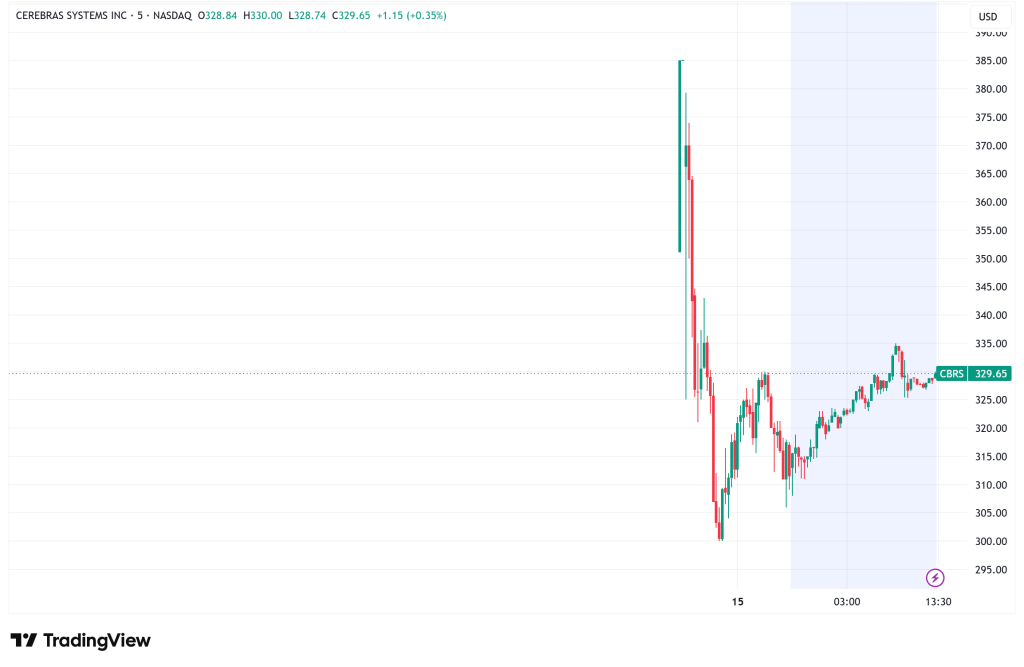
CBRS Technical Analysis: Momentum Dominates Early Trading
Since CBRS just began trading publicly, technical analysis remains limited but still useful for understanding market psychology.
Key Support and Resistance Levels to Watch
- Immediate Resistance: $350–$385
- Psychological Resistance: $400
- Near-Term Support: $300–$311
- Secondary Support: $250
- IPO Price Support: $185
- Check out our free forex signals
- Follow the top economic events on FX Leaders economic calendar
- Trade better, discover more Forex Trading Strategies
- Open a FREE Trading Account
- Read our latest reviews on: Avatrade, Exness, HFM and XM

Related Articles
Sidebar rates

Related Posts
 Save
Save