UnitedHealth (UNH): Up 20% in 2026, But Buffett’s Heir Just Walked Out the Door
Berkshire exits UnitedHealth Group as UNH stock rebounds 20% YTD. Here's what the charts, earnings, and DOJ probe really mean for investors
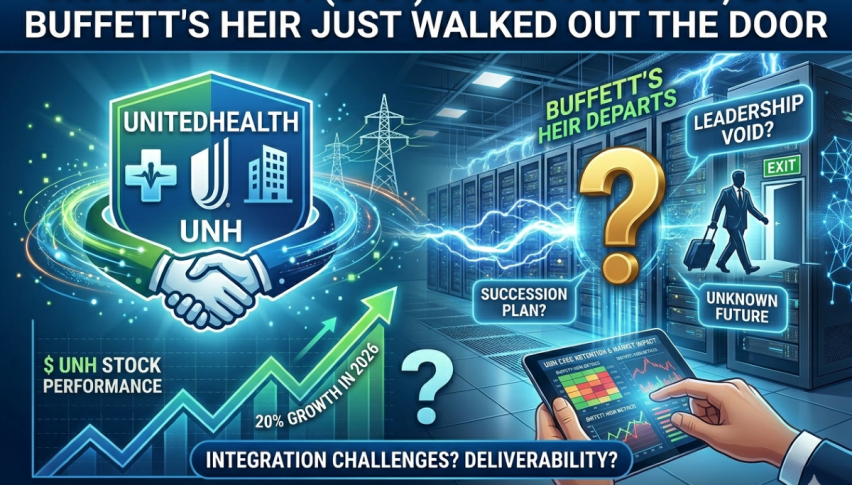
Quick overview
- UnitedHealth Group's stock closed at $391.13 on May 18, 2026, following Berkshire Hathaway's exit from its 5.04 million share position, which caused market concern.
- Despite the exit, analysts suggest it reflects Berkshire's leadership changes rather than a negative outlook on UnitedHealth's fundamentals.
- UnitedHealth is facing significant challenges, including rising costs, regulatory scrutiny, and a strategic retreat in its Medicare Advantage segment to protect margins.
- The company's investment in AI and its Optum platform could potentially transform its business model and improve long-term earnings prospects.
UnitedHealth Group (NYSE: UNH) closed at $391.13 on May 18, 2026, down 0.69% on the day.
The trigger? Berkshire Hathaway disclosed it had fully exited its ~5.04 million share position during Q1 2026. The exit rattled markets. But the real story is far more nuanced.
This is a company navigating a historic reset — rising costs, regulatory heat, a leadership shake-up — while quietly rebuilding from the inside out.
Why Did Berkshire Exit Stake in UnitedHealth?
Berkshire first bought 5 million UNH shares in August 2025, when the stock was in freefall after shedding over 50% in a matter of months. The bet was bold. Now it’s gone.
Under new CEO Greg Abel — who replaced Warren Buffett at the start of 2026 — Berkshire overhauled its equity portfolio in Q1. UNH was one of several exits, alongside Amazon, Visa, Mastercard, and Domino’s Pizza. Berkshire simultaneously put $2.65 billion into Delta Air Lines and tripled its Alphabet position.
Most analysts say this was a leadership transition play, not a UNH verdict.
Todd Combs, widely credited as the architect of the original UNH bet, had left Berkshire in December to join JPMorgan Chase. That context matters enormously. As Morningstar’s Julie Utterback put it, the exit likely reflects roster changes at Berkshire, not a fundamental view on UnitedHealth’s prospects.
“The news that Berkshire has exited its stake in UNH may take some air out of the stock near-term but does not diminish the operational turnaround that’s underway.” — James Harlow, Novare Capital Management
UnitedHealth’s Fundamentals: A Giant Under Pressure
UnitedHealth is the largest private healthcare company on the planet. The numbers are staggering.
Key Financial Metrics
- Revenue (FY2025): $447.6 billion (+12% YoY)
- Net Income: $12.06 billion
- Market Cap: ~$357.7 billion
- P/E Ratio (TTM): 29.75x
- EPS (TTM): $13.27
- Dividend Yield: 2.24% ($2.21/quarter)
- Beta: 0.58 — low volatility relative to the broader market
- Employees: ~390,000
UNH operates through four segments — UnitedHealthcare, OptumHealth, OptumInsight, and OptumRx — serving nearly 150 million people. But beneath the scale, real pressure points exist.
UnitedHealth’s Cost Problem
The medical care ratio hit 88.9% in FY2025 — a 340 basis point jump from 85.5% in 2024. That surge crushed margins badly last year. Q1 2026 showed meaningful improvement: EPS came in at $7.23 against estimates of $6.58 — a 9.95% upside surprise — and management raised full-year guidance.
The Medicare Advantage Reset
This is the most structurally important issue for UNH’s long-term model.
- UNH is voluntarily cutting 1.3–1.4 million Medicare Advantage members in 2026 to protect margins on unprofitable plans.
- CMS proposed a net rate increase of just 0.09% for MA plans in FY2027 — effectively a cut when adjusted for medical inflation of 7–10%.
- The company guided for 2026 revenue above $439 billion — a ~2% YoY decline and its first revenue contraction in over a decade.
This is a painful but strategic retreat. UNH is choosing margin over volume.
The DOJ Overhang
UnitedHealth confirmed it faces both criminal and civil DOJ investigations into its Medicare Advantage billing practices. The probes focus on whether the company inflated patient diagnoses to trigger higher reimbursements, including allegations tied to in-home nurse assessments. The company is cooperating and has launched a third-party review. Analysts broadly view the risk as serious but not existential. Resolution timelines remain unclear — this is a live wire for the stock.
The Optum Wildcard
This is UNH’s differentiated, underappreciated asset. The company is rolling out 1,000+ internal AI use cases, has budgeted $1.5 billion in AI spending for 2026, and is already reporting AI-driven reductions in call volume and faster claims processing. If Optum continues to scale, it shifts UNH’s story from health insurer to integrated healthcare platform — a fundamentally different, higher-multiple business.
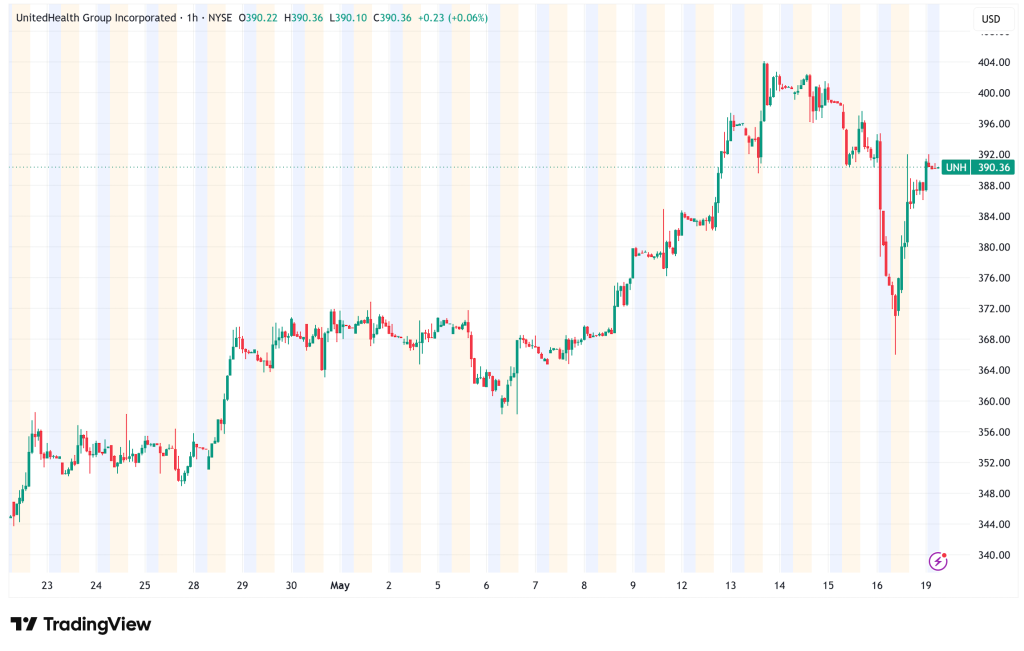
UNH Technical Analysis: What UnitedHealth’s Charts Reveal
UNH has staged a sharp recovery from multi-year lows. But it’s now entering contested territory.
Trend Structure
The stock has broken above the ceiling of a long-term falling trend channel — typically signaling a slower rate of decline or the start of a base-building phase. Short and long-term moving averages have turned bullish, with the 50-day MA crossing above the 200-day MA earlier in 2026 — a “golden cross” and historically positive signal.
Key Levels to Watch
- Resistance: $396–$405. The 52-week high sits at $404.15. A sustained break above $405 would open the door toward $443.
- Near-term support: $389–$360. A hold at $389 is critical. Failure there risks a retest of $353–$360.
- Medium-term support: $325–$337. The broader pullback target if selling accelerates.
Momentum Indicators
RSI is tracking near neutral — neither overbought nor oversold after the prior spike above 70 near the $400 level. A sell signal was triggered from a pivot top on May 13, and MACD is flattening. Bulls need the MACD line to hold above its signal line to preserve upward momentum. Volume balance remains positive overall, suggesting buyers are still more aggressive than sellers — but volume rose on falling prices last week, a mild caution flag
Three Scenarios for UNH Stock in the Near-Term
- Bull case — UNH holds $389 support, consolidates, and breaks above $405 on positive regulatory or macro news. Target zone: $420–$443.
- Base case — The stock oscillates between $360–$400 over the next few months as the market digests the Berkshire exit, DOJ uncertainty, and the Medicare reset.
- Bear case — A break below $360 on negative DOJ developments or macro pressure (rising yields, risk-off sentiment) pulls the stock back toward $325–$337.
UnitedHealth’s Long-Term Potential: Patience Warranted for Bull Case
Despite near-term noise, the structural bull case remains intact.
- Scale advantage: $447B+ in revenue and 150M people served. No competitor comes close.
- Ecosystem moat: UnitedHealthcare + Optum creates a closed-loop platform with powerful data advantages and high switching costs.
- AI leverage: $1.5B in AI investment in 2026 could structurally lower the MCR over time — the single most important margin lever.
- Earnings recovery path: Analysts forecast EPS to recover from ~$18 in 2025 to ~$34.61 by 2029. If achieved, today’s stock looks significantly undervalued in retrospect.
- Prior authorization reform: UNH plans to eliminate approval requirements for 30% of services by end of 2026 — a meaningful reputational and regulatory reset.
The 10-year total return on UNH exceeds 200%, even after the brutal 2025 crash.
What’s Next for UnitedHealth Investors?
UnitedHealth is a battleground stock in 2026. Q1 earnings beat hard. The Optum platform is building quietly. The turnaround has real evidence behind it.
But the risks are unresolved and material:
- A live DOJ criminal investigation with no timeline
- Medicare Advantage under structural rate pressure
- Berkshire’s exit removing a key psychological anchor
- Rising Treasury yields and crude prices adding macro friction
The stock sits just below a major resistance zone with mixed signals. For short-term traders, the $389 support level and MACD direction are the key tells.
For long-term investors, the question isn’t whether UNH has problems. It clearly does. The question is whether those problems are already priced in at $391 — and whether Optum and AI can rebuild the earnings engine over the next 2–3 years.
History says UNH has earned the benefit of the doubt. This time, that doubt comes with a federal subpoena attached.
- Check out our free forex signals
- Follow the top economic events on FX Leaders economic calendar
- Trade better, discover more Forex Trading Strategies
- Open a FREE Trading Account
- Read our latest reviews on: Avatrade, Exness, HFM and XM

Related Articles
Sidebar rates

Related Posts
 Save
SaveAva