$67 Billion NextEra-Dominion Energy Merger to Take on the AI Power Age, But Can It Deliver?
Dominion Energy surges 9.4% as NextEra's $67B all-stock deal creates the world's largest regulated utility. Here's all you need to know.

Quick overview
- NextEra Energy and Dominion Energy announced a historic $66.8 billion all-stock merger, creating one of the largest energy companies in the U.S.
- The merger aims to capitalize on the growing demand for electricity from data centers, particularly in Dominion's service area known as 'Data Center Alley.'
- The combined company will lead in renewables and battery storage, with a projected adjusted EPS growth of over 9% through 2035.
- Regulatory scrutiny poses risks to the merger, with potential impacts on pricing and competition in the energy market.
On May 18, 2026, two of America’s biggest power companies made history. NextEra Energy and Dominion Energy announced a plan to merge in a $66.8 billion all-stock deal. It is one of the largest energy mergers ever executed.
The combined enterprise value tops $420 billion — exceeding the next two largest U.S. power companies combined. This isn’t just a deal. It’s a structural reshaping of American energy.
AI Electricity Gold Rush: Why NextEra and Dominion Energy Merged
The merger has one core thesis: artificial intelligence is hungry for power. The build-out of server warehouses across the country has opened up lucrative new revenue streams for power companies.
Dominion sits at the epicenter of that boom. Its service territory includes Northern Virginia’s “Data Center Alley” — the world’s largest concentration of data centers and one of the fastest-growing electricity markets.
Dominion already has nearly 51 gigawatts of contracted data-center capacity, with clients that read like a Big Tech hall of fame:
Together, NextEra and Dominion have about 130 gigawatts of electricity demand from data centers proposing to connect to their grids — enough to power roughly 97 million homes.
What the Deal Delivers
The combined company isn’t just bigger — it’s strategically repositioned.
Operations will be more than 80% regulated, with a combined rate base of $138 billion expected to grow at approximately 11% through 2032. That’s rare visibility for investors.
The merged entity will be No. 1 globally in renewables and battery storage, No. 1 in the U.S. in natural gas generation, and No. 2 in nuclear power.
Adjusted EPS growth is targeted at 9%+ through 2032 — and 9%+ through 2035 — off NextEra’s 2025 base. That’s well above Dominion’s standalone 5%–7% guidance.
For Dominion shareholders: a fixed exchange ratio of 0.8138 NextEra shares per Dominion share, plus a one-time $360 million cash payment at closing. The transaction is structured as tax-free.
Customer and Community Commitments
The companies aren’t ignoring rate pressure optics. Dominion’s customers in Virginia, North Carolina, and South Carolina will receive $2.25 billion in bill credits spread over two years post-close.
Enhanced charitable giving — $10 million more annually for five years — and employment protections for Dominion’s approximately 15,000 employees are also on the table. These commitments are designed to ease regulatory scrutiny.
Dominion Energy Boast Solid Fundamentals, Though Not Spectacular
Dominion’s financials heading into this deal tell a story of steady, regulated utility strength.
Q1 2026 operating earnings came in at $0.95 per share, topping the consensus estimate of $0.90. Revenue hit $5.02 billion in the quarter — a 23.1% jump year-over-year, versus analyst estimates of $4.43 billion.
Full-year 2025 operating EPS reached $3.42, up sharply from $2.77 in 2024. The growth trajectory is real.
Key Metrics at a Glance
- Operating margin: 29.44% | Net margin: 16.67%
- 3-year revenue growth: 6.8%
- Debt-to-equity ratio: 1.75 — high, reflecting the capital-intensive utility model
- FY2026 EPS guidance: $3.45–$3.69 per share (midpoint $3.57)
- Long-term EPS growth target: 5%–7% annually through 2030
The debt load is a watchpoint. As of March 31, Dominion carried $44.11 billion in total long-term debt. That’s not unusual for a regulated utility, but it limits financial flexibility.
The Altman Z-Score of 0.73 places Dominion in the distress zone — a technical flag worth monitoring, though common among heavily leveraged utilities.
D Stock Technical Analysis: Breakout or Bull Trap?
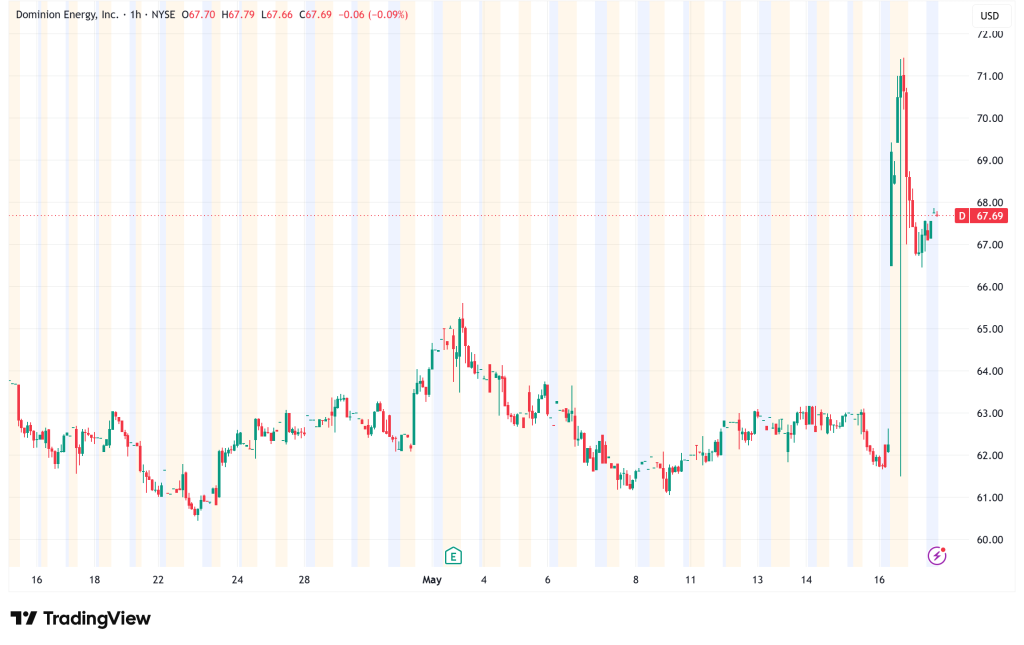
Before the merger news, Dominion’s chart was sending mixed signals. The 14-day RSI stood near 45, indicating neutral momentum — neither overbought nor oversold. The 50-day moving average of ~$63 and 200-day moving average of ~$62.30 both signaled a buy, with price trading above both key levels.
The MACD reading was positive at 0.260, suggesting mild bullish momentum — though the signal wasn’t strong.
Monday’s 9.4% surge dramatically changes the technical picture. At $67.56, the stock:
- Broke above its 52-week resistance zone in a single session
- Touched its highest level since November 2022, per Reuters data
- Printed heavy volume, a classic confirmation of a breakout move
The 1-week and 1-month technical ratings shifted to “buy” following the announcement-driven momentum. However, the speed of the move warrants caution.
Dominion Energy (D) Stock’s Likely Scenarios
- Bull case: The merger premium holds. The stock consolidates between $65–$68 as deal timelines firm up. Institutional investors build positions anticipating long-term value creation.
- Bear case: Regulatory risk spooks the market. If FERC or state regulators demand significant concessions, the deal premium could compress. A pullback to the $62–$64 zone — near the 50-day moving average — is a realistic reversion target.
NextEra’s Merger with Dominion Energy Faces Some Risks
The transaction is expected to close in 12 to 18 months, pending antitrust review, shareholder approval, and sign-offs from FERC, the Nuclear Regulatory Commission, and state utility regulators in Virginia, North Carolina, and South Carolina.
That’s a long runway — and a lot of hurdles.
Constellation Energy’s deal with Calpine faced heightened regulatory scrutiny, ultimately requiring divestitures of natural-gas plants in Pennsylvania and Texas. NextEra-Dominion could face similar demands.
U.S. power prices have risen roughly 40% over the past five years, making regulators sensitive to any deal that could limit competition or raise rates further.
Analyst Verdict: Should You Hold Dominion Energy (D) Stock?
As of May 18, 2026, 13 analysts rate Dominion as a “Hold.” Fifteen percent recommend Buy, 77% suggest Hold, and 8% advise Sell.
Wells Fargo holds an “Overweight” rating. Mizuho rates it “Neutral” with a $66 target. The consensus price target sits at $65.69 — now slightly below Monday’s close of $67.56, suggesting the deal premium is already priced in.
Looking further out, analysts forecast Dominion’s earnings growing at roughly 9% per year and revenue at 6.2% per year. Both are respectable for a utility — but trail the broader U.S. market.
What Should Dominion Energy Traders Watch Next?
Dominion Energy is no longer just a regulated utility play. It is now a merger arbitrage story, an AI infrastructure bet, and a long-term energy platform investment — all wrapped in one.
The deal’s strategic logic is hard to argue with. Two companies with 238 years of combined experience, serving 10 million customers across four of America’s fastest-growing states, will have the scale to win in the data center era.
But 12–18 months of regulatory uncertainty is real. Investors entering here are buying both the opportunity and the risk. The $65–$68 zone is the near-term battleground to watch.
- Check out our free forex signals
- Follow the top economic events on FX Leaders economic calendar
- Trade better, discover more Forex Trading Strategies
- Open a FREE Trading Account
- Read our latest reviews on: Avatrade, Exness, HFM and XM

Related Articles


Sidebar rates

Related Posts
 Save
Save