Partial Fuel Relief: South Africa Diesel Price to Drop in June but Petrol Set to Rise on Tax Hike
June’s fuel outlook shows only partial relief for motorists, as tax increases and lingering global risks offset improvements in underlying oil price recoveries.
Quick overview
- June's fuel outlook indicates mixed price trends, with petrol prices expected to rise modestly while diesel prices are set to decline significantly.
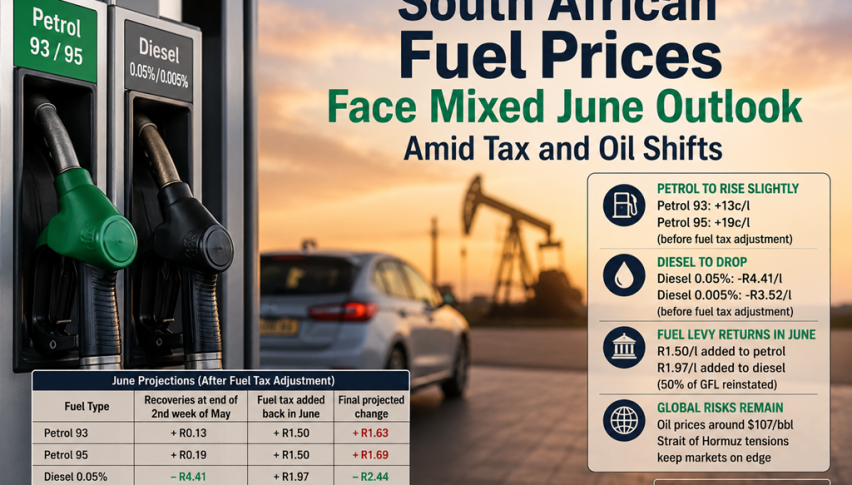
- Petrol 93 is projected to increase by about 13 cents per litre, while diesel 0.05% may decrease by up to R4.41 per litre.
- Global oil market volatility remains a concern due to geopolitical tensions, impacting crude prices and raising supply risks.
- The reinstatement of the General Fuel Levy will offset some of the benefits from improved oil recoveries, leading to higher final prices for consumers.
June’s fuel outlook shows only partial relief for motorists, as tax increases and lingering global risks offset improvements in underlying oil price recoveries.
Mixed Fuel Price Signals Heading Into June
Fuel price expectations for June point to a divided outcome, with petrol set to rise modestly while diesel is expected to decline. According to the latest data from the Central Energy Fund (CEF), fuel recoveries have stabilised after two months of sharp volatility.
Petrol now shows a relatively small under-recovery of between 13c and 19c per litre, a significant improvement from earlier estimates of up to 88c per litre just one week prior. Diesel, by contrast, is positioned for a notable price drop, reflecting improved global input cost conditions.
Diesel Gains as Petrol Edges Higher
Current projections suggest petrol 93 will increase by around 13 cents per litre, while petrol 95 is expected to rise by approximately 19 cents. Diesel users are set to benefit more meaningfully, with wholesale diesel 0.05% forecast to decrease by up to R4.41 per litre and diesel 0.005% by around R3.52 per litre.
This divergence highlights the uneven impact of global fuel dynamics, where refining margins and product-specific demand continue to drive separation between petrol and diesel pricing trends.
Global Oil Volatility Keeps Risks Elevated
Despite improved short-term stability, the global oil market remains exposed to geopolitical shocks. Ongoing tensions in the Strait of Hormuz, limited progress in US–Iran negotiations, and intermittent regional security incidents have kept crude prices volatile.
Oil recently moved from around $100 per barrel to $107 following renewed conflict-related disruptions, while earlier spikes saw prices briefly double from $60 to $120 during peak escalation periods. Analysts also warn that global inventories are being depleted at an unusually rapid pace, raising the risk of sustained supply tightness through the coming months.
Rand Stability Offers Partial Offset
One supportive factor has been the relative resilience of the rand, which has remained below R17/USD and is currently trading near R16.71. This stability has helped cushion imported fuel costs, preventing sharper upward pressure on local pump prices despite global volatility.
Fuel Levy Reversal Dampens Net Relief
However, much of the potential benefit from improved oil recoveries is being offset domestically by fiscal policy changes. The National Treasury is reinstating 50% of the General Fuel Levy (GFL) in June after temporary cuts introduced earlier in the year.
This translates into an added R1.50 per litre for petrol and R1.97 for diesel, significantly altering the final outcome. Once adjusted, petrol is effectively set to rise by around R1.63 to R1.69 per litre, while diesel’s expected decline is reduced to between R1.55 and R2.44 per litre, limiting overall consumer relief.
- Check out our free forex signals
- Follow the top economic events on FX Leaders economic calendar
- Trade better, discover more Forex Trading Strategies
- Open a FREE Trading Account
- Read our latest reviews on: Avatrade, Exness, HFM and XM

Related Articles


Sidebar rates

Related Posts
 Save
Save
