ORCL Stock Heads to $135 as Job Cuts and Soaring Debt Weigh on Oracle
Oracle's sharp decline in June reflects growing investor concerns that soaring AI infrastructure spending, mounting debt, and large-scale workforce reductions may be creating more risks than rewards despite another earnings beat.

Quick overview
- Oracle's shares fell 6% despite reporting better-than-expected earnings, reflecting investor concerns over rising AI infrastructure costs and workforce reductions.
- The company announced plans to eliminate approximately 21,000 jobs as part of a restructuring effort, raising questions about its operational health.
- Oracle's capital expenditures have surged to nearly $56 billion annually, alarming investors who fear excessive spending without proven demand.
- Despite a strong backlog and significant contracts, investor sentiment remains focused on risks rather than growth opportunities.
Oracle’s sharp decline in June reflects growing investor concerns that soaring AI infrastructure spending, mounting debt, and large-scale workforce reductions may be creating more risks than rewards despite another earnings beat.
Oracle’s Earnings Beat Fails to Restore Confidence
Shares of Oracle fell 6% on Tuesday, sliding toward $165 and extending a significant reversal that has developed throughout June. The decline came despite the company reporting quarterly results that exceeded Wall Street expectations, highlighting a growing disconnect between headline earnings and investor sentiment.
Oracle reported earnings of $2.11 per share on revenue of $19.18 billion, surpassing analyst forecasts of $1.97 per share and $19.09 billion in revenue. The company also delivered strong year-over-year growth compared with earnings of $1.70 per share on revenue of $15.9 billion during the same period last year.
Ordinarily, such results would have been viewed positively. Instead, investors focused on emerging weaknesses beneath the surface and the increasingly aggressive spending required to maintain Oracle’s position in the artificial intelligence infrastructure race.
Massive AI Investments Fuel Overspending Fears
Investor anxiety has increasingly shifted toward Oracle’s unprecedented level of AI infrastructure spending.
Capital expenditures reached approximately $16.5 billion during the quarter, pushing annual spending to nearly $56 billion and exceeding previous guidance. Management now expects net capital expenditures to rise to roughly $70 billion during fiscal 2027, while total spending could approach $90 billion to $95 billion once additional component prepayments are included.
These figures have alarmed some investors who fear the company is committing enormous amounts of capital before demand and profitability have been fully proven.
The broader technology sector is already facing growing scrutiny over whether the current AI investment cycle can generate adequate returns. Oracle’s spending plans have become a focal point in that debate.
Job Cuts Highlight Deep Restructuring Effort
Further unsettling investors was Oracle’s announcement that it will eliminate approximately 21,000 jobs, representing nearly 13% of its global workforce.
The reduction is part of a broad restructuring initiative designed to control costs and redirect resources toward higher-priority areas such as artificial intelligence infrastructure and cloud computing.
However, the scale of the cuts has raised concerns about the underlying health of the business. The restructuring is expected to generate approximately $1.8 billion in charges and reflects a significant operational adjustment as Oracle attempts to balance aggressive growth ambitions with cost discipline.
Investors are increasingly questioning whether such drastic measures signal deeper challenges associated with the company’s transition strategy.
Oracle Selloff Accelerates Despite Strong Headline Results
Oracle shares extended their sharp decline following the company’s fiscal fourth-quarter earnings release, with the stock falling to $165 after investors looked beyond better-than-expected earnings and focused on mounting AI infrastructure costs and slowing cloud momentum. Although Oracle delivered solid revenue and profit growth, concerns that capital spending is rising faster than sustainable returns triggered heavy selling and renewed debate over whether the AI investment boom is becoming too excessive.
ORCL Chart Weekly – Testing the Support

Rising Debt Creates Additional Pressure
Financing such expansion has required a substantial increase in borrowing.
Over the past fiscal year, Oracle raised approximately $43 billion through debt financing and another $5 billion through equity issuance. Management has indicated that an additional $40 billion could be raised during fiscal 2027 through a combination of debt and equity offerings.
While management argues that these investments are necessary to secure future growth opportunities, investors are becoming increasingly concerned about the long-term implications of a rapidly expanding balance sheet.
The prospect of rising debt obligations at a time of elevated interest rates has added another layer of uncertainty to Oracle’s outlook.
Cloud Revenue Miss Sparks New Concerns
The primary source of disappointment came from Oracle’s cloud business.
Although cloud revenue continued to grow, total cloud sales reached $9.91 billion, slightly below analyst expectations of $9.99 billion. While the shortfall was relatively small, the reaction reflected a market that has become increasingly unforgiving toward highly valued technology companies.
Cloud Infrastructure revenue rose an impressive 93% year-over-year to $5.8 billion and exceeded forecasts. However, investors appeared more concerned that overall cloud growth failed to provide the decisive upside surprise many had expected given the enormous capital being deployed across Oracle’s AI initiatives.
The result reinforced concerns that spending is accelerating faster than revenue generation.
Strong Backlog Provides Limited Relief
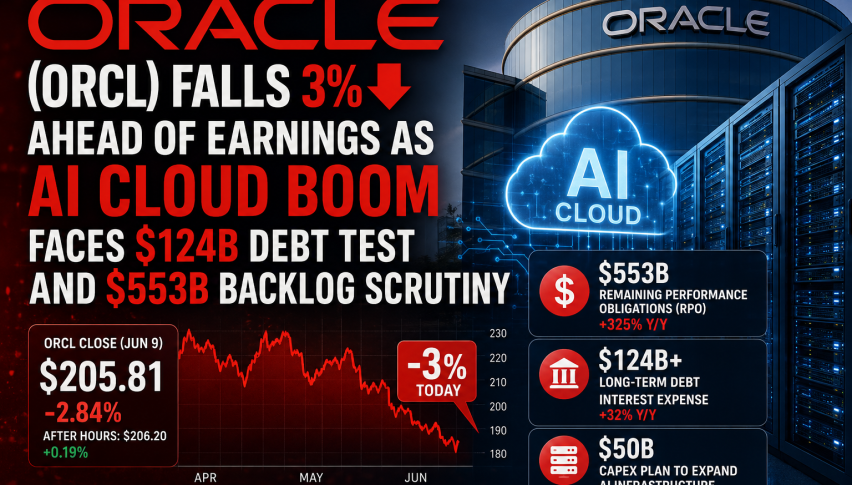
Oracle attempted to reassure markets by highlighting strong future demand. Remaining performance obligations climbed to $638 billion, well above expectations and reflecting substantial long-term commitments from enterprise and AI customers.
Management also pointed to continued progress at its flagship AI data center project in Texas and emphasized that many customer agreements include prepayments that reduce future financing requirements.
Despite these positive indicators, investors remained focused on execution risks, financing needs, and the sheer scale of spending commitments still ahead.
Markets Focus on Risks Rather Than Growth
Oracle also announced a significant government cloud contract that will support modernization efforts across federal agencies. Under normal circumstances, such a deal would likely have strengthened confidence in the company’s long-term prospects.
Instead, markets largely ignored the announcement.
The combination of a cloud revenue miss, surging capital expenditures, expanding debt levels, workforce reductions, and mounting concerns about AI investment returns has shifted investor attention away from growth opportunities and toward risk management.
As skepticism surrounding the sustainability of the AI infrastructure boom continues to grow, Oracle’s latest results have reinforced fears that spending may be outpacing future returns. For now, investors appear far more concerned about the costs of Oracle’s AI ambitions than the potential rewards.
- Check out our free forex signals
- Follow the top economic events on FX Leaders economic calendar
- Trade better, discover more Forex Trading Strategies
- Open a FREE Trading Account
- Read our latest reviews on: Avatrade, Exness, HFM and XM

Related Articles
Sidebar rates

Related Posts
 Save
Save