Gold Price Forecast: $3,960 Floor Defended as Swiss Accord Erases War-Risk Premium
Market for global precious metals is going through a major technical consolidation period in a delicate balancing act, fighting...

Quick overview
- The global precious metals market is experiencing a technical consolidation amid geopolitical tensions and monetary tightening from the U.S.
- Spot gold stabilized around $4,050.10 per troy oz, with institutional investors accumulating long-term positions while some short-term traders are closing out.
- The recent U.S.-Iran peace treaty has reduced immediate war premiums, normalizing energy transport and impacting gold prices.
- Central banks, particularly the People's Bank of China, continue to accumulate physical gold, providing a structural floor for prices despite dollar strength.
Market for global precious metals is going through a major technical consolidation period in a delicate balancing act, fighting off a major release of geopolitical war premiums while contending with extreme monetarist tightening coming out of Washington. On Friday, June 26, 2026, spot gold (XAUUSD) printed a compressed in-day value range in afternoon hours and stabilized around $4,050.10 per troy oz. Institutional investment committees and sovereign banking units are selectively filling automated buy block orders in this extremely compressed discount region to accumulate long-term protective hedges, while some more speculative short-term positions are closing out.
Swiss Signing Ceremony Safely Uncools Global Safe-Haven Premium
The main fundamental force behind the near-term gold price decline was the quick implementation of the U.S.-Iran short-term peace treaty, known by the formal name Islamabad Memorandum of Understanding. The official ceremonial signing on June 17 in Switzerland helped normalize the key shipping lanes in the Strait of Hormuz, as the price of front-month Brent crude has fallen under the $73-per-barrel range.
The overall normalization in regional energy transport networks has effectively priced out the immediate and fear-based war premium in the paper commodities market. Still, many global asset allocation analysts note that ongoing tensions across other Middle Eastern regions keep them away from more aggressively shorting gold, supporting its core role as a store of value in a portfolio.
The Warsh Doctrine Hardens Capital Carry Costs for Non-Yielding Assets
While tactical short-term futures traders do tend to follow central bank interest rate moves, the physical gold market continues to attract substantial interest from very long-term non-retail buyers. The People’s Bank of China has continued the aggressive non-public accumulation of physical gold for more than 17 consecutive months.
Additionally, a more general set of emerging-market central banks are diversifying their national portfolios away from G7 debt and into physical bullion in a move to protect against currency devaluation and weaponized financial systems. This persistent, non-price elastic demand from central banks supports a long-term fundamental floor and prevents deeper gold liquidations as dollar strength emerges.
Persistent Sovereign Reserve Diversification Limits Long-Term Downside Exposure
While short-term tactical futures desks react to central bank interest rate adjustments, gold’s physical marketplace infrastructure continues to receive significant insulation from long-term, non-retail buyers. The People’s Bank of China (PBOC) has officially extended its aggressive, non-public physical accumulation streak for well over 17 consecutive months.
Concurrently, broad emerging-market central banking institutions are systematically rotating sovereign capital reserves out of G7 fiat debt instruments and into physical bullion to shield against currency volatility and weaponized financial networks. This persistent, price-insensitive central bank demand ensures a permanent structural floor that prevents deeper liquidations during periods of dollar breakout strength.
Gold Technical Analysis: XAUUSD Tests Dynamic Support Base in Stretched Descending Channel
Looking past the Fed dot plot projections and into a 2-Hour chart for spot gold, the recent gold price move has come into an overbought trend area.
XAUUSD shows dynamic defense off its main black descending trendline from recent swing highs, while defending lower trend boundaries in this matrix. The current price action is touching the bottoms of this channel that have shown multiple touch-points (marked in orange consolidation circles on charts for analysts) as buy zone support, well below the leading macro 2-Hour EMA200 at $4,221.76.
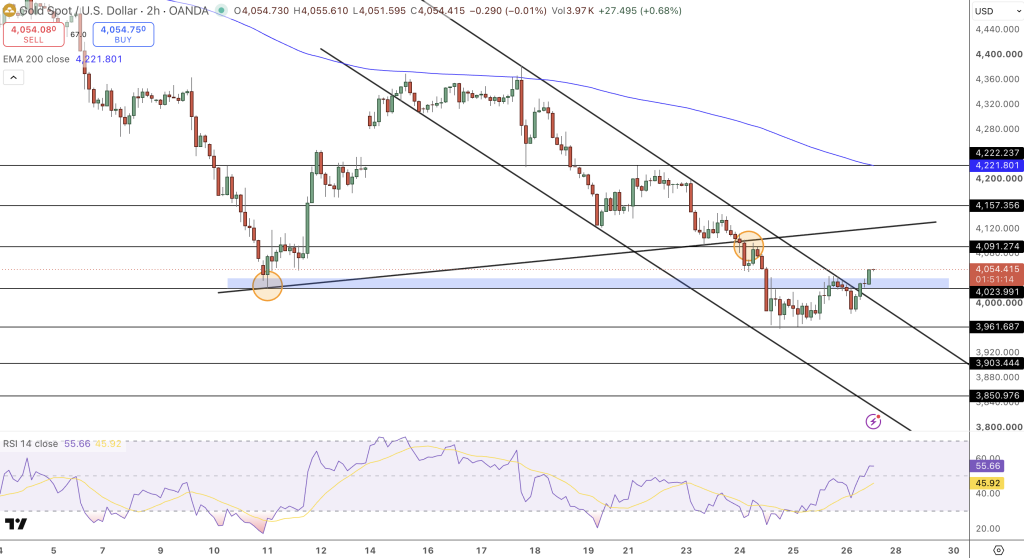
The 14-period RSI indicator has hit clear mathematical exhaustion limits at 54.38 and looks structurally balanced. The degree of oscillator compression implies that near-term selling momentum has finished draining out and the first signs of price stabilization via the moving averages on the MACD indicator suggest a potentially highly coiled setup on the short-term side.
Conclusion and Trade Idea
The gold price was adjusting as an important macro event (new peace accord) had just occurred and it followed the monetary policy pivot of a Federal Reserve transition to a more hawkish leadership. While Kevin Warsh’s hawkish rates should push general financing costs high for the moment, the fact that central banks have kept accumulating a bull market position for 17 consecutive months will support the price.
Trade Idea Gold: Look to buy on 2-Hour candlestick confirmation and a bounce off the bottom of the descending trendline at $4,023.99 with a stop-loss underneath the local horizontal structural invalidation shelf at $3,961.69 targeting $4,091.27 and higher toward 0.382 fib target at $4,157.36.
- Check out our free forex signals
- Follow the top economic events on FX Leaders economic calendar
- Trade better, discover more Forex Trading Strategies
- Open a FREE Trading Account
- Read our latest reviews on: Avatrade, Exness, HFM and XM

Related Articles


Sidebar rates

Related Posts
 Save
SaveAva

