Crypto Signals for Technical Traders

Technical traders rely on price charts, historical data, and market indicators to identify potential trading opportunities. In the cryptocurrency market, this analysis often leads to the creation of crypto trading signals. These signals are structured trade ideas based primarily on technical analysis and are designed to help traders determine potential entry and exit points.
Because cryptocurrency markets operate continuously and can move rapidly, signals help simplify complex analysis into clear trading instructions. Instead of spending hours reviewing multiple charts and indicators, traders can use signals as a quick reference when evaluating possible trades. Both beginners and experienced traders use crypto signals to stay informed about market opportunities and react quickly to price movements.
 | Minimum Deposit: $100 Regulated by: CBI, BVI, FSC, ASIC, FSCA, JFSA, FFAJ Crypto: Yes |
What Are Crypto Signals?
A crypto trading signal suggests when traders should buy or sell a cryptocurrency under specific market conditions. Experienced analysts, professional traders, or automated trading systems typically create these signals after analyzing market data.
Most trading signals provide a structured trade setup that helps traders execute the trade correctly. A typical signal includes several key details, such as the cryptocurrency pair, the suggested trade direction, and the price levels for entering and exiting the position. A standard signal may include the following components:
- Cryptocurrency pair such as BTC/USDT
- Trade direction, which can be buy or sell
- Suggested entry price
- Take-profit targets where profits may be secured
- Stop-loss level used to limit potential losses
- Expected timeframe for the trade
This structured format allows traders to manage risk and plan their trades before they enter the market.

 | Minimum Deposit: $50 Regulated by: AUSTRAC, BAFIN, CIMA, ESCA, CySEC, FSC, FMA, MAS, TFG, VFSC Crypto: Yes |
How Crypto Signals Are Generated
Crypto trading signals are mainly generated through technical analysis. Technical analysis involves studying previous price movements, chart patterns, and trading indicators to estimate possible future price behavior. Signal providers evaluate several types of market data when generating signals.
Technical Indicators
Technical indicators are mathematical calculations derived from price and trading volume. These indicators help traders evaluate momentum, trend direction, and potential reversal points in the market. Some commonly used indicators include moving averages, the relative strength index, the moving average convergence divergence indicator, Bollinger Bands, and Fibonacci retracement levels.
For instance, a signal may appear when a moving average crossover indicates a new trend or when the relative strength index moves out of an oversold zone.
Chart Patterns
Chart patterns also play an important role in signal creation. These patterns appear on price charts and may suggest possible continuation or reversal of market trends.
Examples of commonly used chart patterns include head and shoulders formations, double tops and double bottoms, triangle patterns, and breakout formations around support or resistance levels. Experienced analysts often use these patterns to identify trading opportunities.
Algorithmic and Data-Driven Systems
Many modern signal providers use automated systems to generate trading signals. These systems continuously scan market data across multiple cryptocurrencies and timeframes.
Advanced platforms may also incorporate machine learning techniques that analyze historical data and identify patterns that could indicate future price movements. Automated analysis allows signals to be generated quickly and consistently.
 | Minimum Deposit: $25 Regulated by: FSC, MISA Crypto: Yes |
Types of Crypto Signals
Crypto trading signals generally fall into three main categories depending on how they are created.
Manual Signals
Manual signals are generated by human analysts or experienced traders. These signals are based on personal market analysis, technical indicators, and chart patterns. Manual signals often include explanations that describe the reasoning behind the trade.
Automated Signals
Automated signals are produced by computer algorithms that monitor the market and trigger signals when certain technical conditions are met. These systems can analyze multiple markets simultaneously and deliver signals quickly.
AI-Based Signals
Some advanced trading systems use artificial intelligence models to analyze large amounts of historical and real-time data. These systems attempt to detect patterns and trends that may not be easily visible through traditional analysis.

 | Minimum Deposit: $200 Regulated by: ASIC, BaFin, CMA, CySEC, DFSA, FCA, SCB Crypto: Yes |
Why Technical Traders Use Crypto Signals
Crypto signals are particularly useful for technical traders because they help simplify the trading process while still relying on analytical data.
Faster Decision-Making
Cryptocurrency markets operate around the clock, and price movements can occur at any time. Signals allow traders to react quickly to potential opportunities by presenting ready-to-use trade setups.
Simplified Market Analysis
Signals condense large amounts of market information into a single trade suggestion. This makes it easier for traders to identify possible opportunities without conducting extensive research for every trade.
Risk Management Support
Most signals include stop-loss and take-profit levels, which help traders control potential losses and define profit targets before entering a trade.
Additional Market Insights
Signals often incorporate insights from multiple indicators, trading volumes, and price patterns. This combination of data can highlight opportunities that individual traders might overlook.
 | Minimum Deposit: $4 Regulated by: CySEC, ASIC, FSA, SVG Crypto: Yes |
Limitations of Crypto Signals
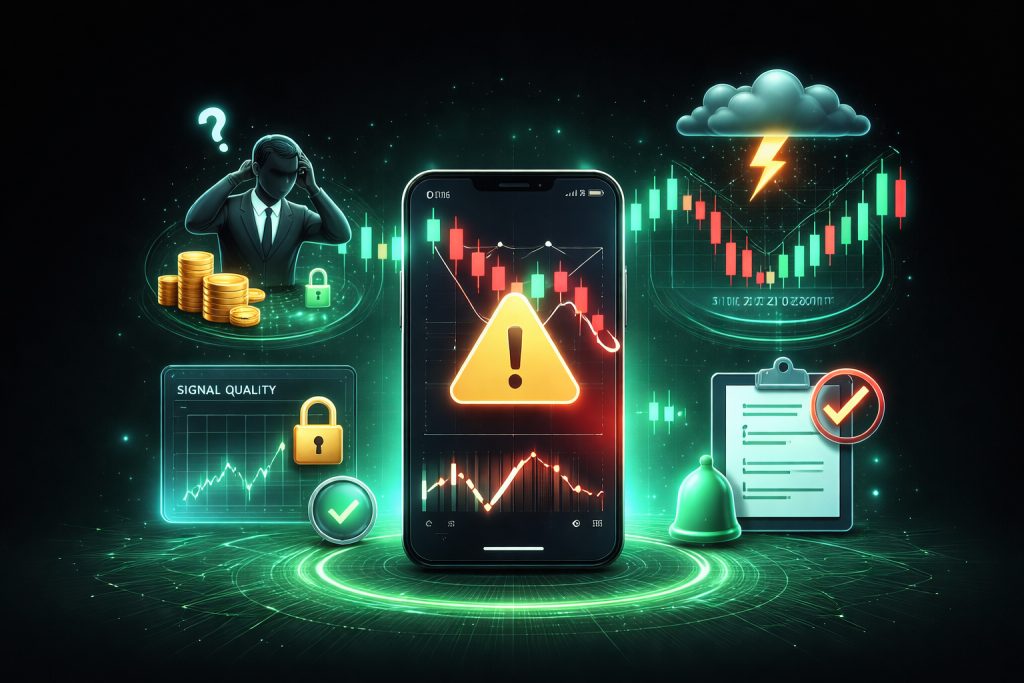
Although crypto signals can be helpful tools, they are not guaranteed to produce profitable trades. Cryptocurrency markets are highly volatile, and price movements can change quickly.
Another limitation is that the quality of signals varies between providers. Some services may not provide transparent performance records, which can make it difficult for traders to evaluate their reliability.
There is also the risk of over-reliance. Traders who follow signals without understanding the underlying analysis may struggle to adapt when market conditions change.
 | Minimum Deposit: $5 Regulated by: FSC Crypto: Yes (not available under CySEC (EU) or DFSA (MENA). |
Best Practices for Using Crypto Signals
To use crypto signals effectively, traders should combine them with their own research and risk management strategies.
Confirm Signals With Independent Analysis
Before executing a trade, traders should verify signals by reviewing technical indicators, chart patterns, and key support and resistance levels.
Use Proper Risk Management
Traders should always define a stop-loss level and avoid risking too much capital on a single trade. This helps protect trading capital during unfavorable market conditions.
Evaluate Signal Performance
Reviewing the past accuracy and consistency of a signal provider can help traders determine whether the signals are reliable.
Combine Signals With Personal Strategies
Many successful traders use signals as one tool among several. Combining signals with personal trading strategies and market understanding can improve long-term performance.
 | Minimum Deposit: $0 Regulated by: FSCA, FSA, FCA, FSC, CMA Crypto: Yes |
Pros and Cons
| ✓ Pros | ✕ Cons |
| Quick trade ideas | No guaranteed profits |
| Saves analysis time | Signal quality varies |
| Clear entry and exit levels | Over-reliance risk |
| Helps manage risk | Market volatility can invalidate signals |
| Useful for beginners | Requires additional verification |
You might also like:
- AvaTrade Review
- MultiBank Group Review
- Elev8 Review
- Pepperstone Review
- FISG Review
- XM Review
- HFM Review
- PU Prime Review
- IUX Review
- FBS Review
In Conclusion
Crypto trading signals play an important role in the trading strategies of many technical traders. By transforming complex market analysis into clear trading instructions, signals help traders identify opportunities and manage risk in the fast-moving cryptocurrency market.
However, signals should be used as a supportive tool rather than a complete trading strategy. Traders who combine signals with independent analysis, disciplined risk management, and a clear trading plan are generally better positioned to navigate the volatility of cryptocurrency markets.
Faq
Crypto trading signals are trade suggestions that indicate when to buy or sell a cryptocurrency based on market analysis.
Signals are usually created by experienced traders, market analysts, or automated trading systems.
Most signals include the trading pair, entry price, stop-loss level, take-profit targets, and trade direction.
Yes, most signals rely on technical indicators, chart patterns, and price data.
Yes, beginners often use signals because they provide structured trading ideas.
No, signals do not guarantee profits, and market conditions can change quickly.
Automated signals are generated by algorithms that analyze market data and trigger trade suggestions.
No, traders should confirm signals with their own analysis and risk management.
Stop-loss levels help limit potential losses and protect trading capital.
 ABOUT THE AUTHOR
See More
ABOUT THE AUTHOR
See More


Sidebar rates


