10 Best Forex Brokers with No KYC

You can still trade forex without uploading a passport or proof of address, but the market looks very different now.
Only a few offshore brokers still offer a clear no-verification account. Most newer no-KYC platforms use a wallet-based setup instead. You connect a crypto wallet, deposit stablecoins, and trade contracts that track forex prices.
You are not opening a normal brokerage account.
That matters.
Fyntura, AZAforex and FenzoFX work more like traditional offshore brokers. Forexiz, gTrade, Ostium, KiloEx, Avantis, Hyperliquid and Paradex offer on-chain trading through perpetual contracts.
All ten let traders get started without standard KYC. That does not make them fully anonymous, well regulated, or available everywhere.
Quick Answer: Which No-KYC Forex Brokers Are Best?
Fyntura is the clearest traditional option. Its FAQ says account verification is not required.
AZAforex also offers a no-KYC route, provided you use qualifying crypto methods for both deposits and withdrawals. Switch to a card, bank transfer or another traditional payment option and the broker may ask for documents.
FenzoFX describes itself as a decentralised forex broker and openly accepts clients without KYC. I would still check its company information, operating history and regulatory claims before depositing.
For traders who already understand wallets, stablecoins and perpetual contracts, gTrade, Ostium and KiloEx are among the more established on-chain options in this comparison.
Avantis gives traders wallet-based access to forex perpetuals on Base.
Hyperliquid is one of the better-known on-chain trading platforms and now supports additional markets through its HIP-3 framework.
Paradex is another serious option. Its wallet onboarding is clearly documented, and traders can access forex-linked perpetual markets such as EUR/USD.
Forexiz also offers genuine no-KYC access, but it has a much shorter track record. That alone is a good reason to start small and stay cautious.
What Does No KYC Mean?
KYC stands for “Know Your Customer.” It is the identity-checking process financial firms use before or during a customer relationship.
A normal KYC check may ask for:
- A passport or national identity document
- Proof of your residential address
- A live selfie or biometric check
- Tax-residency details
- Proof that the payment method belongs to you
- Information about your job, income or source of funds
A no-KYC provider lets you start trading without going through that full process.
That does not automatically make your activity private.
Crypto transactions are usually recorded on a public blockchain. Wallet addresses can also be screened by analytics firms. The exchange, bridge or fiat onramp you use to buy crypto may run its own KYC checks.
Are No-KYC Forex Brokers Regulated?
Most genuine no-KYC forex brokers are not regulated by major financial authorities.
Recognised regulators usually require brokers to identify clients, verify their information, understand the business relationship, and monitor transactions that may look suspicious.
Also, do not mistake an offshore company-registration certificate for a forex-broker licence.
10 No-KYC Forex Brokers and Platforms at a Glance
| Rank | Provider | No KYC | Provider Type | Best For | Funding Model |
| 1 | Fyntura | Yes | Offshore forex broker | Conventional MT4 trading | Cryptocurrency |
| 2 | AZAforex | Yes, conditionally | Offshore forex broker | Crypto-only deposits and withdrawals | Crypto and traditional methods |
| 3 | FenzoFX | Yes, based on provider claim | Broker-style provider | Low-entry forex accounts | Cryptocurrency |
| 4 | Forexiz | Yes | Decentralised forex protocol | Direct wallet-based forex trading | USDC on Arbitrum |
| 5 | gTrade | Yes | Decentralised leveraged trading protocol | Broad forex-pair selection | Crypto collateral |
| 6 | Ostium | Yes | Self-custodial perpetual platform | Forex and real-world assets | USDC on Arbitrum |
| 7 | KiloEx | Yes | Decentralised perpetual exchange | High-leverage forex perpetuals | Web3 wallet |
| 8 | Avantis | A wallet-based platform offering no-KYC forex perpetual trading. | Yes – direct wallet route | Decentralised perpetual platform | Forex and commodity perpetuals |
| 9 | Hyperliquid | A popular on-chain exchange with wallet access and builder-deployed markets. | Yes – wallet or email access | Decentralised perpetual exchange | Advanced on-chain trading |
| 10 | Paradex | A decentralised exchange offering wallet-based access to forex perpetuals. | Yes – direct wallet route | Decentralised derivatives exchange | EUR/USD and global markets |
How We Selected These Providers
We reviewed the providers’ websites, signup information, funding pages, documentation, legal disclosures and published no-KYC statements.
To make the list, a provider had to offer forex or forex-linked trading and openly support access without standard identity verification.
A short registration form was not enough on its own.
The platforms fall into three groups:
| Model | How It Works |
| Offshore broker | A company opens and runs a conventional leveraged trading account |
| Decentralised protocol | Trades are handled through blockchain-based smart contracts |
| Wallet-integrated platform | A wallet app connects the trader to an underlying decentralised derivatives protocol |
10 Best Forex Brokers with No KYC overview
-
- Fyntura – A no-verification offshore forex broker with crypto funding.
- AZAforex – Offers conditional no-KYC access through cryptocurrency payments.
- FenzoFX – Promotes wallet-based forex trading without KYC.
- Forexiz – A decentralised forex platform with no identity checks.
- gTrade – A wallet-based trading protocol spreads with no signup or KYC.
- Ostium – Offers brokerless forex trading through a self-custodial wallet.
- KiloEx – A decentralised exchange offering no-KYC forex markets.
- Avantis – supports wallet onboarding and more than ten forex pairs on Base.
- Hyperliquid– supports wallet or email onboarding
- Paradex– EUR/USD perpetual contract settled from 0.0 pips
1. Fyntura
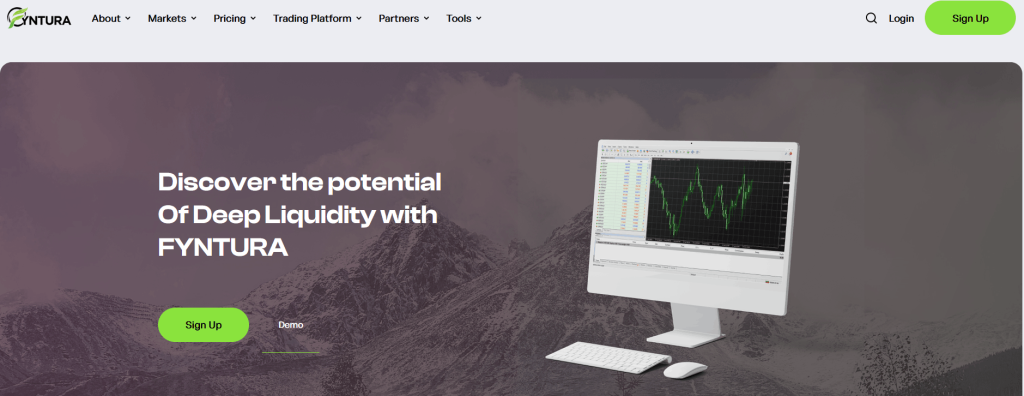
Fyntura is the closest match on this list because its public FAQ says account verification is not required.
It supports cryptocurrency deposits and withdrawals and advertises accounts starting from $10.
That sounds straightforward, but do not confuse a no-verification statement with proper financial protection.
A sentence on a broker’s FAQ page is not the same thing as a strong licence, client-money rules, or a withdrawal guarantee you can enforce.
| Feature | Fyntura |
| No KYC | Yes |
| Provider type | Offshore forex broker |
| Minimum deposit | $10 |
| Platform | MT4 |
| Maximum leverage | Up to 1:500 |
| Forex offering | More than 70 pairs advertised |
| Funding | Cryptocurrency |
| Company location | Seychelles |
| Recognised financial licence | Not shown on the FAQ reviewed |
What We Like
- Fyntura publishes one of the clearest first-party no-verification statements we found.
- The minimum deposit is $10.
- It advertises more than 70 forex pairs.
- Crypto deposits and withdrawals are supported.
- The broker says it does not charge its own deposit or withdrawal fee.
- Trading is available through MetaTrader-based platforms.
What to Watch
- We did not find a recognised top-tier financial licence on the public pages reviewed.
- A Seychelles company registration is not the same thing as a financial-services licence.
- Crypto transfers are usually irreversible.
- Bonus terms can affect withdrawals.
- The broker could introduce compliance checks if required by law or internal policy.
Frequently Asked Questions
Does Fyntura require KYC verification?
Fyntura’s public FAQ says account verification is not required. Traders can register and fund an account without uploading a passport or proof of address. This remains an offshore arrangement, though, and the broker could change its compliance rules or request information where legally necessary.
Can I withdraw from Fyntura without submitting an ID?
Fyntura’s current no-verification policy suggests that ordinary withdrawals can be processed without completing standard KYC. Deposits and withdrawals are mainly cryptocurrency-based. Traders should still read the latest withdrawal and bonus terms before depositing, as a no-KYC statement is not a guarantee that every withdrawal will be approved automatically.
Verdict
Fyntura is the closest literal match for someone searching for a no-KYC forex broker.
That does not make it the safest broker here. Before putting in serious money, ask for written confirmation of the latest withdrawal requirements. Start small. Make a deposit, place a few trades, and test a withdrawal before increasing the balance.
2. AZAforex
AZAforex offers no-KYC access, but only under certain conditions.
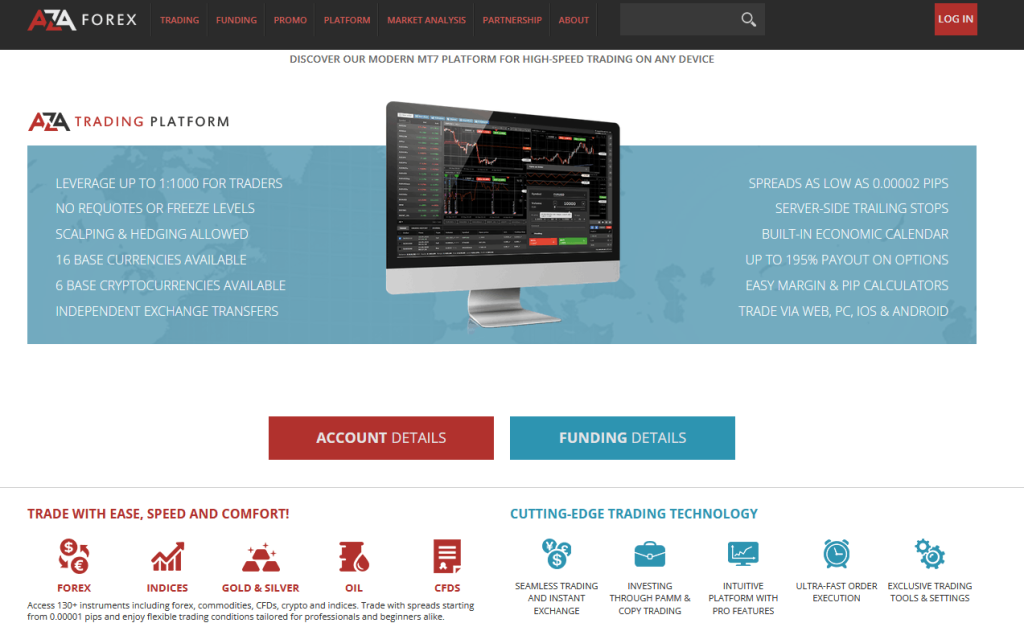
Its funding pages state that clients using cryptocurrency for both deposits and withdrawals do not need to verify their accounts. Withdraw through a card, e-wallet or another traditional route and documents may be requested.
AZAforex advertises a $1 minimum deposit and uses Mobius Trader 7.
| Feature | AZAforex |
| No KYC | Yes, for qualifying crypto transactions |
| Provider type | Offshore forex broker |
| Minimum deposit | $1 |
| Platform | Mobius Trader 7 |
| Funding | Crypto, cards, transfers and payment services |
| Anonymous route | Crypto deposits and withdrawals |
| Traditional withdrawals | Verification may be required |
| Minimum withdrawal | $10 |
What We Like
- Crypto users have a published no-verification route
- The minimum deposit is only $1
- Forex and other asset classes are available
- Traders can use desktop, web, or mobile
- Crypto-denominated accounts are offered
- The broker advertises no withdrawal fee
What to Watch
- The no-KYC policy depends on the payment method
- The crypto exchange you use may still require KYC
- Cards and traditional withdrawal methods can trigger verification
- Mobius Trader 7 is less widely used than MT4 or MT5
- AZAforex may ask for proof that a payment method belongs to you
- Dispute options are limited when dealing with an offshore company
Frequently Asked Questions
Is AZAforex genuinely a no-KYC forex broker?
AZAforex offers conditional no-KYC access. Verification is not required when traders use qualifying cryptocurrency methods for both deposits and withdrawals. Clients using cards, bank transfers or certain e-wallets may need to provide identity and address documents.
Can I use a bank card at AZAforex without verification?
Usually not. AZAforex requires card ownership checks and may ask for identity documents when cards, bank transfers or e-wallets are used. The clearest no-KYC route is to deposit and withdraw through supported cryptocurrencies, although an external exchange or payment provider may conduct its own checks.
Verdict
AZAforex is the best conditional no-KYC option here.
It suits traders who plan to deposit, trade and withdraw entirely in cryptocurrency. The moment you move back into bank-based payments, extra checks become more likely.
3. FenzoFX
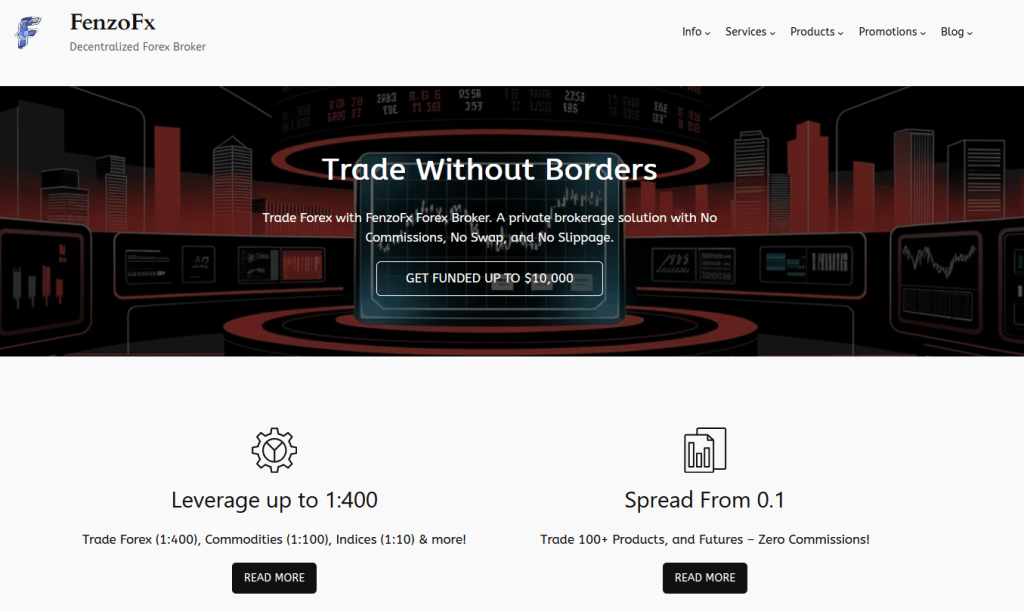
FenzoFX describes itself as a decentralised forex broker and openly promotes no-KYC access.
Its website lists forex, commodities, indices, crypto, stocks and agricultural markets. The standard account page shows a $1 minimum deposit and forex leverage of 1:200.
There is one issue. The homepage advertises leverage as high as 1:400. Traders need to confirm which limit applies to the account they are opening.
| Feature | FenzoFX |
| No KYC | Yes, based on provider claim |
| Provider type | Self-described decentralised forex broker |
| Minimum deposit | $1 |
| Forex leverage | Standard page states 1:200 |
| Highest advertised leverage | Up to 1:400 |
| Forex spreads | From 0.5 pips on the standard page |
| Funding | Cryptocurrency |
| Regulation | Provider claims require independent verification |
What We Like
- Crypto users have a published no-verification route
- The minimum deposit is only $1
- Forex and other asset classes are available
- Traders can use desktop, web, or mobile
- Crypto-denominated accounts are offered
- The broker advertises no withdrawal fee
What to Watch
- The no-KYC policy depends on the payment method
- The crypto exchange you use may still require KYC
- Cards and traditional withdrawal methods can trigger verification
- Mobius Trader 7 is less widely used than MT4 or MT5
- AZAforex may ask for proof that a payment method belongs to you
- Dispute options are limited when dealing with an offshore company
Frequently Asked Questions
Does FenzoFX allow forex trading without KYC?
FenzoFX publicly advertises no-KYC access and promotes itself as a decentralised forex broker. It accepts cryptocurrency payments and offers forex and other leveraged markets. The claim comes from FenzoFX itself, so traders should independently verify its legal company, withdrawal policy, and current account conditions before depositing.
Is FenzoFX a regulated forex broker?
FenzoFX displays company-registration information for Switzerland and Saint Vincent and the Grenadines. A company registration is not automatically a financial-services or forex-broker licence. Traders should look for the exact legal entity and licence number on an official regulator’s register rather than relying only on information displayed by the provider.
Verdict
AZAforex is the best conditional no-KYC option here.
It suits traders who plan to deposit, trade and withdraw entirely in cryptocurrency. The moment you move back into bank-based payments, extra checks become more likely.
4. Forexiz
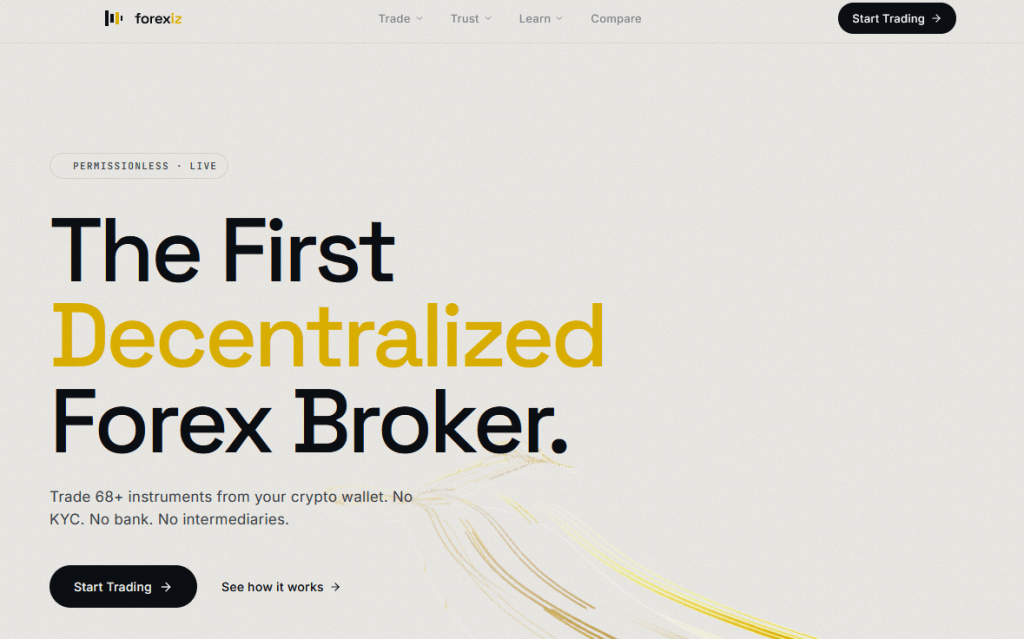
Forexiz is a decentralised forex protocol. It does not work like a normal broker.
Traders connect a crypto wallet and get exposure to forex, metals, indices, stocks, commodities and cryptocurrencies.
The website advertises more than 68 instruments, no identity uploads and no standard KYC signup. Collateral is held in a USDC smart contract on Arbitrum.
The live protocol launched on 13 May 2026. That gives it a very short track record.
| Feature | Forexiz |
| Feature | Forexiz |
| No KYC | Yes |
| Provider type | Decentralised forex protocol |
| Account access | Cryptocurrency wallet |
| Collateral | USDC |
| Network | Arbitrum |
| Instruments | More than 68 advertised |
| Custody | Smart-contract based |
| Main concern | Very short track record |
What We Like
- The no-KYC policy is clear
- There is no normal broker account to open
- Forex and several other markets are available
- Access is wallet-based
- Collateral is recorded on-chain
- Withdrawals do not go through a standard broker approval queue
What to Watch
- The protocol is new
- It is not a regulated forex broker
- A smart-contract bug or exploit could lead to losses
- Oracle and pricing failures are possible
- Traders carry USDC, issuer, and stablecoin risk
- There is no established ombudsman or investor-compensation scheme
Frequently Asked Questions
Does Forexiz require identity verification?
Forexiz directly advertises no-KYC access, with no passport, selfie or proof-of-address upload during its standard onboarding process. Users access the service through a cryptocurrency wallet or supported login option and fund trades with crypto-based collateral. Its no-KYC model does not make trades private from blockchain analysis.
Is Forexiz a normal forex broker?
No. Forexiz is a decentralised trading protocol rather than a conventional regulated brokerage. It offers forex-price exposure alongside metals, indices, stocks, commodities and crypto, while collateral is held through an Arbitrum-based smart contract. The protocol only went live in May 2026, so its operating history remains limited.
Verdict
Forexiz is one of the clearest examples of a true no-KYC forex protocol.
The setup may work for experienced Web3 traders. Beginners, or anyone who needs regulation and normal legal recourse, should stay away.
5. gTrade
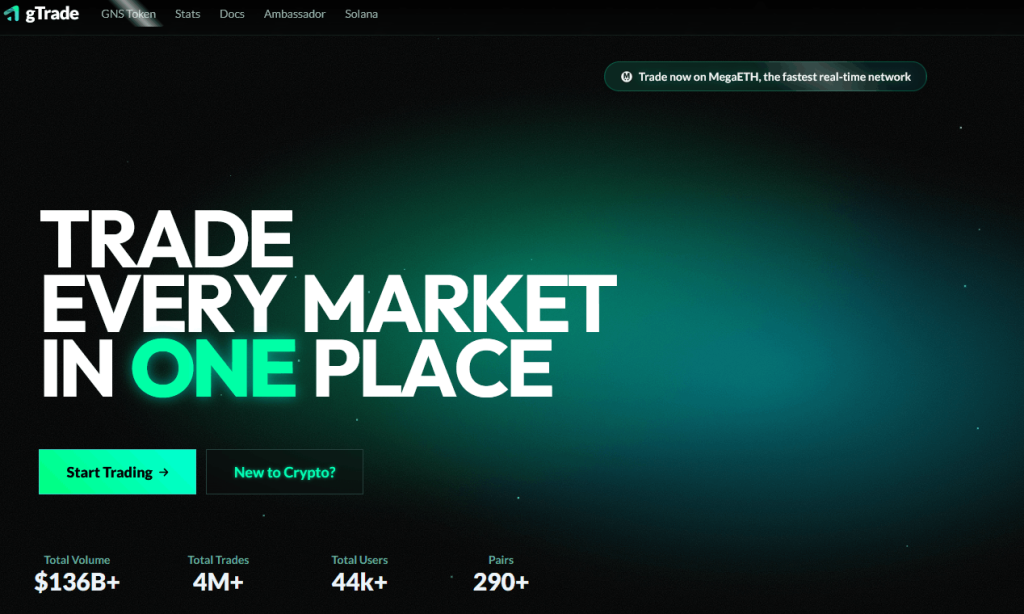
gTrade is the leveraged trading platform built by Gains Network.
It gives traders exposure to more than 30 forex pairs. Published forex leverage ranges from 10x to 1,000x.
You connect a Web3 wallet and use collateral such as DAI, USDC or WETH. There is no normal brokerage-account application.
The market list includes EUR/USD, USD/JPY, GBP/USD and USD/CAD. Individual pairs may be suspended or unavailable on certain networks.
| Feature | gTrade |
| No KYC | Yes |
| Provider type | Decentralised leveraged trading protocol |
| Account access | Web3 wallet |
| Forex markets | More than 30 pairs advertised |
| Forex leverage | 10x to 1,000x |
| Collateral | DAI, USDC or WETH, depending on network |
| Networks | Polygon and Arbitrum |
| Platform type | Perpetual leveraged trading |
What We Like
- The forex-pair list is wider than most decentralised alternatives
- Access is wallet-based
- No standard account application is required
- Traders can choose from several collateral assets
- Polygon and Arbitrum are supported
- The trading documentation is detailed
What to Watch
- Forex perpetuals are different from buying or holding actual currencies
- At 1,000x leverage, a tiny move against the position can wipe out the collateral
- Smart contracts and price oracles can fail
- Some markets can be switched off temporarily
- Stop losses may not execute at the expected level after weekend gaps
- Wallet security is entirely the trader’s responsibility
Frequently Asked Questions
Do I need an account or KYC to use gTrade?
gTrade does not use a conventional brokerage application. Traders connect a Web3 wallet, approve the relevant smart contracts, and use DAI, USDC, or WETH as collateral. Its official trading flow does not describe a passport or proof-of-address upload, although exchanges used to obtain crypto may require KYC.
Can I trade real forex pairs on gTrade?
gTrade provides leveraged price exposure to more than 30 forex pairs. These are decentralised leveraged positions rather than physical currency purchases or normal spot-forex accounts. Published leverage ranges from 10x to 1,000x, making careful position sizing especially important.
Verdict
gTrade is one of the more established decentralised options for trading forex prices without KYC.
Its market range is good. The leverage is the part that needs real discipline.
At 1,000x, there is almost no room for the trade to move against you.
6. Ostium
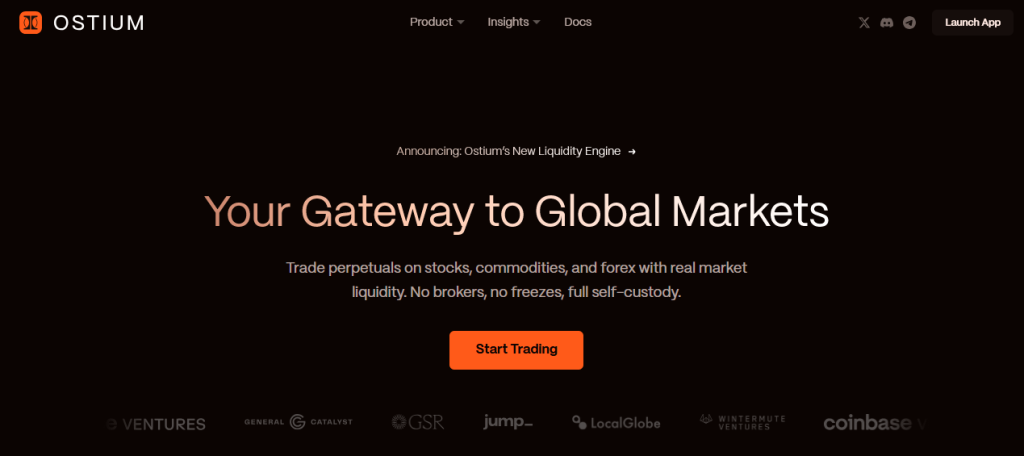
Ostium is a self-custodial perpetual platform covering forex and other real-world assets.
Traders connect a wallet or use a supported email-based wallet flow, deposit USDC and trade without completing a normal broker application.
The platform offers forex, stocks, ETFs, commodities, indices and crypto through perpetual contracts.
Its documentation lists 71 markets across six asset classes. Available leverage ranges from 50x to 200x, depending on the instrument.
| Feature | Ostium |
| No KYC | Yes |
| Provider type | Self-custodial perpetual platform |
| Account access | Wallet or supported email flow |
| Settlement | USDC |
| Network | Arbitrum |
| Markets | 71 listed across six asset classes |
| Maximum leverage | Up to 200x |
| Minimum trade | $5 advertised |
What We Like
- No conventional broker account is required
- The platform uses a self-custodial structure
- Forex and real-world-asset markets are available
- Market documentation is detailed
- Positions settle in USDC
- Transactions can be viewed on-chain
What to Watch
- Ostium is not a regulated retail forex broker
- Perpetual contracts do not have an expiry date
- Rollover and trading fees still apply
- Smart-contract and oracle failures remain possible
- Country restrictions may apply
- Users are responsible for wallet security and blockchain transactions
Frequently Asked Questions
Does Ostium require KYC?
Ostium’s standard onboarding allows users to connect a Web3 wallet or create a non-custodial smart account through email. Its published setup does not include conventional identity-document verification. Fiat services, exchanges or bridging providers used to obtain USDC may still apply their own KYC procedures.
What forex products can I trade on Ostium?
Ostium offers forex perpetual instruments alongside stocks, ETFs, commodities, indices and cryptocurrencies. Positions settle in USDC on Arbitrum, and forex markets generally follow traditional 24/5 trading hours. These are leveraged perpetual contracts, not ownership of the underlying currencies.
Verdict
Ostium is one of the better brokerless choices in this comparison.
The product feels more developed than several of the newer protocols. Just remember what you are trading: leveraged perpetual contracts, not currencies held in a standard forex account.
7. KiloEx
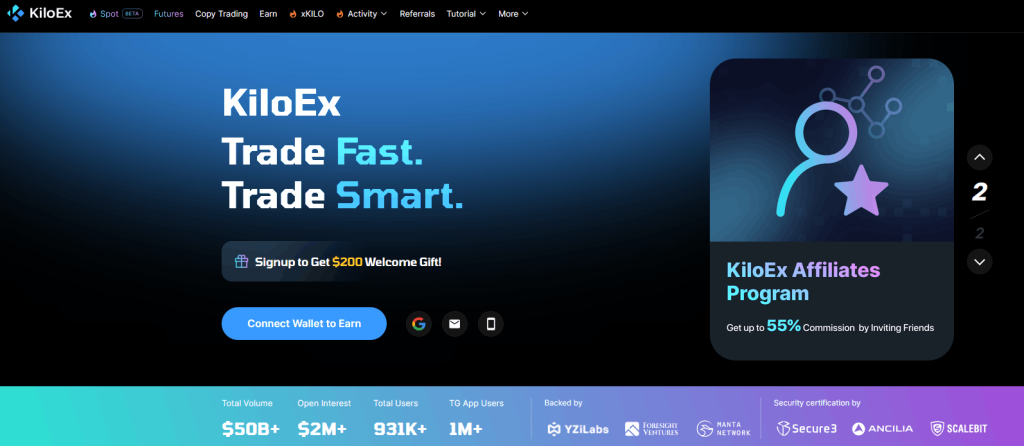
KiloEx is a decentralised perpetual exchange available on networks including opBNB and Base.
Its website states that there is no KYC, account registration or email signup. Traders connect a Web3 wallet and keep control of their funds.
The platform supports crypto, stock-linked and forex perpetual contracts.
KiloEx advertises forex leverage between 10x and 1,000x, with a stated forex transaction fee of 0.02%.
| Feature | KiloEx |
| No KYC | Yes |
| Provider type | Decentralised perpetual exchange |
| Account access | Web3 wallet |
| Forex products | Forex perpetual contracts |
| Forex leverage | 10x to 1,000x |
| Forex fee | 0.02% stated |
| Networks | Includes opBNB and Base |
| Custody | Non-custodial |
What We Like
- The platform has a direct no-KYC policy
- No email registration is needed
- Forex perpetual markets are available
- Traders connect through self-custodial wallets
- Trades use an on-chain model
- Public documentation is available
What to Watch
- Forex leverage can reach extremely high levels
- There are no normal broker protections
- Smart-contract risk cannot be removed completely
- Supported markets and leverage limits may change
- Network congestion can delay or affect transactions
- One wallet mistake can permanently destroy access to funds
Frequently Asked Questions
Can I use KiloEx without registering or completing KYC?
KiloEx allows traders to connect a compatible Web3 wallet without creating a conventional account. Its documentation describes full custody of funds with no deposit account or signup requirement. Traders need supported collateral and the relevant network token to pay blockchain transaction fees.
Are KiloEx forex markets open all day?
KiloEx forex markets are not open 24/7. They generally follow the traditional global forex week, opening on Sunday afternoon New York time and closing on Friday. KiloEx advertises forex leverage from 10x to 1,000x, which creates an extremely high liquidation risk.
Verdict
KiloEx deserves a place on the list for experienced traders looking specifically for no-KYC forex perpetuals.
It is a poor fit for anyone expecting MT4, bank deposits, client-money rules or a normal complaints department.
8. Avantis
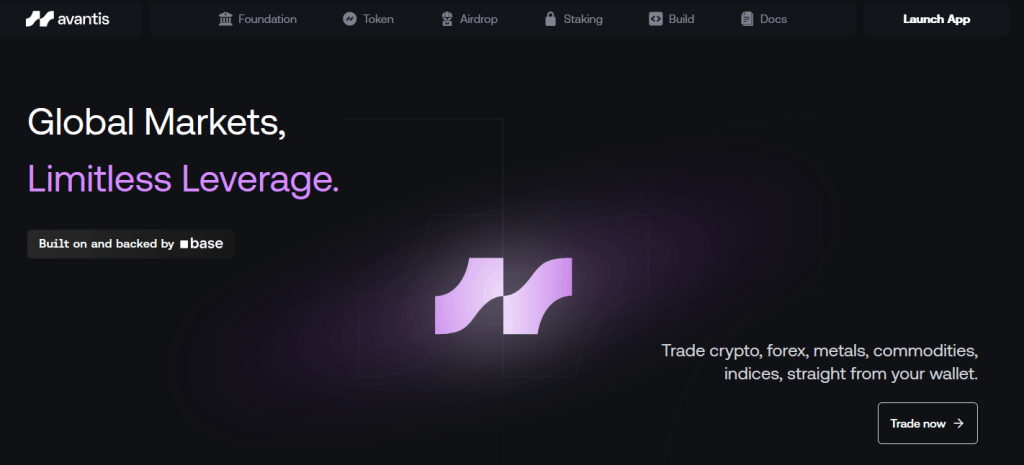
Avantis is a decentralised leveraged-trading platform built on Base. It offers perpetual contracts linked to forex, cryptocurrencies and commodities rather than conventional spot-forex accounts.
Users can access Avantis through an EVM wallet such as MetaMask or Rabby. Email, SMS, Google and social-login options are also available. The direct wallet route does not describe a conventional identity-document upload, although third-party exchanges and fiat-payment services may apply their own KYC requirements. (docs.avantisfi.com)
Avantis currently supports more than ten forex pairs and advertises leverage of up to 100x on forex and commodity markets. Trading collateral is held in USDC on Base, with ETH used for network fees.
| Feature | Avantis |
| No KYC | Yes – direct wallet route |
| Provider type | Decentralised perpetual platform |
| Account access | EVM wallet, email or social login |
| Network | Base |
| Trading collateral | USDC |
| Forex markets | More than 10 pairs |
| Maximum forex leverage | Up to 100x |
| Trading product | Forex perpetual contracts |
| Regulation | Not a conventional regulated forex broker |
| Main restriction | US persons and sanctioned jurisdictions excluded |
What We Like
- Direct wallet onboarding without a traditional broker application
- More than ten forex pairs
- Leverage of up to 100x on forex markets
- Self-custodial access
- Major pairs include EUR/USD, GBP/USD and USD/JPY
- Forex, crypto, metals and commodities are available
- No closing fee is currently charged on fixed-fee forex perpetuals
- Zero additional spread is advertised on selected major forex pairs
What to Watch
- Avantis is not a conventional forex broker
- Users trade perpetual contracts rather than physical currencies
- Opening and hourly margin fees may apply
- High leverage can liquidate a position quickly
- Smart-contract, oracle and blockchain risks remain
- USDC carries stablecoin and issuer risk
- The direct interface excludes US persons and certain sanctioned jurisdictions
- A fiat onramp or centralised exchange may require KYC even when Avantis does not
Frequently Asked Questions
Does Avantis require KYC?
Direct wallet onboarding on Avantis does not describe a conventional KYC upload. Users can connect an EVM wallet or sign in through email or social accounts. Some direct crypto deposits require no KYC, while card and fiat-onramp providers may require full verification.
Does Avantis offer zero-spread forex trading?
Avantis currently advertises zero fixed spreads on EUR/USD, USD/JPY and GBP/USD. That does not mean trading is free. Dynamic opening fees and ongoing margin charges can still apply to leveraged positions, so traders should compare the complete cost rather than looking only at the displayed spread.
Verdict
Avantis is a stronger replacement for FXED Protocol because it has clearer documentation, active forex markets and a more established on-chain trading product.
It is best suited to experienced traders who already understand USDC, Base and self-custodial wallets. Avantis should be described as a no-conventional-KYC decentralised trading platform, not as a regulated forex broker.
9. Hyperliquid
Hyperliquid is an on-chain trading ecosystem built around its own Layer 1 blockchain. It is best known for cryptocurrency spot and perpetual trading, but its HIP-3 framework also allows independent builders to launch additional perpetual markets.
Users can begin through a compatible EVM wallet or an email-generated wallet. Hyperliquid’s standard onboarding instructions do not describe a conventional passport, proof-of-address or broker-account verification process.
Hyperliquid itself should not be presented as a normal forex broker. Forex-linked markets depend on active HIP-3 builder deployments, and each deployer is responsible for the market definition, price oracle, leverage limits and ongoing operation.
| Feature | Hyperliquid |
| Feature | Hyperliquid |
| No KYC | Yes – wallet or email onboarding |
| Provider type | On-chain perpetual exchange and trading infrastructure |
| Account access | EVM wallet or email-generated wallet |
| Trading collateral | Primarily USDC |
| Core markets | More than 100 assets |
| Forex access | Through active HIP-3 builder-deployed markets |
| Core maximum leverage | Generally 3x to 40x, depending on asset |
| Forex leverage | Set by the relevant HIP-3 deployer |
| Trading product | Perpetual derivatives |
| Main limitation | Forex availability is deployment-dependent |
What We Like
- Wallet-based onboarding
- Email access is available for users without an existing Web3 wallet
- Fully on-chain order books
- Cross-margin and isolated-margin options on supported markets
- More than 100 core perpetual assets
- Detailed public technical documentation
- HIP-3 allows additional asset classes to be introduced
- Trading fees use a published volume-based structure
What to Watch
- Hyperliquid is not primarily a forex platform
- Forex-linked contracts are dependent on third-party HIP-3 deployments
- A market deployer controls its oracle design and leverage limits
- Active forex pairs can change or disappear
- Perpetual contracts are not the same as spot forex
- Smart-contract, blockchain and oracle risks remain
- Users must protect their wallet keys or email-generated wallet access
- Regional and legal restrictions may still apply
Frequently Asked Questions
Does Hyperliquid require KYC to start trading?
Hyperliquid’s standard onboarding lets users connect an EVM wallet or log in using an email address. Its official setup guide does not include a conventional passport or proof-of-address upload. However, regional restrictions may still apply, and centralised exchanges used to obtain USDC can require their own KYC.
Can I trade forex directly on Hyperliquid?
Hyperliquid is primarily known for crypto markets. Forex-linked exposure can be introduced through HIP-3 builder-deployed perpetual contracts. The builder controls the market definition, oracle, leverage limits, and ongoing operation.
Verdict
Hyperliquid is a more recognised replacement for OneKey Perps, but it needs careful wording.
It belongs on the page as no-KYC trading infrastructure with access to builder-deployed perpetual markets, not as a confirmed conventional forex broker. Before publishing, verify that active forex-linked HIP-3 contracts are visible through the interface or builder platform you intend to reference.
10. Paradex
Paradex is a decentralised derivatives platform built on a Starknet Appchain. It offers perpetual futures, options and spot markets through a unified margin account.
Users can onboard through an EVM wallet, Starknet wallet, email or social wallet. The normal wallet process creates a Paradex trading account from a signed wallet message rather than a traditional broker application. Paradex may still collect information, monitor access, or verify identity where required for security and legal compliance. (docs.paradex.trade) (paradex.trade)
Paradex currently publishes dedicated forex contracts, including EUR-USD-PERP. That contract settles in USDC, has a minimum order value of $10, and uses an initial margin fraction of 20%, equivalent to maximum leverage of approximately 5x.
| Feature | Paradex |
| No KYC | Yes – wallet-based onboarding |
| Provider type | Decentralised perpetual and derivatives exchange |
| Account access | EVM, Starknet, email or social wallet |
| Network | Paradex Starknet Appchain |
| Trading collateral | USDC |
| Markets | More than 90 markets advertised |
| Forex example | EUR-USD-PERP |
| EUR/USD minimum order | $10 |
| EUR/USD maximum leverage | Approximately 5x |
| Regulation | Paradex says it is not registered or licensed as a broker |
| Main restrictions | US, Canadian and sanctioned persons excluded |
What We Like
- Directly documented EUR/USD perpetual contract
- Wallet-based onboarding
- More than 90 markets across several product types
- USDC settlement
- Unified margin account
- Mobile and web trading access
- Multiple advanced order types
- Orders, positions, and account data use privacy-focused technology
What to Watch
- Paradex is not a regulated forex broker
- Forex products are perpetual futures, not spot currencies
- KYC-free onboarding does not guarantee unrestricted access
- Paradex can monitor and verify service access for legal or compliance reasons
- US and Canadian persons cannot use the service
- VPN use to bypass restrictions is prohibited
- Transactions are final and generally irreversible
- Smart-contract, wallet, oracle and Appchain risks remain
Frequently Asked Questions
Does Paradex require KYC?
Paradex supports wallet-based onboarding through EVM and Starknet wallets, along with email and social-wallet options. The standard process uses wallet signatures rather than a traditional broker application with identity uploads. Access may still be restricted by country, and third-party funding services can apply separate verification requirements.
Can I trade EUR/USD on Paradex?
Yes. Paradex publishes an EUR/USD perpetual-futures contract settled in USDC. The minimum order value is currently $10, and the contract uses a 20% initial margin fraction, which works out to maximum leverage of roughly 5x. It is a perpetual derivative, not a conventional spot-forex position.
Verdict
Paradex is a much stronger replacement for ForX.
It has a working official website, detailed documentation, and a clearly specified EUR/USD perpetual market. Its wallet-based onboarding supports the no-KYC theme, but the page must explain that Paradex is an unlicensed, non-custodial derivatives platform rather than a normal forex broker.
It is best suited to experienced traders who understand perpetual futures, USDC collateral, and self-custodial wallet security.
Can a Broker Request KYC Only When You Withdraw?
Yes. Some brokers let you open and fund an account before completing a full identity check.
Verification may start after:
- A large withdrawal request.
- Unusual trading or account activity.
- A payment from a wallet or account that does not match your details.
- A country-risk flag.
- A sanctions-screening alert.
- A request to change account details.
- A source-of-funds review.
- A change in the broker’s compliance policy.
This is why a signup form that does not ask for an ID tells you very little about the withdrawal process.
Main Risks of Trading Forex Without Verification
| Risk | What can happen | Practical safeguard |
| Verification at withdrawal | The broker freezes or delays the withdrawal until you provide an ID or proof of address | Ask for the full KYC and withdrawal policy in writing |
| Weak legal recourse | No effective regulator or ombudsman handles the dispute | Verify the exact legal entity before depositing |
| Broker closure | The website, company, or payment system stops operating | Do not leave a large unused balance in the account |
| Irreversible crypto transfer | Funds are sent to the wrong wallet or network | Test deposits and withdrawals with a small amount |
| High leverage | A small market move creates a large loss | Lower the leverage and control position size |
| Bonus restrictions | Your funds are locked behind turnover conditions | Avoid bonuses with unclear terms |
| Country restrictions | The broker closes the account because residency rules were broken | Use brokers that accept your real country |
| Tax and recordkeeping problems | Missing records make reporting difficult | Keep wallet, deposit, withdrawal, and trading records |
No-KYC Broker vs Regulated KYC Broker
| Feature | No-KYC or low-document broker | Regulated KYC broker |
| Initial signup | Usually faster | Online verification is normally required |
| Privacy | Less personal information may be collected at first | Identity and address details are collected |
| Withdrawal certainty | Higher chance of a later document request | Requirements are usually clearer before funding |
| Legal protection | Often limited | Usually stronger |
| Dispute resolution | May be unclear or unavailable | A regulator or ombudsman may be available |
| Cryptocurrency funding | Common | Available at selected brokers |
| Leverage | Often extremely high | Often restricted by local rules |
| Best suited to | Experienced traders who understand the risk | Most retail traders |
How to Check a No-KYC Broker Before Depositing
Identify the Company Holding Your Account
Find the full legal company name in the client agreement.
Do not rely on the brand name at the top of the homepage. Several brokers use one brand across multiple companies.
Check the Financial Licence
Compare the following information with the regulator’s official register:
- Company name.
- Licence number.
- Website domain.
- Approved financial services.
A company can exist legally without being authorised to offer leveraged forex or CFDs.
Read the Withdrawal Policy Before You Deposit
Search the broker’s terms for phrases such as:
- Full verification.
- Enhanced due diligence.
- Source of funds.
- Additional documents.
- Compliance review.
- Payment ownership.
- Proof of residence.
These phrases usually show where a later document request may come from.
Confirm Country Restrictions
Do not use a VPN, fake address, or borrowed documents to get around location rules.
The broker may take the deposit anyway. The problem usually arrives later, when you need to prove your address before withdrawing.
Ask Support One Direct Question
Ask:
Can I withdraw my original deposit and all trading profits without submitting an ID or proof of address?
Keep a screenshot or copy of the answer.
It will not override the broker’s legal terms, but it gives you a record of what support told you before funding.
Test a Small Withdrawal
A successful deposit proves that the broker can receive money.
That is all it proves.
A completed withdrawal tells you far more about how the payment and compliance process actually works.
Check Payment-Ownership Rules
Most brokers do not allow third-party deposits.
The bank account, card, or crypto wallet may need to belong to the same person named on the trading account.
Secure the Account
Use a password that you do not use anywhere else.
Turn on two-factor authentication and keep copies of:
- Deposits.
- Trades.
- Support conversations.
- Wallet transactions.
- Withdrawal requests.
- Any documents or terms shown during signup.
Who Should Avoid No-KYC Forex Brokers?
No-KYC and low-document brokers are usually a poor fit for:
- Beginners.
- Anyone trading with rent money, emergency savings, or money needed for daily expenses.
- Traders who want access to a recognised ombudsman.
- Anyone unable to check company and licence details independently.
- Traders who need predictable withdrawals to a bank account.
- Anyone trying to avoid tax or legal reporting.
- Users trying to get around sanctions, age limits, or country blocks.
Final Verdict
Fyntura is the clearest conventional no-verification forex broker in this comparison.
AZAforex also offers no-KYC access, provided the trader uses qualifying crypto deposit and withdrawal methods.
FenzoFX makes a direct no-KYC claim and offers a broker-style product. Its company, regulatory and account information needs more independent checking.
Among the decentralised choices, gTrade, Ostium and KiloEx have the strongest mix of public documentation, forex coverage and wallet-based access.
Forexiz, FXED Protocol and ForX are newer. Their no-KYC policies are clear, but their shorter track records add more uncertainty.
OneKey Perps offers a convenient route through the OneKey wallet and Hyperliquid, although regional restrictions still matter.
There is no low-risk option on this list.
Avoiding KYC can make account opening faster. In return, traders often give up regulation, compensation schemes and a normal legal path when something goes wrong.
Privacy has value. Access to your money, safe custody and proper legal protection matter more.
Risk Warning
Forex and CFD trading uses leverage and carries a serious risk of loss. You can lose every dollar deposited into the account. Offshore and low-document brokers may also offer weaker regulatory protection and fewer options when a withdrawal or account dispute goes wrong.
This guide is for general information. It is not financial, investment, legal, or tax advice.
Frequently Asked Questions
Fyntura’s public FAQ says account verification is not required. Coinexx appears to allow a relatively low-document signup, but it does not publish a permanent no-KYC guarantee. Policies can change. A broker that does not request an ID during registration may still ask for one before processing a withdrawal.
Some offshore brokers may let you register, deposit, and start trading without uploading an ID. That does not guarantee you can withdraw your deposit or profits without completing verification later.
The broker may run delayed customer-due-diligence checks, sanctions screening, or a source-of-funds review. A withdrawal may also trigger a review because of its size, destination, payment method, or activity on the account.
That depends on your country, the broker’s legal entity, and the products being offered. A website accepting your application does not prove the broker is authorised to offer forex or CFDs where you live.
They are generally riskier than properly regulated brokers. Client-money protection, complaints procedures, and legal recourse may be limited. Anonymous signup also does nothing to protect you from leverage losses, hacking, platform failure, or an irreversible crypto transfer.
Using a VPN to hide your real location may breach the broker’s terms. The account can be suspended, and you may run into serious withdrawal problems if the broker later asks for proof of address or residency.
No. Crypto is a payment method. The broker may still ask for identification, proof of address, proof that you own the wallet, or information about where the money came from.
Some do not ask for it when you register. They may ask later. Read the AML, withdrawal, and enhanced-due-diligence policies before depositing.
A regulated broker with fast online verification is usually safer. Signup may still be quick, and you get clearer information about withdrawals, regulation, and legal protection.
Using a no-KYC broker does not remove your tax obligations. Keep full records of deposits, withdrawals, wallet transfers, and trading activity. Follow the tax rules that apply where you are resident.

Sidebar rates

