Why Is the KOSPI Up 17% Today? Samsung, SK Hynix Surge Nearly 30% on Microsoft AI Rally
On July 31, South Korea’s KOSPI rose by 17%, with Samsung Electronics and SK Hynix peaking by nearly 30%. Microsoft’s Azure...
On July 31, South Korea’s KOSPI rose by 17%, with Samsung Electronics and SK Hynix peaking by nearly 30%. Microsoft’s Azure sales grew 43% with leaner spending on infrastructure for AI as fears of recession for the sector grew. Aggressive dip-buying for the KOSPI, after the record sell-off earlier in July, was warranted.
With a significant help of the Microsoft induced tech trade, the KOSPI staged one of the strongest rebound’s in years, and investors turned back to South Korean semiconductor stocks. After the sell-off earlier in the week, Samsung Electronics and SK Hynix rose sharply, but the KOSPI remained almost 25% down for the month, meaning the increase on Friday was a major relief, not a confirmed trend change. At times, it was reported by Reuters, that the KOSPI had its best record-breaking performance for a single day.
Microsoft’s 43% Azure Growth Revives the Korean AI Trade
Microsoft’s fiscal Q4 results drove the most change. Year-over-year growth of Azure and other cloud services increased by 43% and Cloud services of Microsoft reached $59.3 billion. Microsoft further reported a commercial backlog of $678 billion indicating that demand of enterprise clients for cloud and AI services remains strong and is only expected to grow.
According to Microsoft’s official earnings release, Azure reportedly crossed $100 billion in annual revenue, and Microsoft 365 Copilot reached 30 million subscribers. This news also calms worries that hyperscalers are spending too much building AI infrastructure and not making enough money.
Samsung and SK hynix, the suppliers of AI servers and accelerators advanced memory, enjoyed the hottest of winter sales from the news. According to AP News, Samsung shares jumped around 21%, while SK Hynix shares increased by 24.6%. As a result, the KOSPI was around 6,376.68.
KOSPI Rebound Follows a Historic Semiconductor Selloff
This performance came just after one of the worst KOSPI trading days. The KOSPI dropped around 10.84% and closed at 6,023.66. Prices for Samsung and SK Hynix dropped by over 14%. Foreign selling was reported to be around ₩5 trillion of Korean shares per Reuters.
The continuation of price drops the following trading day is attributed to profit taking of all the traders that were margin trading. Many were doubtful about AI-enhanced memory profits and revenue after the earnings report. Reuters reports that Analysts attributed the fall more to the market situation (i.e. liquidity) and the high level of margin trading, more than the collapse of the semiconductor market.
Memory prices and supply are predicted to remain tight. That is also positive that Samsung has signed long term contracts with guaranteed advanced memory and cash up front, according to Reuters.
Bank of Japan Holds Rate at 1% in an 8-1 Vote
The Bank of Japan did not raise its Policy rate from 1.0% after it’s June rate increase. The decision, which passed with an 8-1 vote, saw Hajime Takata supporting a move to 1.25%.
The BOJ stated that if the risks of inflation continue to rise, tightening would still be an option. Yet, the central bank’s decision was a minor factor in Korean equities. What was mostly affecting the market was the revived interest in AI and semiconductor stocks, as a result of Microsoft’s earnings.
KOSPI Technical Analysis: 7,100 Trend-Reversal Examination
KOSPI shows a notable response in the range of 5,521 support, with a resilient advance testing 5,989. The RSI has rebounded to 49 from the oversold zone.
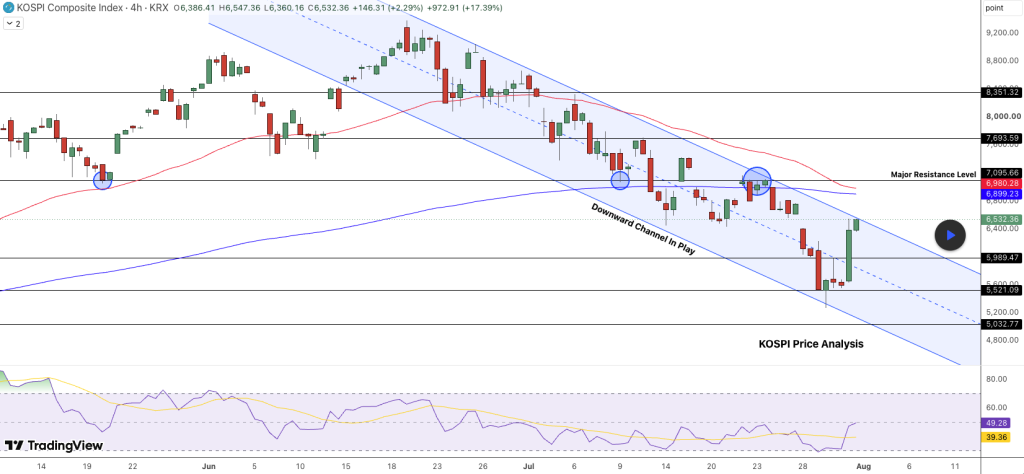
Channel resistance from 7,095 to 7,100, combined with the 50 and 100 period EMAs, are pointed to a bearish assessment of the negative structure.
- Resistance: 7,095, 7,694 and 8,351
- Support: 5,989, 5,521 and 5,033
KOSPI Trade Setup
Entry: Buy after 7,100 is confirmed with a close
Target: 8,351, with an intermediate target of 7,694
Stop: 6,899
The advance is constructive above 5,989; however, the 7,100 barrier is critical to the descending channel with a broader and more significant bullish reversal.
Frequently Asked Questions
What is the cause of the sharp increase in KOSPI today?
Microsoft’s strong Azure growth and the positive impact on the market and infrastructure reinforced the recovery of Samsung, SK Hynix, and the semiconductor sector.
Has KOSPI recovered the July losses?
No. KOSPI has not recovered losses. While the KOSPI increased 17% intraday, July losses were almost 25%, according to reports from Reuters.
What is the bullish reversal confirmation level for KOSPI?
The confirmation of a bullish reversal for KOSPI would be a close above 7,100.
- Check out our free forex signals
- Follow the top economic events on FX Leaders economic calendar
- Trade better, discover more Forex Trading Strategies
- Open a FREE Trading Account
- Read our latest reviews on: Avatrade, Exness, HFM and XM

Related Articles
Sidebar rates

Related Posts
 Save
SaveAva