Intel Q2 Revenue Jumps 25% on AI Demand, but Foundry Losses Keep INTC Under Pressure
Intel (NASDAQ: INTC) faced challenges after its latest earnings reporting despite having the highest quarterly revenue growth...
Intel (NASDAQ: INTC) faced challenges after its latest earnings reporting despite having the highest quarterly revenue growth for them in over 15 years. Investors had to consider the operational recovery against the foundry losses and higher capital spending.
The established semiconductor company had strong results for the second quarter and most attributed this to the increased demand to support AI and premium PCs. However, the share prices were in a downward trend the markets were likely concerned with the restoration of sustainable profitability and funding the long-term manufacturing plans.
Intel Reports the Highest Revenue Growth in Over a Decade with Annual Revenue at $16.1 Billion
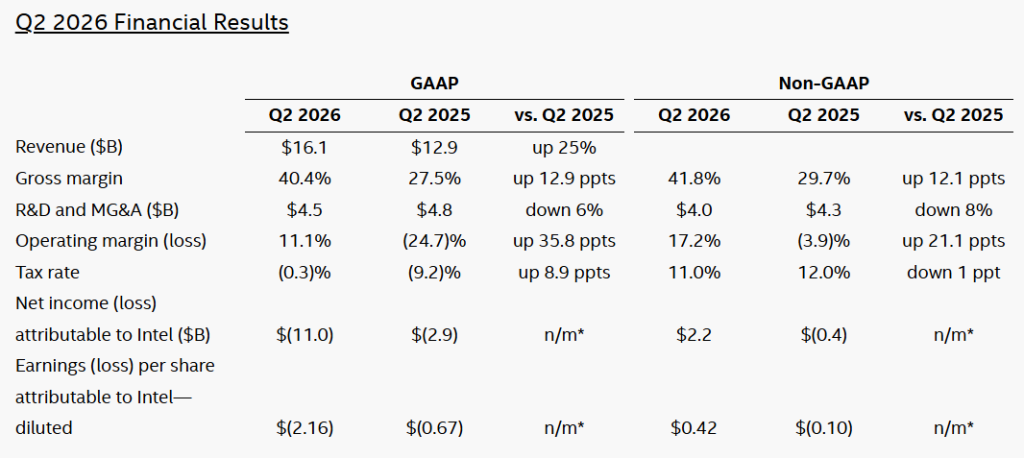
For the second quarter of fiscal year 2026, Intel’s revenue was $16.1 billion, a 25% year-over-year increase from $12.9 billion. This revenue increase was well beyond the expected fiscal revenue.
The turnaround in operations was apparent in the positive changes in gross and operating margins. For the second quarter, Intel had a non-GAAP gross margin of 41.8% and a non-GAAP operating margin of positive 17.2%. For the second quarter of fiscal year 2026, Intel’s non-GAAP earnings per share was $0.42 and Intel’s non-GAAP net income was approximately $2.2 billion.
In the second quarter, Intel’s GAAP net income was a loss of $11.0 billion. Most of this loss was due to a $12.5 billion non-cash expenditure for escrowed CHIPS Act Secure Enclave Agreement Shares. Adjusting for this expenditure, there was improvement in the Intel operations.
AI and Data Center Demand Fueled Revenue Growth
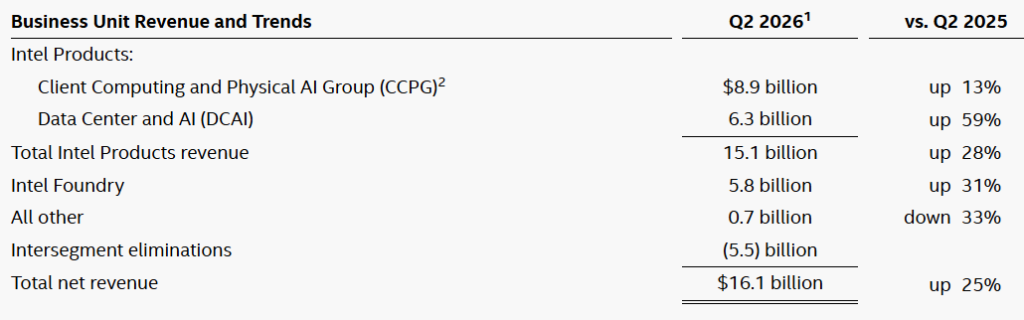
For the second quarter of fiscal year 2026, Intel’s best performing segment was the Data Center and AI (DCAI) segment with a 59% year-over-year increase in revenue. This segment’s revenue for the second quarter was $6.3 billion.
Sales to hyperscale cloud providers and enterprise server processors contributed most to the growth, with higher performance Xeon platforms resulting in better average selling prices. Revenues also grew from custom silicon and ASIC products with increased investments in AI infrastructure.
The Client Computing and Physical AI Group reported revenues of $8.9 billion, an increase of 13% from the previous year. Revenue growth was supported by better product mix with premium notebook and desktop processors, and better prices supported by AI-enabled PCs.
Management observed customers’ greater demand for AI-based computing products and the continuing expansions of AI and cloud infrastructure-related business activities.
Expansion of Foundry Business Associated with Continued Losses
Intel Foundry reported $5.8 billion in revenue, showing a 31% year over year growth. This revenue growth is attributed to the increase of production at multiple advanced manufacturing nodes including Intel 18A, Intel 3 and Intel 4.
Despite the growth in revenue, profitability is still a long way off. The operating loss of the foundry division for the quarter was approximately $2.1 billion. This loss is attributed to the aggressive growth strategy Intel is employing in the manufacturing sector, specifically, in the area of advanced packaging and cutting-edge processes.
Management stated there was improvement in the yields of Intel 18A and confirmed Intel 18A-P has entered risk production. It was also stated that Intel 14A was on schedule for high-volume production by 2028. The manufacturing roadmap has significant implications for Panther Lake and Xeon 6+.
Though outside foundry revenues are low, Intel is positioning the business to grow over time and compete against incumbent contract manufacturers.
Continuance of Positive Trends Anticipated
Intel is projecting third quarter revenues to be in the range of $15.8 billion to $16.8 billion, with non-GAAP EPS of approximately $0.38 and gross margins around 42%.
For the quarter, approximately $7.0 billion in operating cash flow was generated, while free cash flow continued to deteriorate due to negative cash flow. This is a result of aggressive capital expenditures to further Intel’s position in manufacturing and to develop advanced semiconductor technologies.
More hostile environments have tempered some areas of the semiconductor industry. Investors are hoping that the existing demand caused by AI, enterprise server upgrades, and the execution of the foundry business are sufficient to counteract impacts from the rest of the semiconductor industry.
Intel Technical Analysis: Descending Channel, Sellers Remain Dominant
Recent price action for Intel has formed another set of lower highs and lower lows for the stock, even with a small bullish rebound from the $75.70 support. Intel has remained inside the confines of a well-structured Descending Channel.
While recent price action has formed a bullish candlestick, buyers are showing signs of an attempt to stabilize the price, but the rebound is not strong enough to consider a trend to be reversing.
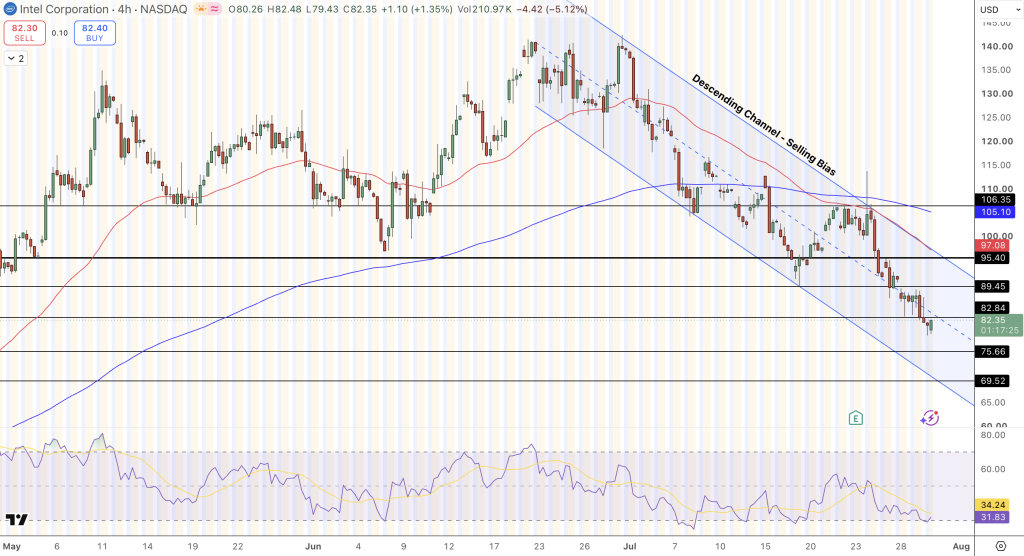
The general trend for Intel stock remains bearish, and prices are sustained below the 50 Period Exponential Moving Average (EMA) of $97.10 and the 200 Period EMA of $105.10. The upper resistance line of the Descending Channel has repeatedly rejected upward price actions, continuing the downtrend.
Indicators of the market’s momentum, and the momentum indicators, imply that the risk of selling will be greater in the near future. The Relative Strength Index (RSI) has recovered, but is presently sitting just below the 32 mark, very close to the oversold region. This implies a possibility of a technical rebound, but will not be confirmed without a break above Descending Channel resistance.
A break and sustain above $89.50 will further improve the technical outlook, and will create a pathway for the 50 Period EMA in the proximity of $97.10. A sustain below the support of $75.70 will create a new price target for the support line of $69.50.
Resistance: $82.80, $89.50, $95.40, $105.10
Support: $69.50, $75.70
Intel Outlook
Recent results from Intel show positive effects from increasing user spending on AI and technology infrastructure, as well as an increase in profits for the core business. However, the market is still focused on if the company can stem losses from the Foundry division and translate investments in manufacturing to a profitable future.
From a technical standpoint, the stock is still viewed as bearish while it continues to trade within its descending channel. If it remains above $75.70, it may recover in the short term. A confirmed break above $89.50 would signal that buyers are regaining control of the medium-term trend.
- Check out our free forex signals
- Follow the top economic events on FX Leaders economic calendar
- Trade better, discover more Forex Trading Strategies
- Open a FREE Trading Account
- Read our latest reviews on: Avatrade, Exness, HFM and XM

Related Articles

Sidebar rates

Related Posts
 Save
SaveAva