HOOD Stock Falls Below $90 Despite Robinhood’s Record Q2 Revenue as Crypto Slump Weighs
Robinhood HOO falls below $90 as weak crypto revenue and a one-time profit boost overshadow record sales and prediction-market growth.

Robinhood delivered record revenue as equities, options and prediction markets surged, but weaker crypto trading and questions about earnings quality kept HOOD stock under pressure.
Robinhood Earnings Beat Fails to Lift HOOD Stock
Robinhood Markets (NASDAQ: HOOD) reported stronger-than-expected second-quarter results, but investors found enough weaknesses beneath the headline numbers to keep selling the stock.
HOOD fell 3.15% during Wednesday’s regular session to $89.84 before slipping another 1.38% to $88.41 in overnight trading. The decline left Robinhood below the psychologically important $90 level despite record quarterly revenue and a clear earnings beat.
The muted response shows how high expectations have become. Robinhood’s operations expanded across equities, options, subscriptions and prediction markets, yet cryptocurrency revenue declined sharply. A one-time investment gain also contributed materially to reported earnings.
Revenue Hits Record $1.31 Billion
Robinhood’s total net revenue increased 32% from a year earlier to $1.31 billion, exceeding market estimates of roughly $1.25 billion to $1.28 billion.
Transaction-based revenue was the main driver, rising 44% to $776 million. Equities revenue nearly doubled, increasing 95% to $129 million, while options revenue advanced 29% to $342 million.
Net interest revenue increased 9% to $389 million as growth in interest-earning assets offset pressure from lower short-term rates and weaker securities-lending activity. Other revenue rose 54% to $143 million, helped by continued expansion in Robinhood Gold.
According to Robinhood’s official second-quarter results, funded customers increased 7% to 28.4 million, while investment accounts reached 29.9 million. Platform assets expanded 32% to $369 billion.
Robinhood also attracted record net deposits of approximately $22 billion. Gold subscriptions grew 39% to 4.8 million, and average revenue per user increased 24% to $187.
Those figures point to stronger customer engagement and a broader revenue base. Robinhood is no longer relying solely on speculative equity and cryptocurrency trading to generate growth.
Headline EPS Received a One-Time Lift
Net income increased 48% to $573 million, while GAAP diluted earnings rose to $0.62 per share.
However, the result included $129 million in gains primarily related to the deconsolidation of Robinhood Ventures Fund I. The company said that benefit contributed approximately $0.14 per share.
Removing that impact leaves underlying earnings near $0.48 per share, still above the approximately $0.44 consensus estimate cited by LSEG. Robinhood therefore delivered a genuine earnings beat, but the difference between reported and underlying profit helps explain why investors did not fully embrace the headline number.
Adjusted EBITDA increased 35% to $741 million. Operating expenses, however, climbed 33% to $734 million as Robinhood increased marketing and product investment and absorbed restructuring expenses associated with its June workforce reduction.
The company tightened its expected 2026 adjusted operating expense and stock-based compensation range to $2.675 billion–$2.775 billion, slightly below its previous outlook.
Expense discipline remains important. Robinhood is launching new products and entering capital-intensive markets, but shareholders will want those investments to produce durable earnings rather than temporary bursts of trading activity.
Prediction Markets Become a Major Growth Engine for Robinhood
The standout business was prediction markets.
Robinhood users traded 13.6 billion event contracts during the quarter, more than ten times the year-earlier level. The segment generated $156 million in revenue, up from approximately $104 million in the first quarter.
That means prediction markets produced more revenue than Robinhood’s cryptocurrency business during Q2.
The category allows users to trade contracts tied to outcomes such as elections, sporting events and economic developments. Its rapid growth gives Robinhood a new engagement tool that can attract customers and keep them active between traditional stock-market sessions.
Robinhood is also directing more prediction-market activity through Rothera, its jointly managed platform with market maker Susquehanna. That could reduce reliance on outside providers and allow Robinhood to retain more revenue while offering tighter pricing.
The opportunity is significant, but risks remain. Prediction markets operate in a changing regulatory environment, and activity can be heavily influenced by major political or sporting events. Investors will need evidence that current volumes are sustainable outside unusually active periods.
Robinhood’s Crypto Revenue Drops 38%
Cryptocurrency was the report’s clearest weakness.
Crypto transaction revenue declined 38% year over year to $100 million. Total cryptocurrency notional volume reached $40 billion, including $18 billion through the Robinhood app and $22 billion from Bitstamp.
Robinhood app crypto volume fell 35%, showing that the weakness was not simply an accounting effect caused by the Bitstamp acquisition.
The decline matters because crypto has historically been one of Robinhood’s most important sources of transaction revenue. The company is investing in Robinhood Chain, tokenized assets and international cryptocurrency infrastructure, but those projects have not yet offset lower trading activity in its core app.
The broader revenue mix provides some protection. Strong equities, options, Gold subscriptions and event contracts allowed Robinhood to post record revenue even as crypto struggled. Still, another weak crypto quarter would increase pressure on newer products to sustain growth.
HOOD Technical Analysis: Oversold, but the Trend Remains Bearish
Robinhood’s four-hour chart shows an oversold stock that has not yet produced a confirmed reversal.
The relative strength index stands at 28.96, placing HOOD close to oversold territory. Stochastic RSI has fallen to zero, while Williams %R is at -93.35. The Commodity Channel Index is at -124.13 and carries a buy signal.
These readings suggest selling has become stretched and could support a short-term rebound.
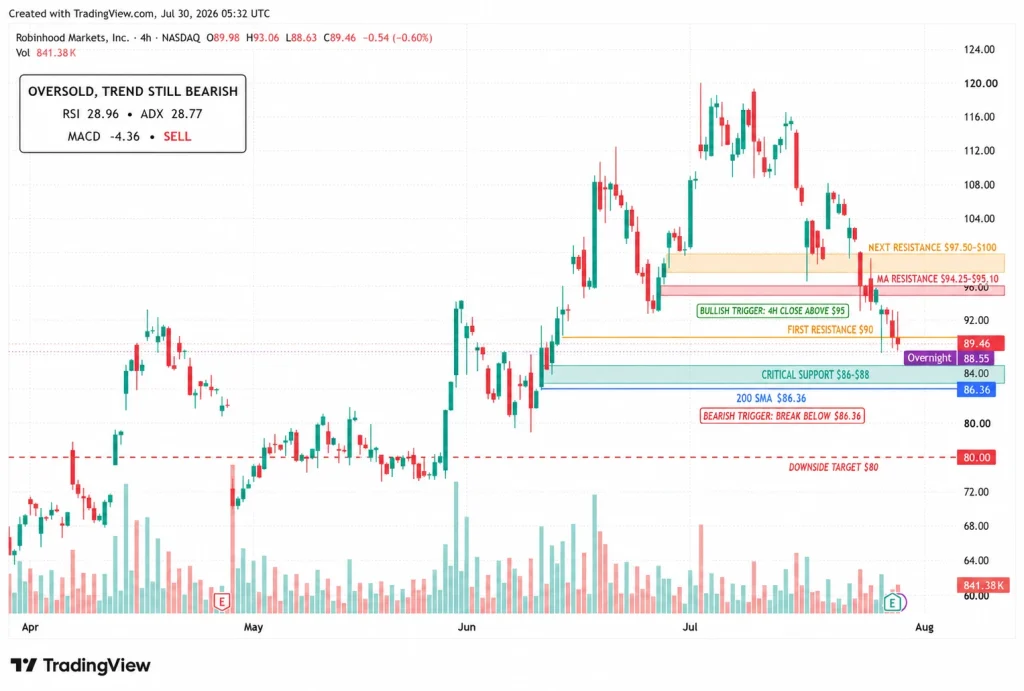
However, the broader structure remains bearish. MACD is at -4.36 with a sell signal, the Awesome Oscillator is negative at -13.21, and Bull Bear Power stands at -10.70. The Average Directional Index at 28.77 suggests the existing trend has meaningful strength.
More importantly, HOOD trades below nearly every major four-hour moving average. The 10-period EMA is at $94.76, the 20-period EMA at $98.74 and the 50-period EMA at $101.15. The 100-period EMA stands at $97.54, while the 200-period EMA is positioned at $94.26.
The only major average still below the stock is the 200-period simple moving average at $86.36.
That makes the $86–$88 area the first critical support zone. A sustained break below $86.36 would weaken the longer-term structure and could expose the $80 region.
On the upside, bulls first need to reclaim $89.78–$90, followed by the dense $94.25–$95.10 resistance zone. A break above $95 would improve the short-term outlook, but HOOD would still face resistance around $97.50–$100.
The main technical levels are:
- Support: $88, $86.36 and $80
- Resistance: $90, $94.25–$95.10 and $97.50–$100
- Bullish trigger: Four-hour close above $95
- Bearish trigger: Sustained break below $86.36
What to Expect From Robinhood Stock in Q3
Robinhood’s second quarter was operationally strong. Revenue reached a record, customer deposits accelerated and prediction markets emerged as a credible new earnings engine.
The problem is that investors had already priced in substantial growth. Crypto revenue declined, expenses increased and a one-time gain enhanced the reported EPS figure. Those details made the record quarter less decisive than its headline suggested.
HOOD is oversold enough for a rebound, but the chart remains bearish below $94–$95. Holding the 200-period SMA near $86.36 is now essential. Until Robinhood reclaims its short-term averages, any bounce risks becoming another opportunity for sellers rather than the start of a durable recovery.
- Check out our free forex signals
- Follow the top economic events on FX Leaders economic calendar
- Trade better, discover more Forex Trading Strategies
- Open a FREE Trading Account
- Read our latest reviews on: Avatrade, Exness, HFM and XM

Related Articles


Sidebar rates

Related Posts
 Save
SaveAva