AAPL Stock Holds $338 Before Apple Earnings as $5 Trillion Valuation Faces a Critical Test
Apple earnings: AAPL stock holds near $338 before earnings as iPhone demand, Services growth, memory costs and its CEO transition take focus
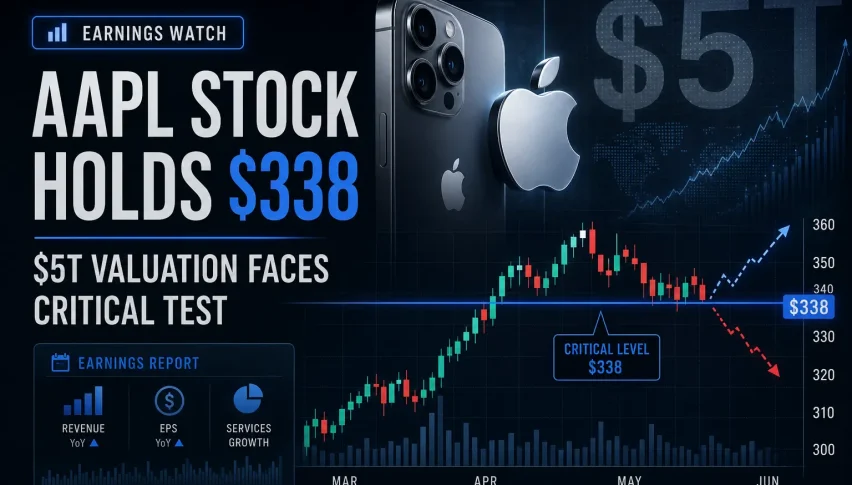
Apple shares held near $338 before earnings as investors prepared to assess iPhone demand, Services growth, rising memory costs and the company’s leadership transition.
Apple Stock Holds Near Record Highs Before Earnings
Apple stock traded cautiously ahead of its fiscal third-quarter results, falling 0.56% to $338.19 before recovering slightly to $338.61 overnight.
The report arrives shortly after Apple briefly reached a $5 trillion market value and reclaimed its position among the world’s most valuable companies.
AAPL has gained approximately 25% in 2026, outperforming its mega-cap technology peers. That rally creates a difficult earnings setup.
Wall Street expects strong revenue and profit growth, but much of the good news may already be reflected in the share price. Investors will focus on whether Services, China and gross margins can justify Apple’s premium valuation.
The call will also mark Tim Cook’s final quarterly earnings presentation as CEO before John Ternus takes over on September 1.
Apple Revenue and Earnings Face High Expectations
Analysts expect fiscal third-quarter revenue of approximately $108.9 billion, compared with roughly $94 billion a year earlier.
Diluted earnings are forecast near $1.89 per share, up approximately 20% from $1.57.
Apple previously guided for revenue growth of 14% to 17%, a gross margin between 47.5% and 48.5% and operating expenses of $18.8 billion to $19.1 billion.
The consensus estimate sits comfortably within management’s revenue range.
Apple has exceeded revenue and earnings expectations for eight consecutive quarters. However, another modest beat may not be enough after the stock’s powerful rally.
The company now trades at a significant premium to its historical valuation, with its trailing price-to-earnings ratio near 40 times compared with a 10-year average close to 25.
This places more pressure on the details inside the report rather than the headline numbers alone.
Services Growth Must Support Apple’s Premium Valuation
Services remains Apple’s most important long-term growth and margin driver.
In the previous quarter, Services revenue increased 16.3% to a record $30.98 billion. The segment includes the App Store, iCloud, Apple Music, AppleCare, payments and other subscriptions.
Wall Street expects third-quarter Services growth near 14% to 15%.
That would represent another strong quarter, but a meaningful slowdown could raise concerns because Services carries higher margins and more recurring revenue than hardware.
Apple’s premium valuation increasingly depends on the idea that Services will produce a larger share of future revenue and profit.
Investors will also monitor App Store trends in China and Japan, where regulatory pressure and weaker commission growth could affect performance.
Services growth in the mid-teens would support the bullish case. A slowdown toward low-double digits could trigger a sell-the-news reaction even if total revenue beats expectations.
China Demand Provides an Important Test
Greater China is another critical area.
Apple’s Greater China revenue jumped 28% to $20.5 billion in the fiscal second quarter. The region had previously been one of the company’s weakest markets.
Independent research indicates Apple’s iPhone shipments in China increased sharply during the April-to-June period, lifting its market share as the broader smartphone market contracted.
Demand may have benefited from consumers purchasing devices before expected price increases later in 2026.
That makes management’s commentary on the current quarter especially important.
Strong reported China revenue would confirm the recent recovery. However, any warning that demand was pulled forward could weaken expectations for the iPhone 18 cycle.
Apple has also received regulatory clearance to introduce Apple Intelligence in Greater China using Alibaba’s Qwen technology, potentially expanding AI features to millions of users.
The rollout could strengthen future iPhone demand, but it is unlikely to contribute meaningfully to the quarter being reported.
Memory Costs Threaten Apple’s Margins
The global memory shortage has become Apple’s biggest near-term operational risk.
The company recently increased prices on several Mac and iPad products, citing higher component costs. Some starting prices rose by at least $100, with larger increases on premium configurations.
Analysts expect iPhone prices to increase as well.
Higher prices could protect gross margins but risk weakening unit demand, particularly if consumers delay upgrades.
Apple’s brand strength gives it more pricing power than many smartphone competitors. Its new Apple Upgrade program, which allows customers to lease devices through monthly payments, could also reduce affordability pressure.
However, investors will want clear guidance on how memory costs will affect the September and December quarters.
A gross margin near the top of Apple’s 47.5%–48.5% range would be reassuring. A weaker outlook could expose the stock’s elevated valuation.
Apple’s Capital-Light AI Strategy Faces Scrutiny
Apple has avoided the enormous AI infrastructure spending undertaken by Microsoft, Amazon, Alphabet and Meta.
While those companies are committing more than $100 billion each to data centres and computing hardware, Apple’s annual capital expenditure is expected to remain near $11 billion.
Instead, Apple is relying more heavily on external models, cloud providers and on-device processing.
This strategy has protected free cash flow and helped the stock outperform as investors became more cautious about Big Tech’s AI spending.
However, Apple still needs to prove that its approach can produce competitive products.
The redesigned Siri remains one of the most important tests. Apple introduced a beta version in June and is expected to launch it more broadly alongside its next iPhone cycle.
Investors will look for details on adoption, timing and whether AI features can create a stronger upgrade incentive.
A convincing AI roadmap could support the valuation. Further delays would reinforce concerns that Apple is sacrificing technological leadership for capital discipline.
Tim Cook’s Final Call Adds Leadership Risk
The earnings call is expected to be Tim Cook’s last as Apple CEO.
Cook will become executive chairman, while hardware chief John Ternus assumes the CEO role on September 1, according to Apple’s leadership announcement.
Cook’s tenure transformed Apple into a Services and wearables powerhouse while its market value increased dramatically.
Ternus now inherits several major challenges: developing a clearer AI strategy, managing rising component costs and finding Apple’s next major product category.
Investors may look for comments from Ternus on innovation priorities, capital allocation and how aggressively Apple intends to invest in AI.
AAPL Stock Remains in a Strong Uptrend
Apple’s 4-hour technical structure remains firmly bullish.
At $338.61, the stock is above every major exponential and simple moving average.
The first support zone sits between $334 and $336, where the 10-period simple moving average and EMA are positioned.
Below that, the 20-period averages stand between $330.81 and $331.35. The Ichimoku baseline at $328.24 creates additional support.
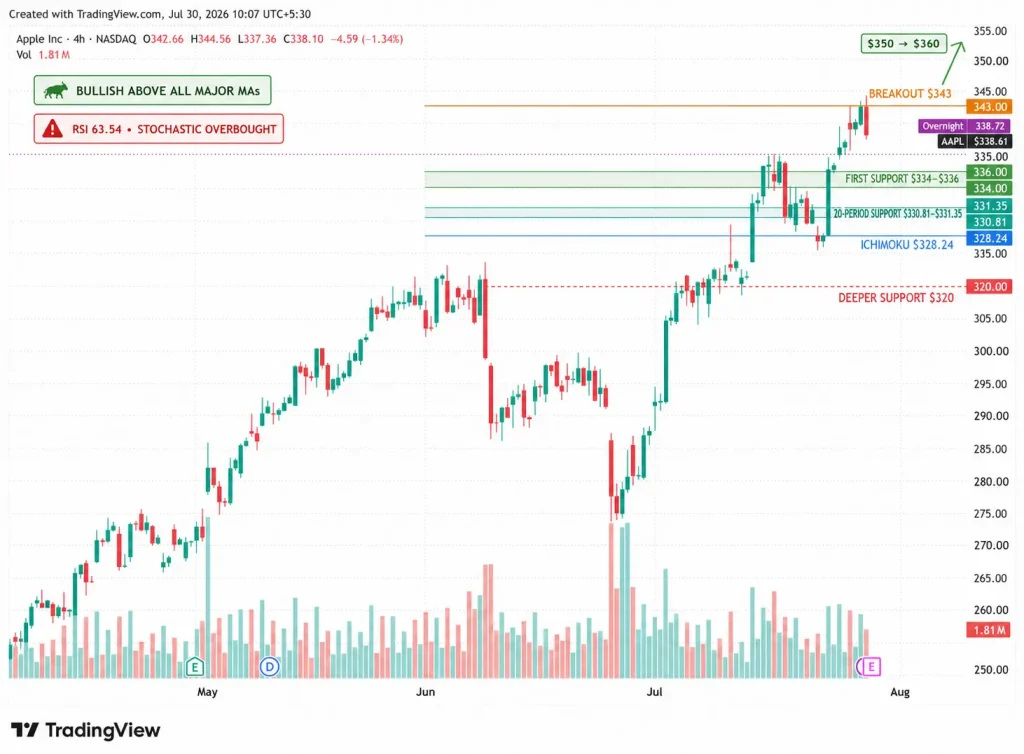
AAPL Chart 4-Hour – Can Apple Break Above $343 After Earnings?
The 30-period averages near $326.50 provide another important support zone. A deeper decline would expose the 50-period EMA at approximately $320.
The first upside barrier is the Hull moving average at $342.72. A decisive break above $343 could expose $350, followed by $360 if earnings produce a stronger-than-expected reaction.
Overbought Signals Warn of Profit-Taking
Momentum remains positive, but several oscillators indicate the rally is becoming stretched.
The RSI stands at 63.54, below the traditional overbought threshold of 70. MACD remains on buy at 6.39.
However, Stochastic %K is at 86.28 and the Commodity Channel Index stands at 114.88, with both giving sell signals. Momentum also shows a sell reading despite remaining positive.
These signals do not confirm an immediate reversal, but they increase the risk of profit-taking if earnings merely meet expectations.
Holding $334–$336 would keep the short-term uptrend intact. A break below $331 could expose $328 and then $320.
Options Market Prices a 4% Earnings Move
Apple options imply a post-earnings move of approximately 4% in either direction.
From a share price near $339, that produces a potential range of roughly $325 to $352.
The implied move is larger than Apple’s average reaction over its previous four earnings reports, which was approximately 1.7%.
However, this quarter carries more uncertainty because of Apple’s valuation, CEO transition and memory-cost pressure.
A strong report could send the stock toward $350–$352. A disappointing margin or China outlook could expose the $325 region.
Apple Earnings Could Decide Whether AAPL Breaks $343
Apple enters earnings with strong momentum, rising iPhone demand, record Services revenue and a capital-light AI strategy.
But the stock’s $5 trillion valuation leaves little room for disappointment.
A revenue and earnings beat combined with mid-teens Services growth, strong China demand and confident margin guidance could push AAPL above $343 and toward $350–$352.
Weak Services growth, cautious China commentary or greater memory-cost pressure could send the stock below $334 and toward $331–$328.
Apple’s business remains strong. The earnings challenge is proving that its fundamentals can continue rising as quickly as its valuation.
- Check out our free forex signals
- Follow the top economic events on FX Leaders economic calendar
- Trade better, discover more Forex Trading Strategies
- Open a FREE Trading Account
- Read our latest reviews on: Avatrade, Exness, HFM and XM

Related Articles



Sidebar rates

Related Posts
 Save
Save