Sasol Share Price (JSE: SOL) Falls Below R200 Again as Oil Rally Fades and Hormuz Tensions Ease
Sasol shares have reversed lower after a strong July recovery, falling back below R200 as cooling oil prices and easing Middle East tensions undermine the energy rally, despite stronger FY26 operating performance and increased PIC ownership supporting the longer-term recovery story.
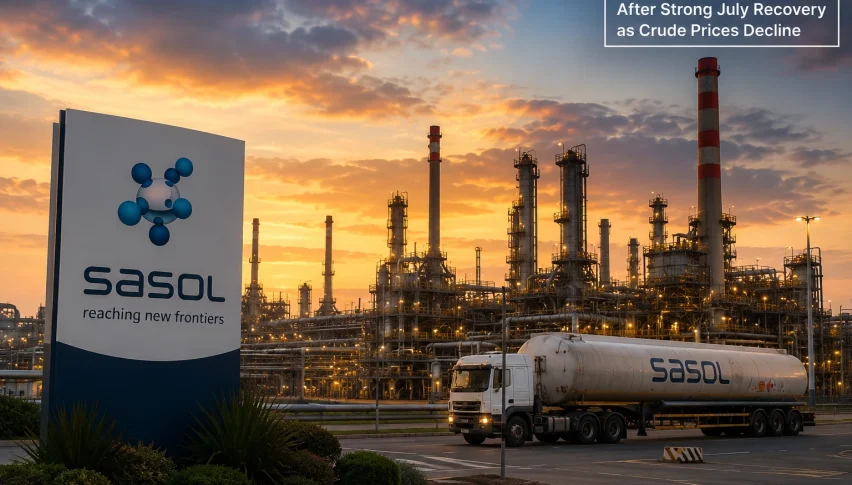
Sasol shares have reversed lower after a strong July recovery, falling back below R200 as cooling oil prices and easing Middle East tensions undermine the energy rally, despite stronger FY26 operating performance and increased PIC ownership supporting the longer-term recovery story.
Sasol Shares Reverse Below R200 as Oil Prices Cool and Middle East Tensions Ease
Sasol Limited shares have lost momentum after staging a powerful recovery during July, falling back below the important R200 level as crude oil prices retreated following renewed hopes for a ceasefire in the Middle East. The reversal has come despite stronger-than-expected FY26 operational performance, increased ownership by the Public Investment Corporation, and efforts to strengthen the company’s balance sheet.
The pullback highlights the continued sensitivity of Sasol’s share price to global oil prices and geopolitical developments. After suffering a brutal selloff in June, the stock briefly recovered above R200 as crude prices surged and investors returned to energy-related shares. However, the latest decline shows that confidence remains fragile.
Sasol Shares Reverse Below R200
Sasol was among the weaker performers on the JSE during June, with its share price falling close to 40% as declining crude oil prices, commodity weakness, and broader market pressure weighed heavily on sentiment.
The stock approached a critical support area near R150 before beginning a sharp recovery in early July.
As oil prices rebounded and geopolitical tensions intensified, Sasol shares climbed back above R200, marking a significant improvement from the June lows.
However, the recovery has now started to reverse.
The renewed decline has pushed SOL JSE back below R200, raising questions about whether the stock can maintain its July recovery. The R200 level has become an important psychological area, and failure to reclaim it could leave the shares vulnerable to further weakness if oil prices continue falling.
Strong FY26 Operations Provide Fundamental Support
Despite the latest share-price pressure, Sasol delivered a relatively encouraging operational update.
The company said it met or exceeded market guidance across its key production and sales metrics for FY2026, supported by improved performance during the final quarter.
Secunda Operations recorded their highest annual production in five years. The improvement was supported by the successful implementation of the destoning project, better natural gas availability, and more stable operational performance.
The Natref refinery also maintained solid performance during the quarter, although ORYX GTL remained offline following earlier disruptions to gas supplies.
Liquid fuel sales volumes increased year over year, benefiting from improved refining margins. However, quarterly sales remained exposed to fuel price volatility and increased fuel imports into South Africa.
Sasol has also completed its FY27 oil hedging programme and continues managing its rand-dollar exposure through currency hedging, providing some protection against the sharp swings in commodity prices and exchange rates.
Falling Oil Prices Threaten the Recovery
The most important driver behind Sasol’s July rebound was the recovery in crude oil prices.
WTI crude initially traded near $67 per barrel as the market assessed global supply conditions and geopolitical developments. The weakness in oil prices contributed to intense selling pressure in Sasol shares during June.
However, the situation changed rapidly as Middle East tensions escalated.
WTI subsequently moved above $90 per barrel, while Brent crude briefly climbed above $100. The dramatic increase in oil prices provided a major boost to sentiment across energy stocks and helped Sasol shares recover above R200.
That support has now weakened.
As hopes for renewed negotiations and a ceasefire increased, crude prices cooled, removing one of the key catalysts behind Sasol’s recent recovery. Although Sasol’s business is diversified across fuels, chemicals, refining, and synthetic fuel production, its shares remain highly sensitive to broader energy-market sentiment.
Middle East Ceasefire Hopes Weigh on Crude
The latest decline in oil prices has been closely linked to easing tensions in the Middle East.
U.S. President Trump said that “very friendly negotiations” were underway regarding the conflict with Iran and expressed optimism that an agreement could eventually be reached.
The pause in military strikes followed nearly two weeks of escalating attacks and renewed concerns about potential disruptions to energy supplies through the Strait of Hormuz.
The earlier escalation had pushed Brent crude above $100 for a brief period, providing a powerful boost to energy stocks.
However, the subsequent easing of tensions has reversed part of that move. For Sasol investors, lower oil prices represent a potential headwind just as the stock attempts to stabilize following its severe June decline.
Resuming the Uptrend After the Pullback
Shares of Sasol staged a notable recovery in 2026 after pulling back to the R150 level on the JSE. That support zone attracted buyers, triggering a sharp rebound above R170, helped by the 200 SMA. Sentiment remains cautious though, with traders still mindful of ongoing volatility and mixed forecasts across the energy market.
SOLJ Chart Daily – The 100 SMA Turns Into Resistance

Now the R200 has been broken, and if the price stays below that level, then it would open the door for further declines for JSE: SOL but if the rebound continues, buyers need to push above the daily moving averages to climb above R200.
Technical Levels Come Back Into Focus
From a technical standpoint, Sasol’s chart could suggest a trend reversal in 2026 after being bearish since 2022. In June, the stock successfully reclaimed its 50-week simple moving average (yellow), reigniting buying interest and confirming a medium-term trend shift.
That level, currently around R150, has since acted as a key support zone and it held strong despite the temporary piercing below it.
SOLJ Chart Weekly – The 50 SMA Held as Support

The 100-week moving average (green) which rejected the bounces higher twice was broken in February and the 200 weekly SMA (purple) was broken too as buyers pushed the price above R200 level. But during the pullback the price fell below the 200 SMA, which might turn into resistance now.
SOLJ Chart Monthly – Failing at the 100 SMA Resistance

On the monthly chart above the 20 SMA (gray) was acting as a resistance indicator, which rejected the price but we saw a clear break last month and turned into support. In March, buyers broke the 50 monthly SMA (yellow) but they failed to break above the 100 SMA (green) which rejected the price and SOLJ shares several times are reversing lower now.
PIC Increases Sasol Ownership
Sasol also received support from increased institutional ownership.
The Public Investment Corporation acquired an additional 5.14% stake in Sasol on July 13, 2026. Following the transaction, the PIC’s total ownership increased to 20.189% of Sasol’s issued ordinary shares, from approximately 15.049%.
The move is significant because the PIC is one of South Africa’s largest institutional investors and manages assets on behalf of the Government Employees Pension Fund.
Although the increased stake does not directly improve Sasol’s operational performance, it could be interpreted as a sign of longer-term confidence in the company’s valuation after the significant decline in its share price.
Strategic Projects Continue
Sasol continues to pursue several initiatives aimed at improving its long-term position.
The company has submitted a gas price application to Nersa, restarted a paraffin production unit in Italy, and continued implementing its enterprise resource planning system.
The group is also expanding its renewable energy portfolio, with operational renewable capacity now exceeding 500MW.
One of the key projects is a power purchase agreement with Enel Green Power RSA linked to the Impofu Wind Farm cluster in the Eastern Cape. The project consists of three wind farms with combined generating capacity of approximately 330MW and is expected to supply renewable electricity to Sasol’s Secunda operations.
The transition toward renewable energy remains important as Sasol attempts to reduce its dependence on coal-based electricity and lower the emissions intensity of its operations.
Balance Sheet Measures Offer Some Stability
Sasol has also continued taking steps to strengthen its financial position.
The company recently completed a $416 million repurchase of notes due in 2028, issued new senior notes maturing in 2033, and launched a tender offer for outstanding 2029 bonds.
These measures could help extend debt maturities, improve liquidity, and reduce refinancing risks.
However, recent financial results continue to highlight the cyclical nature of Sasol’s business. Net income for the six months ending December 2025 fell sharply to R241 million from R4.6 billion a year earlier, reflecting weaker commodity prices, operational disruptions, and impairment charges.
Although Sasol maintained positive free cash flow and continued to demonstrate capital discipline, the latest decline below R200 shows that the recovery remains vulnerable.
For now, the direction of oil prices remains a critical factor. If crude prices continue cooling as Middle East tensions ease, Sasol shares could struggle to regain their July momentum. Conversely, renewed geopolitical risks or a recovery in oil could once again support the stock. The immediate challenge for buyers is therefore to stabilize the share price above R200 and rebuild momentum after the latest reversal.
Sasol 2025 Earnings Report
📊 Financial Performance
Adjusted EBITDA:
- Declined 12% YoY to R21 billion
- Impacted by weaker commodity prices and a stronger rand
Cost Discipline:
- Cash fixed costs down 2% to R34 billion
- Capital expenditure reduced 43% to R8.5 billion
Free Cash Flow:
- Positive R0.8 billion
- First positive FCF in four years
- Improvement of more than 100% versus the prior period
Impairments:
- Total impairments of R7.8 billion
- R3.0bn (Secunda)
- R3.9bn (Mozambique PSA)
- R0.5bn (CTT)
- EBIT declined 52%
Net Debt:
- Stood at US$3.8 billion
- Slightly above long-term target of below US$3 billion
- Year-end target set below US$3.7 billion
⚙️ Operations & Safety
- Management highlighted safety focus following a fatal incident
- Secunda production increased 10%
- De-stoning plant now operating at full capacity
- Gas startup delays and revised PSA volumes slowed monetization
- Throughput remained constrained despite operational improvements
🌱 Grow and Transform Strategy
- Over 1.2 GW of renewables contracted toward 2 GW by 2030 target
- Secured approximately 9 million tonnes of carbon offsets
- Zaffra JV awarded EUR 350 million grant
- Targeting ~2,000 barrels per day eSAF production
- First production expected around 2030
Operational Improvements Support Outlook
Operationally, Sasol is showing signs of improvement.
- Enhanced coal quality at Secunda has boosted production output
- The recovery of the Natref refinery has improved fuel supply capacity
- Fuel sales expectations for 2026 have been revised higher
- Check out our free forex signals
- Follow the top economic events on FX Leaders economic calendar
- Trade better, discover more Forex Trading Strategies
- Open a FREE Trading Account
- Read our latest reviews on: Avatrade, Exness, HFM and XM

Related Articles


Sidebar rates

Related Posts
 Save
SaveAva