APLD Stock Rebounds Above $27 as Revenue Surges 407% and AI Backlog Reaches $36 Billion
Applied Digital stock APLD rebounds above $27 after revenue surged 407% and its AI data-center lease backlog reached $36 billion.

Applied Digital stock rebounded above $27 after a historic revenue beat and $36 billion of contracted leases strengthened its AI growth story, although debt, losses and execution risks remain.
APLD Stock Jumps 2.6% After Blowout Q4 Results but Bearish Technical Structure Limits the Recovery
Applied Digital shares are attempting to recover after the company delivered one of the strongest earnings surprises in the artificial intelligence infrastructure sector.
APLD fell $0.82, or 3%, to $26.38 during regular trading before rebounding 2.71% to approximately $27.09 overnight.
The recovery followed fiscal fourth-quarter results that dramatically exceeded Wall Street expectations. Revenue increased more than fivefold, adjusted earnings turned positive and the company added approximately $20.2 billion of long-term contracted lease revenue during the quarter.
The results provide evidence that Applied Digital’s rapid expansion into high-performance computing and AI data centers is beginning to generate significant revenue.
However, investors must balance that growth against a $111.6 million quarterly net loss, $5 billion of debt, substantial capital requirements and dependence on a limited number of hyperscale customers.
Applied Digital Revenue Surges 407%
Applied Digital reported fiscal Q4 revenue of $258.7 million for the period ending May 31, representing year-over-year growth of 407%.
The result was more than 170% above the analyst consensus estimate of approximately $95 million.
Adjusted earnings reached $0.04 per diluted share, beating expectations for a loss of around $0.19 by $0.23. Adjusted net income was $12.9 million.
Adjusted EBITDA increased to $42.4 million from only $1 million in the corresponding quarter a year earlier, showing that the company’s expanding data-center operations are beginning to produce greater operating leverage.
Services revenue reached $208.2 million, while data-center rental and other revenue contributed approximately $50.6 million.
Applied Digital’s high-performance computing hosting business generated $203 million, including $152.4 million from tenant fit-out services, $44.1 million in base rent and $6.5 million in tenant recoveries.
These figures demonstrate that Applied Digital has moved beyond being a speculative data-center developer. Its facilities are increasingly generating substantial construction, rental and service revenue.
However, tenant fit-out revenue can be less recurring than base rent. Investors will therefore focus on how quickly the company’s long-term leases translate into stable rental income.
$36 Billion Contracted Backlog Transforms the Growth Story
The most important development was Applied Digital’s expansion of contracted AI data-center capacity.
The company ended the quarter with approximately 1.41 gigawatts of contracted critical IT load across its campuses, representing roughly $36 billion of aggregate base-term lease revenue.
Applied Digital signed three new 15-year take-or-pay leases with the same high investment-grade hyperscale customer. The agreements cover Polaris Forge 1, Polaris Forge 2 and Polaris Forge 3 across three states and two regions.
Two of the campuses represent approximately $7.5 billion each in contracted base-term revenue, while the third adds about $5.2 billion.
Together, the new agreements contributed approximately $20.2 billion of contracted revenue during the quarter.
Take-or-pay leases can provide greater revenue visibility because customers commit to paying for reserved capacity over extended periods. This structure could help Applied Digital support project financing and reduce some of the uncertainty surrounding future data-center demand.
Nevertheless, contracted revenue is not the same as immediately recognized revenue. The company must complete construction, deliver power and cooling infrastructure and meet contractual milestones before the full economic value can be realized.
Additional Leases Could Add More Than $6 Billion
Applied Digital is also negotiating potential expansion agreements totaling approximately 250 megawatts.
The company is in advanced discussions with two existing investment-grade customers regarding 100 megawatts at Polaris Forge 2 and another 150 megawatts at a Delta Forge campus.
If completed, the agreements could lift contracted capacity to around 1.66 gigawatts and add more than $6 billion in long-term revenue based on current rates and lease durations.
Management expects future agreements to command higher pricing because demand for powered data-center capacity continues to exceed available supply.
Applied Digital is marketing another 1.7 gigawatts across several states and sees a path toward more than 5 gigawatts of critical IT load by 2032.
This creates substantial long-term potential.
However, the more aggressively Applied Digital expands, the more capital it must raise and deploy before the campuses begin generating cash. Growth therefore increases both the opportunity and the execution risk.
Net Loss and Stock Compensation Remain Major Concerns
Despite the adjusted profit, Applied Digital reported a net loss attributable to common shareholders of $111.6 million, or $0.39 per share.
Selling, general and administrative expenses rose to approximately $165.3 million, primarily because of $116.8 million in stock-based compensation.
That amount included $47.9 million in one-time awards connected to the ChronoScale transaction and $65.1 million associated with performance stock units.
One-time compensation expenses may not repeat at the same level, but the size of the charges highlights the difference between Applied Digital’s adjusted results and its GAAP profitability.
The company’s high-performance computing operations produced net operating income of $39.9 million under management’s definition, representing a 91% margin on base rental revenue after selected property-level expenses.
That margin demonstrates the attractive economics that completed facilities could eventually produce.
However, corporate costs, financing expenses, stock compensation and depreciation must still be considered when evaluating the profitability of the entire company.
Financing Reduces Near-Term Risk but Debt Reaches $5 Billion
Applied Digital completed several large financing transactions to support its construction program.
These included $2.15 billion of 6.75% senior secured notes for Polaris Forge 2, a $300 million bridge facility led by Goldman Sachs, a revolving credit facility of up to $550 million and $1.59 billion of 7% senior secured notes for another building at Polaris Forge 1.
The company said it has secured financing for the full 400 megawatts at Polaris Forge 1 and 200 megawatts at Polaris Forge 2.
Applied Digital ended the quarter with approximately $4.2 billion in cash and $5 billion in debt. Much of the cash is connected to specific projects and cannot necessarily be treated as unrestricted corporate liquidity.
Capital expenditure is expected to reach approximately $600 million in the coming quarter and could rise as additional campuses enter more intensive construction phases.
The financing package lowers the immediate risk that key projects will run out of capital. However, it also creates significant fixed obligations.
Applied Digital must complete projects on schedule, control construction costs and ensure customers begin paying rent as expected. Delays could pressure cash flow while interest expenses continue accumulating.
Customer Concentration Creates Another Risk
Applied Digital’s contracts with investment-grade hyperscalers provide greater financial security than leases with smaller customers.
However, the company appears increasingly dependent on a limited number of large counterparties.
The same customer signed all three of the newest 15-year leases, accounting for approximately $20 billion of contracted revenue. Losing a major customer or renegotiating a large agreement could therefore have a substantial effect on the company’s outlook.
Demand for AI computing remains exceptionally strong, but the economics of large data centers are still evolving.
If hyperscalers reduce capital expenditure, develop more capacity internally or demand lower lease rates, operators such as Applied Digital could face pressure.
Power availability and supply-chain constraints also remain major obstacles. Management has identified electricity, equipment and construction labor as the principal limits on growth.
APLD Technical Outlook Remains Bearish Below $29
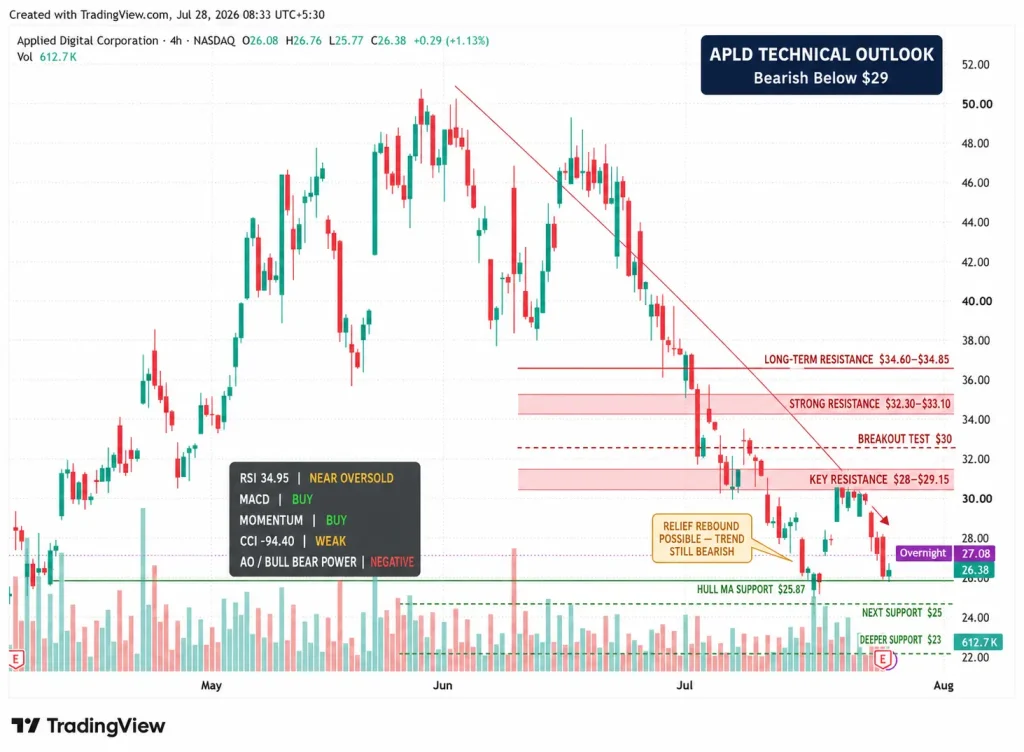
From a technical perspective, Applied Digital’s four-hour chart remains weak despite the overnight rebound.
At $26.38, APLD is trading below every major simple and exponential moving average. The Hull moving average at $25.87 is the only listed average showing a buy signal and represents the first short-term support.
The overnight recovery to approximately $27.09 leaves the stock below the 10-period EMA at $27.98 and the volume-weighted moving average at $28.08.
A cluster of resistance between $28 and $29.15 includes the 20-period SMA, Ichimoku baseline, 20-period EMA, 10-period SMA and 30-period SMA.
A sustained break through this region could allow APLD to challenge the psychological $30 level. Stronger resistance sits around $32.30–$33.10, followed by the long-term averages near $34.60–$34.85.
Momentum indicators suggest the selloff may be losing force. The RSI stands at 34.95, placing the stock close to oversold territory.
MACD and Momentum both show buy signals, while the Commodity Channel Index at -94.40 reflects continued weakness without reaching an extreme reading.
However, the Awesome Oscillator and Bull Bear Power remain negative. These signals suggest a relief rebound is possible, but the broader trend remains bearish until APLD recovers at least $29–$30.
On the downside, failure to hold $25.87 could expose $25, followed by a deeper test near $23.
Applied Digital Faces a Major Execution Test
Applied Digital’s fiscal fourth quarter transformed the scale of its AI infrastructure story.
Revenue growth of 407%, positive adjusted earnings and approximately $36 billion of contracted lease value demonstrate that hyperscalers are committing substantial capital to its data-center platform.
Management’s target of reaching a $1 billion annualized net operating income run rate within about a year provides another potentially powerful catalyst.
However, the company must now convert signed contracts into completed, energized and cash-generating campuses.
High debt, continuing GAAP losses, substantial stock compensation, customer concentration and aggressive capital spending remain significant risks.
For now, the overnight move above $27 suggests investors are responding positively to the earnings beat. A break above $29–$30 would strengthen the technical recovery, while continued trading below that region would leave the stock vulnerable despite its improving fundamentals.
Applied Digital has built an enormous contracted AI pipeline. The next challenge is proving it can deliver that capacity profitably and without placing excessive pressure on its balance sheet.
- Check out our free forex signals
- Follow the top economic events on FX Leaders economic calendar
- Trade better, discover more Forex Trading Strategies
- Open a FREE Trading Account
- Read our latest reviews on: Avatrade, Exness, HFM and XM

Related Articles



Sidebar rates

Related Posts
 Save
Save