Boeing Stock Jumps 4.8% Above $220 as Revenue Beat and Cash Flow Offset Wider Q2 Loss
Boeing stock BA jumps 4.8% as revenue and cash flow beat forecasts, while Air Force One costs keep the earnings recovery uneven.
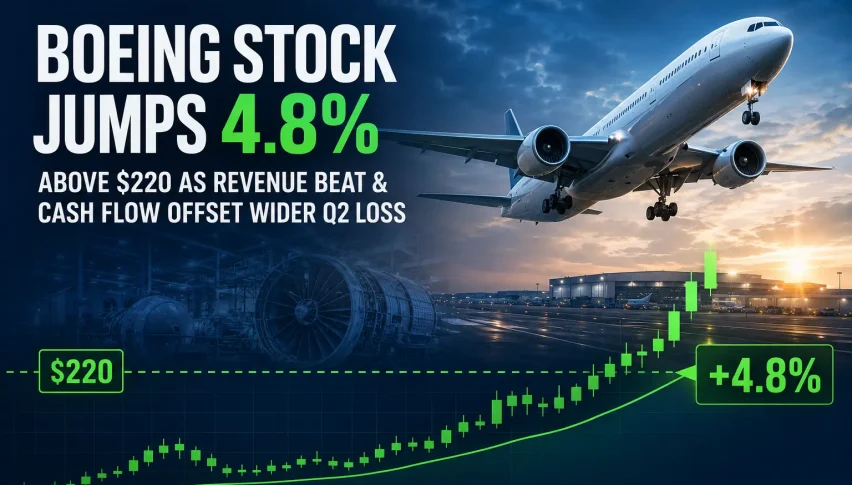
Boeing shares surged 4.76% to $221.56 after stronger revenue, positive free cash flow and rising aircraft deliveries outweighed a wider-than-expected adjusted loss and another costly Air Force One charge.
Boeing Stock Rallies Above $220 as Investors Focus on Cash Flow and Deliveries
Boeing shares climbed $10.06, or 4.76%, to $221.56 after the aircraft manufacturer reported stronger second-quarter revenue and positive free cash flow, encouraging investors to look beyond a larger-than-expected adjusted loss.
The rebound pushed BA stock back above the psychologically important $220 level, although overnight trading showed a modest 0.30% retreat to $220.90 as investors assessed whether the improving operational picture can develop into sustainable profitability.
Boeing Revenue Beat Overshadows Wider Earnings Loss
Boeing reported second-quarter revenue of $24.56 billion, an increase of 8% from the previous year and above Wall Street forecasts of approximately $24.0 billion to $24.25 billion.
However, the company posted a core loss of $0.76 per share, considerably worse than the roughly $0.30 loss expected by analysts. Its GAAP net loss narrowed to $428 million, or $0.67 per share, from $612 million and $0.92 per share a year earlier.
The mixed figures highlight the complicated nature of Boeing’s recovery.
Revenue, deliveries and cash generation are improving, but program charges, manufacturing costs and years of accumulated operational problems continue to prevent the company from producing consistent profits.
Investors nevertheless appeared willing to focus on the areas showing the clearest progress. Boeing generated $1.36 billion in operating cash flow and $631 million in free cash flow, reversing the $200 million free-cash-flow deficit recorded a year earlier. The result was also substantially stronger than the cash burn analysts had expected. Boeing’s official results showed the company ended the quarter with $20 billion in cash and marketable securities while reducing consolidated debt to $45.9 billion.
Commercial Aircraft Deliveries Strengthen the Recovery
Boeing’s commercial aircraft division provided the strongest evidence that its operational recovery is gaining momentum.
The company delivered 171 airplanes during the quarter, up 14% from 150 a year earlier and the highest quarterly total since 2018. Deliveries included 129 Boeing 737 aircraft and 25 Boeing 787 Dreamliners.
Commercial Airplanes revenue increased 8% to $11.75 billion, while its operating loss narrowed to $322 million from $557 million. The division’s negative operating margin improved from 5.1% to 2.7%, suggesting that higher deliveries, a more favorable aircraft mix and better production performance are beginning to reduce the financial pressure.
Boeing has started transitioning 737 production toward 47 aircraft per month and remains focused on reaching 52 per month later in 2026. Management also continues to target approximately 500 total 737 deliveries and between 90 and 100 Dreamliner deliveries for the year.
These targets are important because Boeing’s ability to generate stronger cash flow depends heavily on moving completed aircraft through its factories and delivering them to customers.
Record Backlog Provides Long-Term Visibility
Boeing’s total backlog reached a record $715 billion, including more than 6,200 commercial aircraft.
The Commercial Airplanes backlog alone was valued at approximately $597 billion after the division booked 246 net orders during the quarter. This gives Boeing substantial long-term revenue visibility at a time when airlines continue investing in newer and more fuel-efficient fleets.
However, a large backlog does not automatically eliminate execution risk.
Higher production rates will require stable engine deliveries, reliable suppliers and consistent factory quality. Any renewed disruption could delay aircraft deliveries, restrict cash generation and make Boeing’s full-year targets more difficult to achieve.
The next phase of the recovery will therefore depend less on demand and more on Boeing’s ability to convert its enormous order book into completed aircraft without sacrificing safety or quality.
Boeing Air Force One Charge Exposes Continuing Defense Risks
Boeing’s defense business remains one of the biggest obstacles to a cleaner turnaround.
Defense, Space & Security revenue increased 13% to $7.48 billion, but the division recorded a $15 million operating loss after producing a $110 million profit a year earlier. The result included a $280 million charge on the VC-25B program to develop two next-generation Air Force One aircraft.
The latest charge reflected additional production and certification resources required to maintain the planned 2028 delivery of the first aircraft. Because the program operates under a fixed-price contract, Boeing must absorb cost overruns rather than passing them to the U.S. government.
This structure has already generated billions of dollars in losses and leaves the company exposed to further charges if engineering complexity, supply-chain problems or schedule pressure increase.
The problem extends beyond Air Force One. Boeing is also still working with NASA to determine the schedule and requirements for future Starliner missions following technical problems during the spacecraft’s 2024 crewed test flight.
Management said it does not currently expect another Starliner charge before the spacecraft returns to flight, but uncertainty surrounding the program remains another reminder that Boeing’s fixed-price space and defense contracts can quickly undermine improving commercial results.
Certification Milestones Could Support Further Gains
Boeing continues to make progress on several delayed aircraft programs.
Certification flight testing has been completed for both the 737 Max 7 and Max 10, with certification still expected in 2026 and first deliveries planned for 2027. The 777X program has also received FAA approval to begin another phase of certification flight testing, while Boeing continues to anticipate its first delivery in 2027.
Successful certification would expand Boeing’s commercial product offering and help unlock additional backlog. However, further delays would create new costs and could weaken investor confidence just as the company appears to be restoring operational momentum.
BA Stock Breaks Above Its 4-Hour Moving Averages
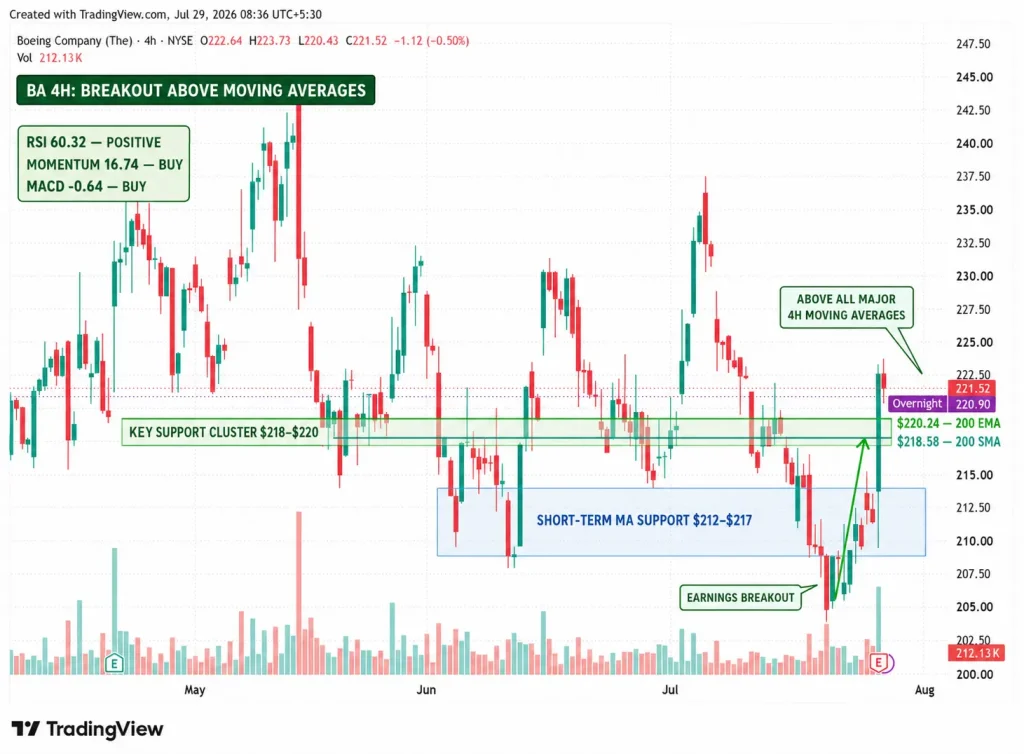
BA Chart 4-Hour – Moving Averages Turn Into Support Above $220
Boeing’s earnings rally has significantly improved the short-term technical picture.
At $221.56, BA stock is trading above every major moving average on the 4-hour chart. The 200-period exponential moving average stands at $220.24, while the 200-period simple moving average is at $218.58. The 100-period averages are positioned between $218.80 and $219.26.
This creates an important support cluster around $218–$220.
The shorter moving averages provide additional support between approximately $212 and $217, with the 50-period EMA at $216.74, the 30-period EMA at $215.12 and the 20-period EMA at $214.19.
Momentum is improving as well. The Momentum indicator is giving a buy signal at 16.74, while the MACD level has turned to buy despite remaining slightly negative at -0.64. The 14-period RSI stands at 60.32, indicating positive momentum without yet reaching a traditional overbought reading.
Overbought Signals Warn Against Chasing the Rally
The technical setup is constructive, but the rally is beginning to look stretched on some shorter-term oscillators.
Stochastic %K has climbed to 80.94, the Commodity Channel Index stands at 164.45 and Stochastic RSI has reached 95.43. Williams Percent Range is also showing a sell signal at -11.27.
These readings do not necessarily mean the rally must reverse, but they indicate that much of the immediate earnings optimism may already be reflected in the price.
If buyers maintain control above $220, Boeing could test the $225 region before attempting a broader move toward $230. A decisive break above that area would strengthen the bullish structure and bring the previous 52-week high near $254.35 back into focus.
However, failure to hold the $218–$220 moving-average cluster could encourage profit-taking toward $215. A deeper break below $212 would weaken the post-earnings structure and suggest the rally has failed to establish durable support.
Boeing’s Turnaround Faces a Critical Test
The positive market reaction shows investors are becoming more confident that Boeing’s manufacturing recovery is producing measurable results.
Higher deliveries, stronger revenue, positive free cash flow and a record backlog provide a more convincing recovery story than the company offered a year ago. Yet the wider-than-expected adjusted loss, Air Force One charge, certification risks and continuing defense-program uncertainty show that the turnaround remains incomplete.
For now, the technical picture favors buyers while BA remains above $218–$220. Holding that area could keep the stock on course for $225 and potentially $230.
A breakdown below the moving-average cluster would expose $215 and $212, particularly if investors begin focusing again on Boeing’s weak profitability and expensive fixed-price contracts. The next challenge will be proving that rising aircraft production can generate dependable profits without allowing legacy program costs to consume the recovery.
- Check out our free forex signals
- Follow the top economic events on FX Leaders economic calendar
- Trade better, discover more Forex Trading Strategies
- Open a FREE Trading Account
- Read our latest reviews on: Avatrade, Exness, HFM and XM

Related Articles


Sidebar rates

Related Posts
 Save
Save