MSFT Stock Tests $400 Before Microsoft Earnings as $40 Billion AI Spending Raises the Stakes
Microsoft stock MSFT tests $400 as Azure’s 40% growth target and a record AI spending bill raise the stakes before earnings.

Microsoft stock gained 1.09% to $393.35 and extended its advance to $396.35 overnight as investors positioned for an earnings report dominated by Azure growth, AI returns and record capital spending.
Microsoft Stock Approaches $400 Ahead of a Critical AI Earnings Test
Microsoft shares moved closer to the psychologically important $400 level ahead of the company’s fiscal fourth-quarter results, with investors preparing for one of the most demanding earnings tests of the current artificial intelligence cycle.
MSFT stock gained $4.25, or 1.09%, to $393.35 before advancing another 0.77% to $396.35 in overnight trading.
The rebound suggests optimism is returning after Microsoft fell more than 15% from its June high. However, the company now faces an unusually high performance bar as investors demand evidence that record infrastructure spending is producing sufficient growth in Azure, Copilot and Microsoft’s broader AI ecosystem.
Microsoft Faces a Much Higher Earnings Bar
Analysts expect Microsoft’s quarterly revenue to rise approximately 15% from a year earlier to around $87.5 billion, with earnings near $4.22 per share.
Those figures would represent another strong quarter for one of the world’s largest technology companies. Yet a routine earnings beat may no longer be enough to satisfy investors.
Microsoft has exceeded earnings expectations in recent quarters while frequently delivering Azure growth slightly above its own guidance. This quarter is different because management has already established a demanding target.
The company expects Azure and other cloud-services revenue to grow between 39% and 40% in constant currency. That follows growth of 40%, or 39% in constant currency, during the previous quarter.
Microsoft is therefore entering the report without the comfortable guidance cushion that supported earlier earnings surprises. Azure may need to exceed 40%, rather than merely reach it, to convince the market that AI demand continues to accelerate.
Azure Growth Must Justify Record AI Investment
Azure remains the most important operating figure in Microsoft’s earnings report.
During the fiscal third quarter, Microsoft generated revenue of $82.9 billion, up 18% year over year. Intelligent Cloud revenue increased 30% to $34.7 billion, while Azure and other cloud-services revenue rose 40%.
Microsoft also disclosed that its AI business had surpassed a $37 billion annual revenue run rate, growing 123% from a year earlier. Commercial remaining performance obligations reached $627 billion, up 99%, although that figure included substantial commitments from OpenAI.
These numbers demonstrate that Microsoft’s AI strategy is producing real demand. The unresolved question is whether that demand can generate attractive returns relative to the enormous cost of building the required infrastructure.
According to Microsoft’s previous earnings call, capital expenditure reached $31.9 billion in the third quarter. Management expects fourth-quarter spending to exceed $40 billion, with approximately $5 billion of the sequential increase connected to higher component prices.
For calendar 2026, Microsoft expects capital expenditure of roughly $190 billion.
That creates a difficult market equation. Investors want Microsoft to build enough data-centre capacity to meet demand, but they also want evidence that higher spending will not permanently weaken free cash flow or cloud margins.
AI Capacity Constraints Create Opportunity and Risk
Microsoft has repeatedly said that customer demand for cloud and AI services exceeds available capacity.
On one hand, this is a positive signal. Supply constraints indicate that Azure, AI models, Microsoft 365 Copilot and other enterprise products continue attracting strong demand.
On the other hand, capacity shortages can limit near-term revenue even as Microsoft spends aggressively to build more infrastructure.
Roughly two-thirds of the previous quarter’s capital expenditure went toward shorter-lived assets, primarily GPUs and CPUs. These assets can support faster revenue growth but also increase depreciation costs and place pressure on margins.
The remaining investment went into long-lived data-centre assets expected to support Microsoft’s infrastructure for 15 years or more.
Investors will therefore pay close attention to fiscal 2027 guidance. If management signals that capital expenditure must rise substantially again without a corresponding acceleration in Azure revenue, the stock could face renewed pressure.
Microsoft’s Backlog Provides an Important Safety Net
The $627 billion commercial remaining performance obligation is one of the strongest elements of Microsoft’s investment case.
Approximately one-quarter of that contracted revenue was expected to be recognized within 12 months, while the portion scheduled beyond that period increased sharply.
The backlog provides Microsoft with considerable revenue visibility and helps explain why management remains confident about expanding AI infrastructure despite the impact on near-term free cash flow.
Microsoft Cloud revenue reached $54.5 billion in the previous quarter, increasing 29%. However, the Microsoft Cloud gross margin declined to 66% as AI infrastructure costs and growing product usage offset efficiency improvements in Azure and Microsoft 365.
A strong earnings report would ideally combine Azure growth above 40% with reassuring commentary on cloud margins and long-term returns.
If Azure meets expectations but management raises spending forecasts without offering clearer evidence of monetization, investors may treat an otherwise solid quarter as a disappointment.
Copilot Adoption Could Become a More Important Catalyst
Microsoft’s AI strategy extends beyond renting computing capacity through Azure.
The company is integrating Copilot products into Microsoft 365, GitHub, Dynamics and its broader enterprise software portfolio. Paid Microsoft 365 Copilot seats exceeded 20 million in the previous quarter, while Microsoft 365 Commercial cloud revenue increased 19%.
This is important because first-party software can potentially generate higher-margin revenue than infrastructure alone.
Investors will be looking for updated Copilot adoption figures, evidence of stronger revenue per user and signs that enterprise customers are expanding from pilot programs into broader deployments.
Microsoft’s ability to monetize AI across applications could help reduce concerns that the company is investing primarily to support infrastructure-intensive workloads with uncertain returns.
Options Traders Prepare for a Large MSFT Move
The options market is pricing a post-earnings move of approximately 7% in either direction, implying a broad potential range between roughly $365 and $420 based on the pre-report share price.
Bullish positioning remains visible, with the put-to-call ratio on near-term contracts reportedly around 0.45. The upper end of recent options pricing sits near $413, suggesting traders see room for a breakout if Microsoft delivers stronger Azure growth and constructive fiscal 2027 guidance.
However, Microsoft’s recent earnings reactions have been unpredictable.
The stock has sometimes fallen despite exceeding headline expectations because investors focused instead on capital expenditure, margins or forward guidance. This makes the quality of the outlook more important than the initial revenue and EPS numbers.
MSFT Stock Faces Heavy Resistance Near $399–$405
Microsoft’s 4-hour technical structure is improving, but the recovery has not yet produced a decisive bullish breakout.
At $396.35 in overnight trading, MSFT is above its short-term moving-average cluster. The 10-period EMA stands at $390.89, the 20-period EMA at $390.64 and the 50-period EMA at $390.66.
The $390–$393 region therefore represents the first important support zone.
However, longer-period moving averages continue to create resistance. The 100-period simple moving average stands at $398.64, almost identical to the 200-period simple moving average at $398.65. The 200-period EMA is higher at $405.23.
This produces a major resistance band between $399 and $405.
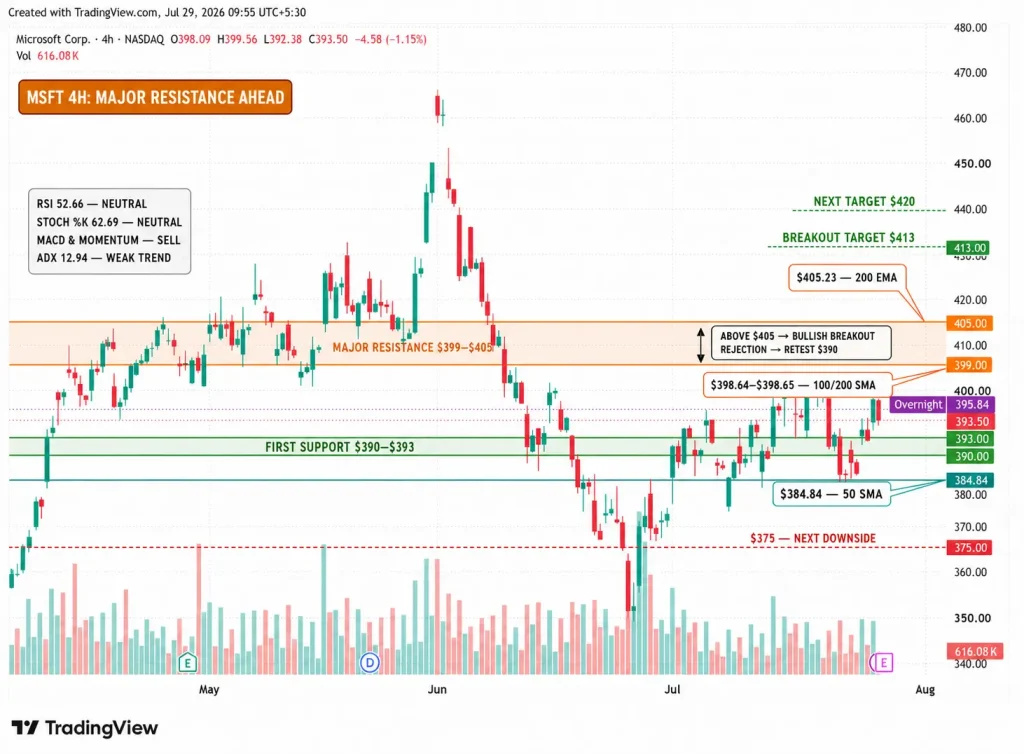
MSFT Chart 4-Hour – Can Microsoft Break the $399–$405 Resistance Zone?
A sustained move above $405 would strengthen the technical outlook and could expose the stock to $413, followed by the broader $420 area implied by the options market.
Failure at $399–$405 could send Microsoft back toward $390. A break below that short-term support cluster would expose the 50-period simple moving average near $384.84, with $375 becoming the next important downside area if the earnings reaction turns sharply negative.
Momentum Indicators Show No Clear Direction
The 4-hour oscillators remain mixed ahead of earnings.
The Relative Strength Index stands at 52.66, while Stochastic %K is at 62.69 and the Ultimate Oscillator is at 51.19. These neutral readings show that Microsoft is neither technically overbought nor oversold.
The Awesome Oscillator gives a buy signal, but Momentum and MACD are producing sell signals. The Average Directional Index is also weak at 12.94, indicating that the current trend lacks strong directional conviction.
This neutral setup increases the importance of the earnings catalyst. A strong report could quickly turn the moving-average structure bullish, while disappointing guidance could reverse the recent recovery.
Microsoft Earnings Could Decide the Next Major Move
Microsoft enters earnings with powerful cloud growth, a vast commercial backlog and one of the strongest enterprise AI positions in the market.
But expectations have caught up with the story.
Azure must now meet or exceed an unusually high growth target while management explains how more than $40 billion in quarterly capital expenditure will generate acceptable returns. A headline earnings beat without convincing guidance may not be enough.
If Microsoft delivers Azure growth above 40% and reassures investors about fiscal 2027 margins, MSFT stock could break through $405 and target $413–$420.
If Azure falls below 39%, or if another aggressive spending increase overshadows growth, the stock could lose $390 and retreat toward $385 or lower.
The $399–$405 zone now represents the critical technical test. Microsoft’s results will determine whether the recent rebound becomes a genuine breakout or another failed recovery within the stock’s broader correction.
- Check out our free forex signals
- Follow the top economic events on FX Leaders economic calendar
- Trade better, discover more Forex Trading Strategies
- Open a FREE Trading Account
- Read our latest reviews on: Avatrade, Exness, HFM and XM

Related Articles



Sidebar rates

Related Posts
 Save
SaveAva