META Stock Tests $590 Before Earnings as $145 Billion AI Spending Threatens Another Selloff
Meta earnings preview: Meta stock trades near $595 as a possible $145B AI spending bill threatens to overshadow 27% revenue growth.
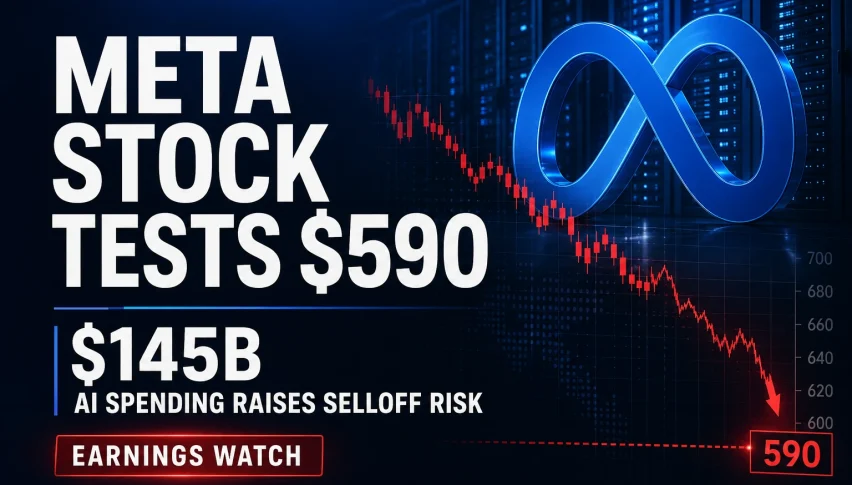
Meta stock remained near $595 before earnings as investors weighed powerful advertising growth against a potential $145 billion capital-spending bill and a deteriorating technical structure.
Meta Stock Struggles Near $595 as AI Spending Concerns Dominate Earnings
Meta Platforms shares traded cautiously ahead of the company’s second-quarter earnings report, with the stock falling 0.08% to $593.41 before recovering 0.31% to $595.26 in overnight trading.
The muted price action reflects a growing conflict surrounding Meta’s investment case.
The company’s advertising engine remains extremely strong, with revenue expected to increase approximately 27% from a year earlier. However, investors are increasingly concerned that enormous spending on data centres, AI chips and superintelligence research could place sustained pressure on free cash flow and margins.
For Meta, another revenue beat may not be enough. The more important question is whether management keeps its 2026 capital-expenditure guidance under control.
Meta’s Advertising Engine Faces a High Earnings Bar
Wall Street expects Meta to report second-quarter revenue of approximately $60.2 billion, up around 27% from $47.52 billion a year earlier.
Adjusted earnings estimates cluster near $7.18 per share, while advertising revenue is projected to reach roughly $59 billion.
Those figures would represent another strong quarter. Yet revenue growth is expected to slow from the 33% increase delivered during the first quarter, making advertising trends particularly important.
In the previous quarter, ad impressions across Meta’s Family of Apps increased 19%, while the average price per advertisement rose 12%. Advertising revenue climbed 33% to $55.02 billion.
The combination suggested that Meta’s AI systems were improving both engagement and advertising efficiency. Better recommendation algorithms can increase the time users spend on Facebook and Instagram, while stronger targeting helps advertisers generate more measurable returns.
Investors will be watching whether both impressions and pricing remain strong. A sharp slowdown in either metric could raise doubts about whether Meta’s rising AI expenses are still producing sufficient gains in its core business.
AI Capex Has Become the Most Important Number
Meta’s capital-spending plans now carry more market significance than the headline revenue figure.
The company spent $19.84 billion on capital expenditure, including finance-lease principal payments, during the first quarter. At the same time, management increased its full-year forecast to between $125 billion and $145 billion from the previous range of $115 billion to $135 billion.
That leaves approximately $105 billion to $125 billion to be spent during the remaining three quarters of 2026.
On average, Meta would need to deploy roughly $35 billion to $42 billion per quarter to reach its own forecast. This is more than double the $17.01 billion spent during the second quarter of 2025.
Analysts currently expect second-quarter capital expenditure of around $33 billion. A figure materially above that level, or another increase to the full-year range, could renew fears that Meta’s AI infrastructure requirements are becoming increasingly difficult to control.
The concern is not whether Meta can finance the spending. It finished the previous quarter with $81.18 billion in cash, cash equivalents and marketable securities and generated $12.39 billion in free cash flow.
The larger question is whether the investment will produce returns quickly enough to justify the scale.
Strong Q1 Results Failed to Protect META Stock
Meta’s previous earnings reaction provides a warning for shareholders.
The company reported first-quarter revenue of $56.31 billion, up 33%, while operating income increased 30% to $22.87 billion. Its operating margin remained at a powerful 41%.
Headline earnings reached $10.44 per share, although that figure included an $8.03 billion one-time income-tax benefit. Excluding the benefit, earnings would have been approximately $7.31 per share.
Despite the impressive results, Meta shares fell sharply after the report as investors focused on the higher capital-expenditure outlook.
The reaction demonstrated that strong advertising growth cannot automatically offset anxiety surrounding AI infrastructure. If Meta raises its spending guidance again, the stock could face another negative response even if revenue and earnings exceed expectations.
Meta’s first-quarter results also showed total costs and expenses increasing 35%, slightly faster than revenue. That relationship will remain important as the company hires expensive AI researchers and expands its computing capacity.
Meta Looks for New Ways to Monetize AI Capacity
Meta’s AI spending has traditionally supported its advertising platforms, recommendation systems and consumer applications rather than a public cloud business.
That may be starting to change.
The company is reportedly exploring ways to lease excess computing capacity to outside customers. Such a move could create an additional revenue stream and help Meta earn returns on expensive infrastructure when internal capacity is not fully utilized.
Investors will be listening for any details about a potential cloud offering, external computing agreements or the commercial strategy surrounding Meta’s latest AI models.
Meta is also using AI to strengthen WhatsApp, Instagram, Facebook and its smart-glasses business. Ray-Ban Meta glasses could receive particular attention during the earnings call as the company attempts to establish AI-powered hardware as a meaningful consumer category.
However, these newer products are unlikely to contribute enough near-term revenue to offset a major increase in infrastructure spending. For now, advertising remains responsible for nearly all of Meta’s financial strength.
Reality Labs Remains a Multibillion-Dollar Burden
Reality Labs continues to represent another major drain on profitability.
The division generated only $402 million in first-quarter revenue while recording an operating loss of approximately $4.03 billion. Management expects full-year Reality Labs losses to remain around the elevated levels seen in 2025.
Meta can currently absorb those losses because the Family of Apps business generates enormous operating profit. But the combination of Reality Labs deficits and rising AI investment creates a heavier spending burden.
If advertising growth slows, investors may become less willing to tolerate losses from long-term projects that lack clear monetization timelines.
The company must therefore demonstrate that its strongest business is growing fast enough to finance several expensive technology bets simultaneously.
META Stock Remains Below Major Moving Averages
Meta’s 4-hour technical picture has deteriorated significantly ahead of earnings.
At $595.26, the stock is below nearly every major exponential and simple moving average. The 10-period averages stand between $604.34 and $605.86, creating the first important resistance zone around $604–$606.
The 50-period simple moving average is at $610.87, while the 100-period EMA stands at $613.25. The 50-period EMA, 20-period EMA and 200-period EMA are grouped between approximately $616 and $621.
This creates a broad and difficult resistance band from $604 to $621.
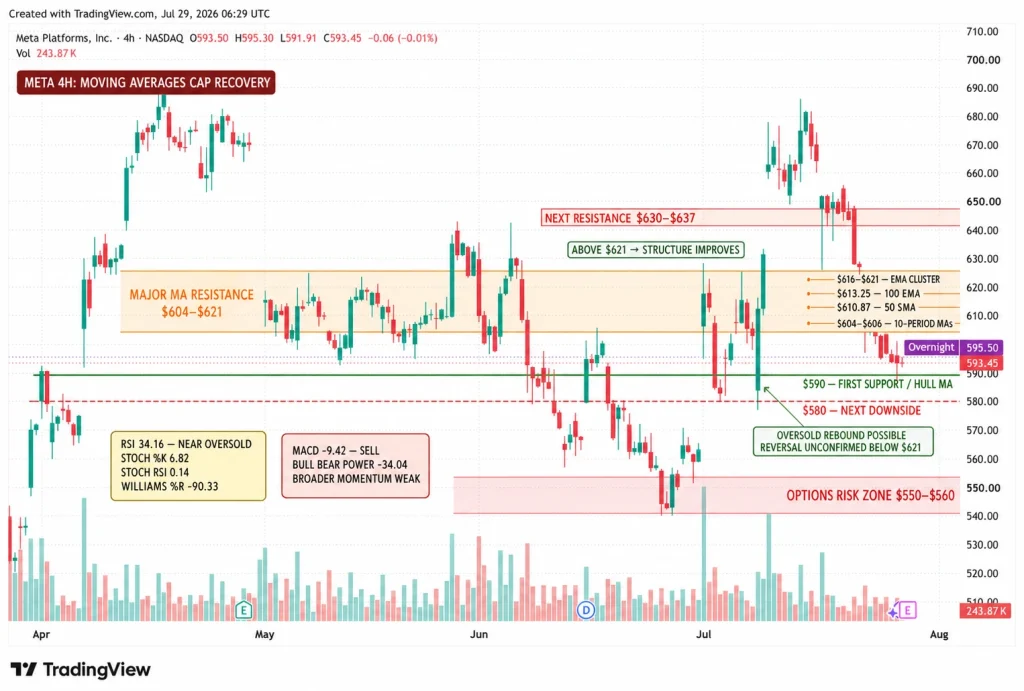
META Chart 4-Hour – Moving Averages Turn Into Resistance Above $600
A break above $621 would improve the short-term structure, but Meta would still face additional resistance near $630–$637. The 20-period simple moving average stands at $630.89, while the Ichimoku baseline and volume-weighted moving average are positioned close to $636.
Without a decisive earnings-driven breakout above this cluster, rebounds could continue attracting sellers.
Oversold Signals Could Trigger a Rebound
Although the moving averages remain bearish, several oscillators suggest that the selloff may be becoming stretched.
The Relative Strength Index stands at 34.16, approaching oversold territory. Stochastic %K has fallen to 6.82, Stochastic RSI is at only 0.14 and Williams Percent Range is at -90.33.
Williams Percent Range and Momentum are producing buy signals, while the Hull moving average at $589.99 also gives a short-term buy reading.
These indicators create the possibility of a technical rebound if earnings avoid another major spending shock.
However, the MACD remains on sell at -9.42, the Awesome Oscillator is deeply negative and Bull Bear Power stands at -34.04. These readings show that the broader 4-hour momentum remains weak despite oversold conditions.
The $590 area is now the first important support. A decisive break below it could expose $580, followed by the broader $550–$560 zone implied by the options market.
Options Traders Prepare for a Sharp META Move
The options market is pricing a post-earnings move of approximately 7% to 7.5% in either direction.
From a share price near $595, that implies a potential range of roughly $550 to $640.
Options positioning appears bullish, with a put-to-call ratio near 0.25 on contracts expiring at the end of the week. The upper end of options pricing sits close to $637, broadly matching an important technical resistance zone.
However, bullish positioning does not guarantee a positive earnings reaction.
Meta has delivered strong results before only to fall after management raised spending expectations. This makes capital-expenditure guidance and the third-quarter outlook more important than whether the company exceeds consensus by a small amount.
Meta Earnings Could Decide Whether $590 Holds
Meta enters earnings with one of the strongest advertising businesses in the global market.
AI is already improving ad recommendations, engagement and pricing, giving the company a clearer monetization path than many other large technology companies. Yet the scale of the infrastructure buildout has changed the market’s expectations.
A revenue and earnings beat combined with unchanged or narrower capital-expenditure guidance could send META back above $606 and toward $621. A decisive break above $621 would expose the important $630–$637 region.
But another increase to the $125–$145 billion spending range could overwhelm otherwise strong results.
If investors conclude that Meta’s AI bill is rising faster than its ability to monetize the investment, the stock could break below $590 and move toward $580 or even $550.
For now, Meta’s advertising performance remains impressive. The earnings reaction will depend on whether management can convince investors that the spending required to sustain that growth has not moved beyond control.
- Check out our free forex signals
- Follow the top economic events on FX Leaders economic calendar
- Trade better, discover more Forex Trading Strategies
- Open a FREE Trading Account
- Read our latest reviews on: Avatrade, Exness, HFM and XM

Related Articles


Sidebar rates

Related Posts
 Save
SaveAva