Avis Budget Group (CAR) Stock Surges 23% in Wild Short Squeeze Frenzy
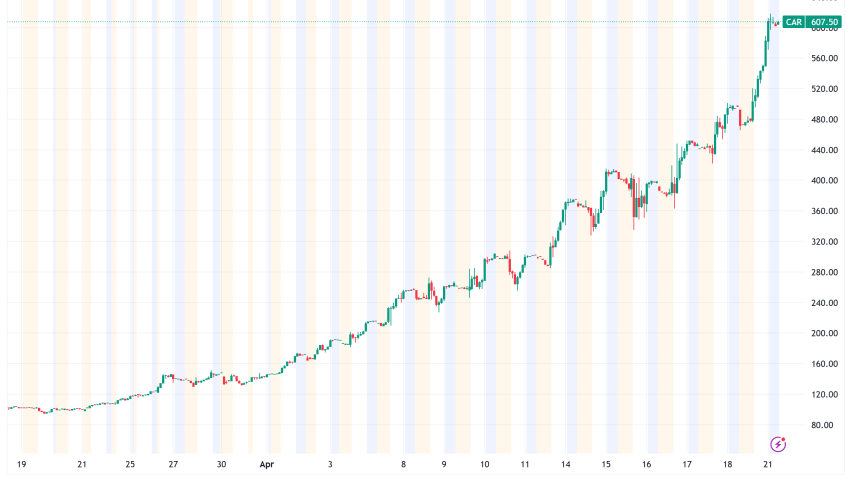
Avis Budget Group Inc. (NASDAQ: CAR) ended the day on Monday at $608.80, up 23.3% from the day before and more than five times what it was
Quick overview
- Avis Budget Group's stock surged 23.3% to $608.80, driven by one of the most intense short squeezes in recent years.
- The stock has increased over 374% this year, drawing comparisons to past meme-stock phenomena like GameStop and Volkswagen.
- Despite the rapid rise, analysts express caution, noting the stock is overvalued and trading at more than 150 times its estimated earnings.
- Concerns linger about potential selling by major shareholders, which could impact the stock's future performance.
Avis Budget Group Inc. (NASDAQ: CAR) ended the day on Monday at $608.80, up 23.3% from the day before and more than five times what it was worth a month earlier, when it was about $100. One of the most intense short squeezes in recent years is causing the sudden rise, and Wall Street is watching with both interest and fear.
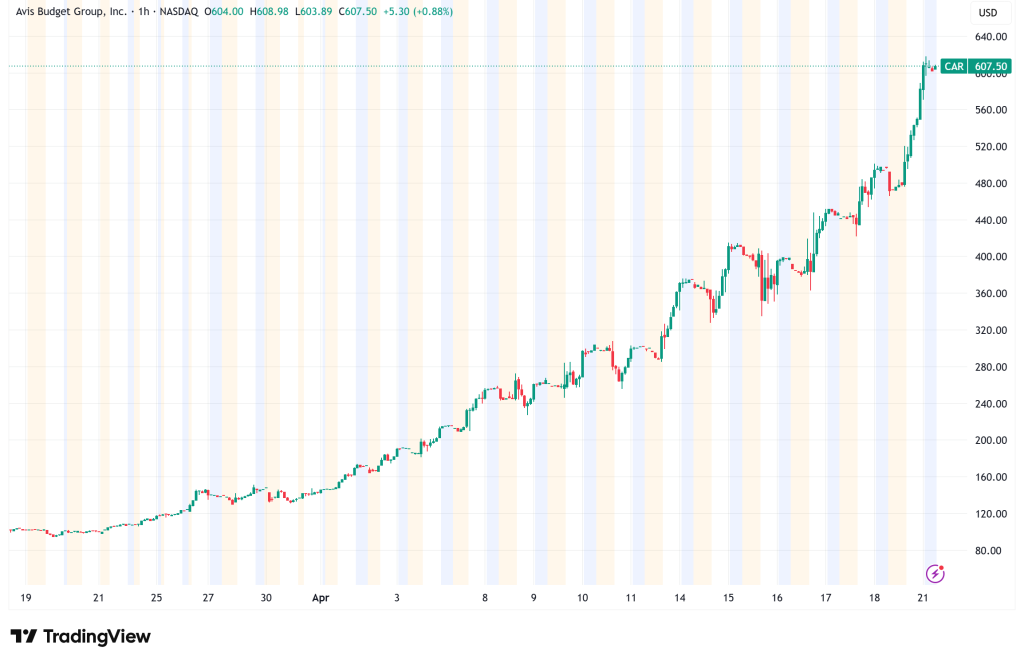
The stock has gone up over 374% this year, and many people are comparing it to the meme-stock crazes that happened with GameStop in 2021 and Volkswagen in 2008. In both of those cases, a huge gap between the number of shares available and the number of short-sellers looking for them caused prices to skyrocket to levels that had little to do with the business’s fundamentals.
How the Short Squeeze on Avis Stock Works
An odd ownership structure lies at the heart of the rally. SRS Investment Management and Pentwater Capital Management are two investors who own almost 71% of Avis’s outstanding shares. As of late March, SRS, which is led by Jagdeep Pahwa, who is also Avis’s executive chairman, had 17.4 million shares. Matthew Halbower runs Pentwater, which is situated in Florida and owns 7.8 million shares.
But the focus goes far beyond. Both companies also have cash-settled equity swaps that raise their aggregate economic interest to more than 100% of the shares outstanding. This is a very rare condition that makes it very hard for short sellers to get shares to cover their holdings.
As of March 31, there were almost nine million shares short, which was over 100% of the float that was publicly available. As the stock price has gone up, short sellers have had to buy back shares to limit their losses, which has pushed the price even higher. This is a typical short squeeze.
Dan Levy, an analyst at Barclays, said in a note on Monday that “at its core, the move is a function of a sharp supply/demand mismatch.” He lowered the stock’s rating to Underweight while lifting his price target from $95 to $150.
Wall Street Analysts Urge Caution on Avis (CAR) Stock
Even with the huge increases, Wall Street is still mostly doubtful. Levy said the surge was “all technical,” pointing out that Avis is currently trading at more than 150 times its estimated 2026 earnings of about $4 per share. This is a big change from its five-year historical median price-to-earnings ratio of just 4.2 times. GuruFocus’s own GF Value model says the stock’s fair value is $132.98, which means it is overvalued by almost 358% at the moment.
The company’s GF Score is 66 out of 100, with a weak 2 out of 10 for financial strength and a low 1 out of 10 for valuation. Avis has over $19 billion in fleet-related debt and $6 billion in corporate debt. This means that its total enterprise value is well over $40 billion at current share prices.
Business Fundamentals Improving, But Modestly
To be fair, the business itself has gotten a little better. Avis’s net loss for the full year 2025 was $889 million, down from $1.82 billion the year before. This was a 51% decrease. Revenues also fell slightly to $11.6 billion. The net loss in the fourth quarter was $747 million, which is over 62% less than the same time last year.
The business also registered in late February to possibly issue up to five million new shares. This might help it take advantage of the high stock price, but no sales under that program have been announced yet.
What’s Next for Avis Budget Group Investors?
The key concern for the market is whether SRS or Pentwater will start selling. Chris Woronka, an analyst at Deutsche Bank, thinks that sales in the foreseeable future are unlikely. As an insider, SRS probably can’t sell until Avis’s first-quarter earnings report comes out. On the other hand, securities laws may limit Pentwater’s options because they compel insiders to give back profits on deals made within six months of their last trade. This could imply that they have to stay in their position until at least late September.
The squeezing is still going on for now. But when prices are at all-time highs and there is no fundamental reason for them to be there, the rally is completely at the mercy of technical forces. History has demonstrated that these forces can change direction just as quickly as they speed up.
- Check out our free forex signals
- Follow the top economic events on FX Leaders economic calendar
- Trade better, discover more Forex Trading Strategies
- Open a FREE Trading Account
- Read our latest reviews on: Avatrade, Exness, HFM and XM

Related Articles

Sidebar rates

Related Posts
 Save
Save