ORCL Stock Fails to Resume Uptrend after SMCI Deal Break, Despite Google Cloud Expansion
Oracle Corporation shares fell sharply despite new cloud announcements, as investors focused on rising costs, margin pressure, and broader..
Quick overview
- Oracle Corporation shares fell over 5% despite new cloud announcements, as investors reacted to rising costs and broader software sector weakness.
- The company deepened its partnership with Google Cloud, enhancing its AI Database offering and expanding regional availability.
- Oracle's strategic pivot towards AI and cloud infrastructure is accompanied by concerns over rising debt and profit margins.
- Recent layoffs and a projected $50 billion capital expenditure raise questions about the sustainability of Oracle's aggressive growth strategy.
Live ORCL Chart
[[ORCL-graph]]
Oracle Corporation shares fell sharply despite new cloud announcements, as investors focused on rising costs, margin pressure, and broader software sector weakness.
Stock Reaction and Market Context
Oracle stock came under pressure on Thursday, reversing recent gains despite fresh cloud updates. Shares dropped more than 5% intraday, falling below $180 after closing at $187.50 the previous session, with premarket losses reaching as much as 3.8%.
The decline was driven less by company-specific news and more by a broader sell-off across software names, which overshadowed Oracle’s latest announcements tied to its expanding AI ecosystem.
Google Cloud Partnership and Expansion
Oracle announced new enhancements to its Oracle AI Database@Google Cloud offering, deepening its partnership with Google Cloud. Updates included a new AI agent designed for Gemini Enterprise, expanded regional availability, and tighter integration with Google’s data tools.
The platform is now available across 15 regions, reflecting growing global demand for cloud infrastructure. These developments reinforce Oracle’s push to position itself as a key provider of enterprise-grade AI services.
Strategic Pivot Toward Infrastructure
Oracle’s valuation is increasingly tied to its AI and cloud infrastructure business rather than its legacy software operations. A major focus is its GPU-as-a-service offering, which provides access to high-performance chips used for AI training and inference.
While demand in this segment is strong, investors are increasingly concerned about the associated costs, including rising debt levels, infrastructure spending, and pressure on profit margins.
Super Micro Fallout Adds Pressure
Adding to the negative sentiment, Super Micro Computer shares also declined following reports that Oracle canceled a major hardware order.
The canceled deal involved 300 to 400 racks of Nvidia GB300 NVL72 systems, representing an estimated revenue loss of between $1.1 billion and $1.4 billion for Super Micro. The development raised concerns about demand visibility and spending consistency within Oracle’s AI infrastructure rollout.,
Technical Signals Reflect Stabilizing Price After the Fall
From a technical perspective, Oracle’s price action reinforces the fundamental unease. On longer-term charts, the stock has slipped below the 20 monthly moving average (gray) at $185 that previously acted as support and might turn into resistance. The 50 SMA (yellow) has been holding and we saw a rebound earlier this month, but buyers are facing the 20 SMA (gray) as resistance now.
ORCL Chart Monthly – Buyers hesitate to break the 20 SMA

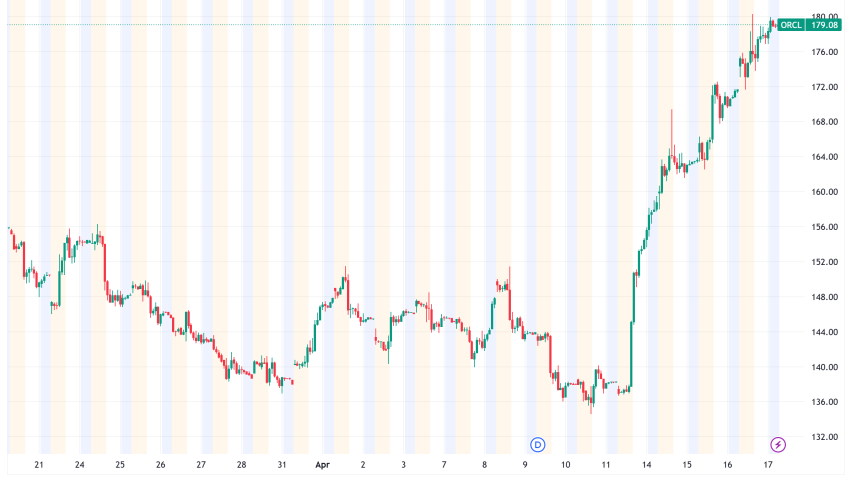
On shorter timeframes, rebounds have consistently failed near resistance levels, forming a clear pattern of lower highs, so we’ll see where this week’s rebound will end. On the daily chart, the 50 SMA (yellow) has been acting as resistance, rejecting the price and pushing the stock lower, sending ORCL back down below $135 last month. But the $135 support zone held once again and the rebound pushed ORCL to the 100 SMA (red), which turnbed into resistance and rejected the price.
ORCL Chart Daily – Failing at the 100 SMA

Agentic AI Applications
At the core of Oracle’s transformation is the launch of 12 agentic AI applications embedded within its Fusion Cloud platform. These tools are designed for finance and supply chain operations and go beyond traditional AI assistants.
Unlike standard systems, these applications can proactively identify issues, make decisions, and execute tasks autonomously within defined parameters. Integrated into Fusion Cloud ERP and supply chain solutions, they represent a shift toward fully automated enterprise workflows.
Product Upgrades and Global Expansion
Oracle also introduced AI-driven enhancements to its Utilities Industry Suite and Aconex platform, aimed at improving efficiency and reducing operational costs for enterprise clients.
In parallel, the company launched a new cloud region in Casablanca, Morocco, underscoring its commitment to expanding its global infrastructure footprint and meeting localized demand for cloud services.
Leadership Change and Strategic Direction
The appointment of Hilary Maxson as Chief Financial Officer signals a shift toward infrastructure-heavy growth. Her background aligns with Oracle’s increasing focus on large-scale data center expansion and capital-intensive operations.
This leadership change highlights the company’s transition from a traditional software model to a cloud and AI infrastructure-driven business.
Cost Pressures and Workforce Reductions
Oracle has initiated widespread layoffs across its global workforce, impacting tens of thousands of employees. These measures are intended to offset the rising costs associated with scaling its cloud and AI capabilities.
While cost-cutting may support margins in the near term, it also reflects the financial strain of Oracle’s aggressive investment strategy.
Massive Capex Raises Investor Questions
A key concern for investors is Oracle’s projected $50 billion capital expenditure for fiscal 2026. The company is investing heavily in data centers, AI infrastructure, and high-performance computing capacity.
These investments are critical for long-term growth but introduce execution risk. If demand does not keep pace with spending, profitability could remain under pressure.
Outlook: Growth vs Discipline
Oracle’s expansion continues to attract attention, but the market response highlights a growing tension. While innovation and expansion are clear, investors are increasingly focused on cost control, margins, and return on investment.
The path forward will depend on Oracle’s ability to balance aggressive growth with financial discipline in an increasingly competitive AI landscape.
- Check out our free forex signals
- Follow the top economic events on FX Leaders economic calendar
- Trade better, discover more Forex Trading Strategies
- Open a FREE Trading Account
- Read our latest reviews on: Avatrade, Exness, HFM and XM

Related Articles
Sidebar rates

Related Posts
 Save
Save