USD/INR at 96.29: Indian Rupee Hits Record Low as Iran War Rattles Forex Markets
USD/INR: Indian rupee hits record low of 96.25 vs dollar as Iran war drives oil above $111. RBI intervenes; analysts warn of 98–100 ahead.
Quick overview
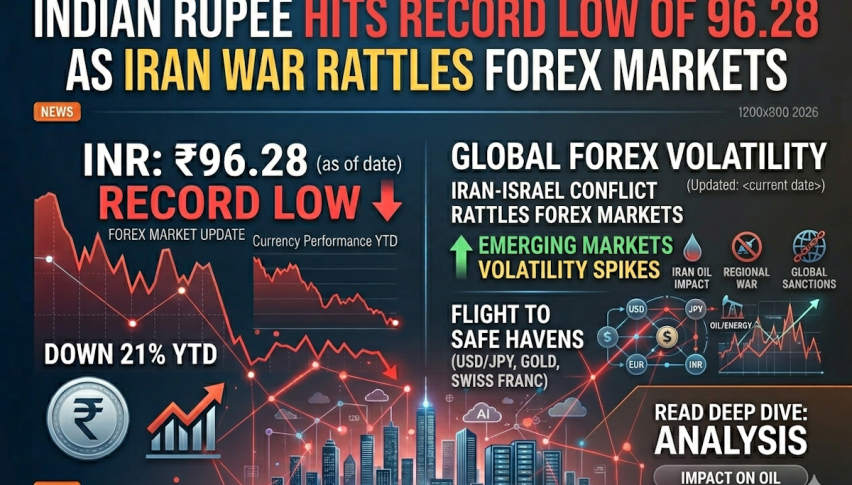
- The Indian rupee fell to an all-time low of 96.28 against the US dollar, driven by rising crude oil prices and the ongoing US-Iran conflict.
- The Reserve Bank of India and the government have implemented measures to stabilize the currency, including import curbs on precious metals and restrictions on speculative trading.
- Analysts predict continued pressure on the rupee, with forecasts suggesting it could reach 100 if the geopolitical situation does not improve.
- The weakening rupee has negatively impacted Indian equity markets, with significant drops in major indices despite some foreign institutional buying.
The Indian rupee crashed to an all-time low of 96.28 against the US dollar in early trade on Monday, extending a brutal five-session losing streak as surging crude oil prices and the widening US-Iran conflict pushed the currency to territory it has never seen before.
At the interbank forex market, the rupee opened at 96.19 and quickly slid to 96.25 — a fall of 44 paise from its previous close of 95.81. As of this writing, USD/INR trades around 96.28.
What’s Driving the Slide in Indian Rupee Against the US Dollar?
Three forces are hammering the rupee simultaneously:
- Oil prices: Brent crude jumped 1.83% to $111.26 per barrel in early trade, up from $109.26 at Friday’s close. The Strait of Hormuz — which handles roughly one-fifth of global oil and LNG flows — remains effectively shut due to the Iran war.
- Dollar strength: The Bloomberg Dollar Spot Index (DXY) traded 0.04% higher at 99.32, lifted by safe-haven demand amid geopolitical uncertainty.
- War risk premium: The US-Iran conflict, now in its 12th week since hostilities broke out in late February, continues to fuel volatility across emerging market currencies. The rupee has lost more than 5% against the dollar since the conflict began.
Reuters has ranked the rupee as the worst-performing Asian currency so far in 2026. Over the past five trading sessions alone, it has weakened by 0.87%.
India’s RBI and Government Move to Contain Damage
Policymakers have not stood still. The Reserve Bank of India and the government have rolled out a series of measures to defend the currency:
- Import curbs on precious metals: On May 13, the government raised import duties on gold and silver from 6% to 15% (effective rate exceeds 18% including IGST), explicitly to reduce US dollar outflows on non-essential imports.
- Silver import restrictions: The government placed silver under a licensed import regime over the weekend, tightening the screws further.
- Net open position cap: On April 10, the RBI capped banks’ net open rupee positions in the forex market at $100 million, reducing exposure to sharp currency swings and limiting speculative trading.
- NDF restrictions: The RBI also barred banks from offering rupee non-deliverable forwards (NDF) to resident and non-resident clients, another step to curb speculative positioning.
India’s forex reserves provide some cushion. The RBI reported a jump of $6.295 billion to $696.988 billion for the week ended May 8 — a meaningful buffer, though reserves had fallen $7.794 billion the week before.
Analyst Outlook on USD/INR Outlook: Expert Views
Analysts warn the pressure is far from over.
“Elevated crude oil prices, global uncertainty, and a stronger dollar continue to remain key risks for the rupee. However, the encouraging sign is that both the government and the RBI have already started taking proactive measures to manage the situation before it becomes more uncomfortable,” said Amit Pabari, Managing Director of CR Forex Advisors.
Anil Kumar Bhansali, Head of Treasury at Finrex Treasury Advisors, was blunter: “Only a stoppage of the war and reopening of the Strait of Hormuz can bring about lower demand on the USD/INR pair — else 100 seems to be on the cards if RBI does not announce schemes to increase dollar inflows into the country.”
Analysts at BofA Global Research have already moved their year-end USD/INR forecast to 98, revising it upward to account for the rupee’s accelerating weakness. J.P. Morgan economists noted that “growing balance of payments pressures will have to be absorbed across multiple instruments: rupee depreciation, FX intervention, incentivising capital flows and compressing the current account.”
A trader at a state-run bank added that if the RBI steps back from active intervention, USD/INR could “very quickly rise past 97–97.50.”
USD/INR Technical Picture
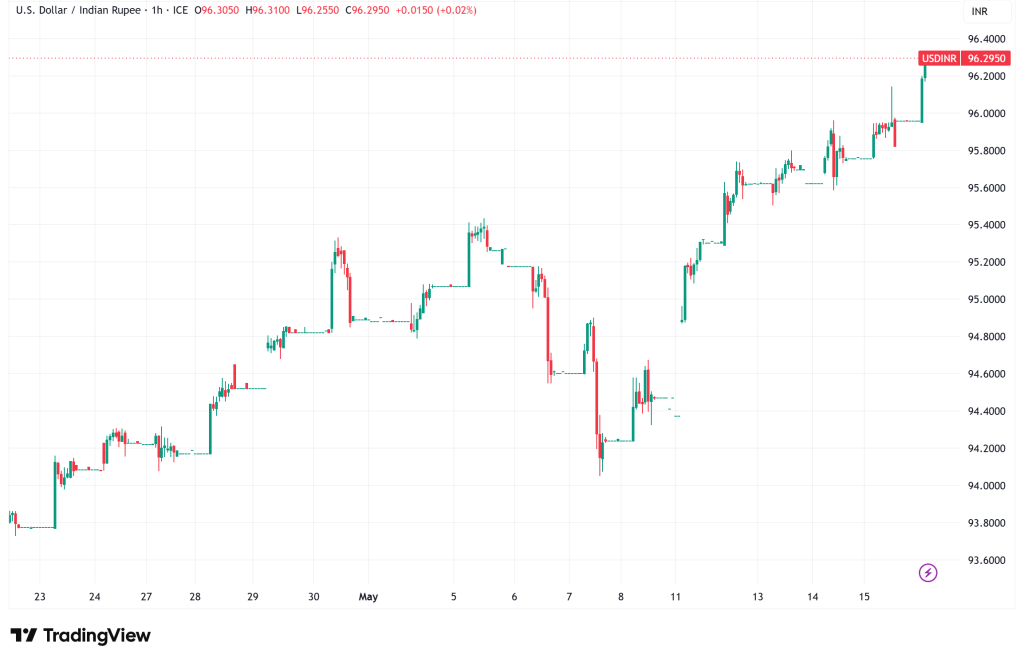
Technically, the pair is trading in heavily overbought territory on short-term oscillators, though the broader trend remains decisively bullish for the dollar.
- Resistance: 96.00–96.50 is the key near-term resistance band. The pair is currently testing the upper end of this zone.
- Support: 94.80–95.10 is expected to act as a significant support floor on any pullback.
- Broader trend: TradingView data shows USD/INR has gained 12.53% over the past year and 7.40% over the past six months, confirming a sustained structural depreciation trend in the rupee.
- Watch level: If 96.50 breaks decisively, the psychological 97.00–97.50 zone comes into play quickly. Beyond that, 98 (BofA’s year-end target) and 100 (a risk scenario flagged by Bhansali) become relevant.
INR Weakness’s Spillover Into Indian Equity Markets
Currency stress has bled into stocks. The BSE Sensex tumbled 833 points to 74,404 in early trade, while the NSE Nifty 50 dropped 234 points to 23,401.
Foreign Institutional Investors (FIIs) offered a rare silver lining — they remained net buyers for the second straight session, purchasing equities worth approximately $16 million on Friday. That points to some continued institutional confidence in Indian equities even as the currency deteriorates.
What to Watch This Week for USD/INR Traders
Several catalysts could drive USD/INR volatility through the week:
- India flash PMIs (manufacturing, services, composite) — May 21
- US weekly jobless claims — May 21
- US Philly Fed Index and Flash PMIs — May 21
- University of Michigan Consumer Sentiment — May 22
- Crude oil price trajectory and any developments in US-Iran ceasefire negotiations
India imports nearly 90% of its crude oil requirements. Every dollar rise in Brent directly widens the current account deficit, pressures the rupee, and complicates the government’s fiscal arithmetic — making oil the single most important variable for the rupee right now.
- Check out our free forex signals
- Follow the top economic events on FX Leaders economic calendar
- Trade better, discover more Forex Trading Strategies
- Open a FREE Trading Account
- Read our latest reviews on: Avatrade, Exness, HFM and XM

Related Articles


Sidebar rates

Related Posts
 Save
Save