Oracle Stock ORCL Heads to $200 as Rate Fears, AI Spending Concerns, and Geopolitical Risks Weigh on Tech
Oracle shares have come under renewed pressure as rising interest-rate concerns, escalating geopolitical uncertainty, and skepticism surrounding massive AI infrastructure investments undermine investor confidence across the technology sector.
Quick overview
- Oracle shares have dropped approximately 10% amid rising interest-rate concerns and geopolitical uncertainty, reflecting a broader pullback in the technology sector.
- Despite strong fiscal third-quarter results, investor confidence waned due to skepticism about massive AI infrastructure investments and high valuations.
- The company's plans to invest between $80 billion and $100 billion in AI infrastructure have raised questions about capital efficiency and future returns.
- Geopolitical tensions and a strong U.S. labor market report have further pressured growth stocks, complicating Oracle's outlook in a challenging economic environment.
Oracle shares have come under renewed pressure as rising interest-rate concerns, escalating geopolitical uncertainty, and skepticism surrounding massive AI infrastructure investments undermine investor confidence across the technology sector.
Oracle’s Powerful Rally Loses Steam
Shares of Oracle Corporation reversed sharply lower after failing to sustain momentum following a rally that briefly pushed the stock toward the $250 level earlier this week.
The stock fell roughly 10% during Friday trading, sliding toward $210 and extending a broader pullback that has accompanied weakness across technology and semiconductor shares. Investors who previously embraced Oracle’s growing role in artificial intelligence infrastructure are becoming increasingly cautious as macroeconomic risks begin to overshadow company-specific growth drivers.
The decline reflects a broader shift in market sentiment, with investors moving away from high-growth technology stocks amid concerns that valuations have become increasingly difficult to justify in a less favorable economic environment.
Hawkish Federal Reserve Fears Pressure Growth Stocks
One of the biggest catalysts behind the latest weakness has been a stronger-than-expected U.S. labor market report.
May nonfarm payrolls increased by 172,000, significantly exceeding expectations, while prior months were revised higher and wage growth remained firm. Combined with inflation readings that have remained stubbornly elevated, the report has strengthened expectations that the Federal Reserve may keep interest rates higher for longer.
For technology companies, this presents a significant challenge. Growth stocks derive much of their value from future earnings potential, making them particularly sensitive to higher interest rates.
As markets reduce expectations for future rate cuts, investors have become increasingly reluctant to pay premium valuations for companies tied to long-term growth themes such as artificial intelligence and cloud infrastructure.
Massive AI Spending Plans Raise New Questions
Investor concerns have also intensified around the scale of spending required to support the next phase of AI expansion.
According to analyst estimates, Oracle could spend between $80 billion and $100 billion over the coming years on data-center infrastructure, AI computing capacity, and advanced hardware deployments tied to large-scale projects such as Project Stargate.
While these investments are designed to position Oracle as a major force in enterprise AI infrastructure, they also raise questions about capital efficiency and future returns.
Markets are becoming increasingly skeptical of technology companies committing enormous sums to infrastructure expansion before clear monetization pathways emerge. As spending commitments continue rising across the industry, investors are beginning to question whether projected demand growth can justify the scale of current investment plans.
Broadcom’s Earnings Reignite AI Valuation Concerns
Additional pressure emerged following the earnings report from Broadcom.
Although Broadcom delivered solid results, investors were disappointed by guidance that failed to exceed elevated expectations. The reaction triggered a wider reassessment of AI-related stocks and highlighted concerns that valuations across the sector have become heavily dependent on continuously rising forecasts.
The selloff reinforced fears that even strong operational performance may no longer be enough to support premium valuations if growth expectations begin to moderate.
For Oracle, which has increasingly been viewed as an AI infrastructure beneficiary, this shift in sentiment created another headwind.
Geopolitical Risks Further Weaken Market Confidence
Beyond economic concerns, geopolitical tensions have added another layer of uncertainty.
Reports that negotiations between the United States and Iran have stalled have raised concerns about potential disruptions in the Middle East. Investors worry that any escalation could threaten critical energy shipping routes, drive oil prices higher, and create additional inflationary pressures.
At a time when markets are already grappling with persistent inflation and uncertainty around monetary policy, rising geopolitical risk has further reduced appetite for speculative growth assets.
Technical Signals Reflect Stabilizing Price After the Fall
From a technical perspective, Oracle’s price action reinforces the fundamental unease. On longer-term charts, the stock slipped below the 20 monthly moving average (gray) that previously acted as support. But the 50 SMA (yellow) held and we saw a strong rebound last week, however this week we saw a reversal.
ORCL Chart Monthly – The 20 SMA Acting As Resistance

On shorter timeframes, rebounds consistently failed near resistance levels, forming a clear pattern of lower highs, but in May we saw a breakout higher. On the daily chart, the 50 SMA (yellow) was acting as resistance, rejecting the price and pushing the stock lower, sending ORCL back down below $135. That support zone held and the rebound has pushed ORCL above all MAs to $250, but this week the price has dipped again.
ORCL Chart Daily – Return Below the 100 SMA

Strong Earnings Fail to Sustain Momentum
Oracle’s fiscal third-quarter 2026 results exceeded expectations, with both revenue and earnings coming in ahead of forecasts.
Despite this strong performance, the stock struggled to maintain gains. Initial optimism faded quickly, with shares slipping back below key levels. The recent rebound appears to be driven more by broader market sentiment than a fundamental shift in investor confidence.
Strong Earnings and Revenue Beat
- Earnings Per Share (EPS): $1.79 vs. $1.70 expected
- Total Revenue: $17.19 billion vs. $16.91 billion forecast
- Year-over-Year Revenue Growth: 22%
- Net Income: $3.72 billion, up from $2.94 billion a year earlier
The results reflect strong demand across Oracle’s cloud services and enterprise software platforms.
Growth momentum continues to accelerate as enterprises expand cloud workloads and AI-driven computing infrastructure.
Cloud Business Drives Growth
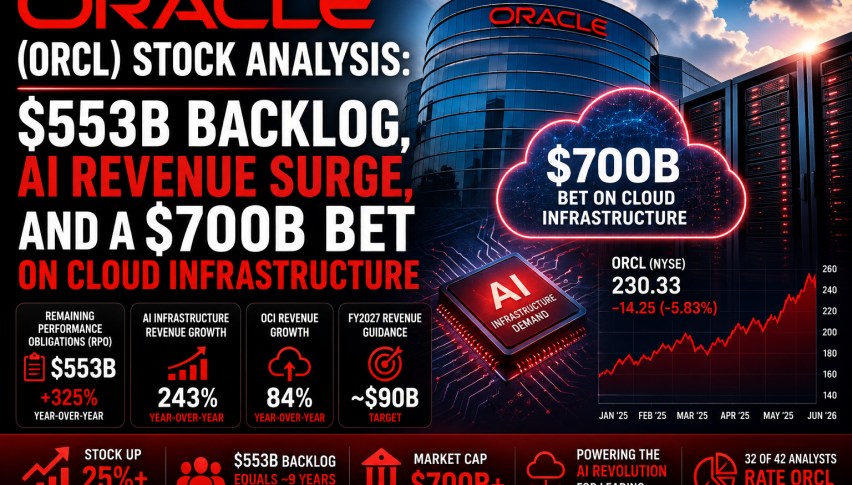
- Total Cloud Revenue: $8.9 billion (including SaaS and infrastructure)
- Cloud Infrastructure Revenue: $4.9 billion vs. $4.74 billion expected
Key highlights:
- Cloud infrastructure revenue surged 84% year-over-year, accelerating from 68% growth in the previous quarter.
- Demand is being fueled by AI workloads, enterprise migrations, and large-scale data processing needs.
- Oracle’s cloud infrastructure platform is increasingly competing with major hyperscalers in high-performance computing and AI training environments.
Massive Capital Investment in AI Infrastructure
- Oracle continues to aggressively expand its data center footprint.
Key figures:
Capital Expenditures:
- Jumped 269% year-over-year in the first quarter
- Reached $8.5 billion during the period
- Full-Year CapEx Forecast: $50 billion
The spending reflects Oracle’s strategy to scale AI infrastructure, cloud capacity, and high-performance data centers globally. Large investments are aimed at supporting growing enterprise demand for AI model training and cloud computing services.
Record Backlog Signals Strong Future Demand
- Oracle reported a massive backlog of $553 billion.
- Key implications:
- The backlog is more than four times higher than a year ago.
- It reflects long-term enterprise cloud contracts and AI infrastructure agreements.
- The pipeline suggests strong revenue visibility over multiple years.
Fiscal 2027 Forecast
- Oracle now expects $90 billion in total revenue.
Fiscal 2026 Outlook
- Revenue Forecast: $67 billion (unchanged)
- Capital Expenditure Plan: $50 billion (unchanged)
Q4 2026 Guidance
- Total Revenue Growth: 19%–21% year-over-year
- Cloud Revenue Growth: Approximately 46%
Outlook Remains Challenging
Oracle remains a significant player in enterprise software, cloud computing, and AI infrastructure. Nevertheless, the combination of elevated valuations, rising interest-rate expectations, geopolitical uncertainty, and growing concerns over massive infrastructure spending has created a difficult backdrop for the stock.
The recent decline suggests investors are becoming less willing to overlook risks in pursuit of future growth. Until there is greater clarity on the return profile of AI investments and the broader economic outlook, volatility is likely to remain a defining feature for Oracle and the wider technology sector.
- Check out our free forex signals
- Follow the top economic events on FX Leaders economic calendar
- Trade better, discover more Forex Trading Strategies
- Open a FREE Trading Account
- Read our latest reviews on: Avatrade, Exness, HFM and XM

Related Articles
Sidebar rates

Related Posts
 Save
Save