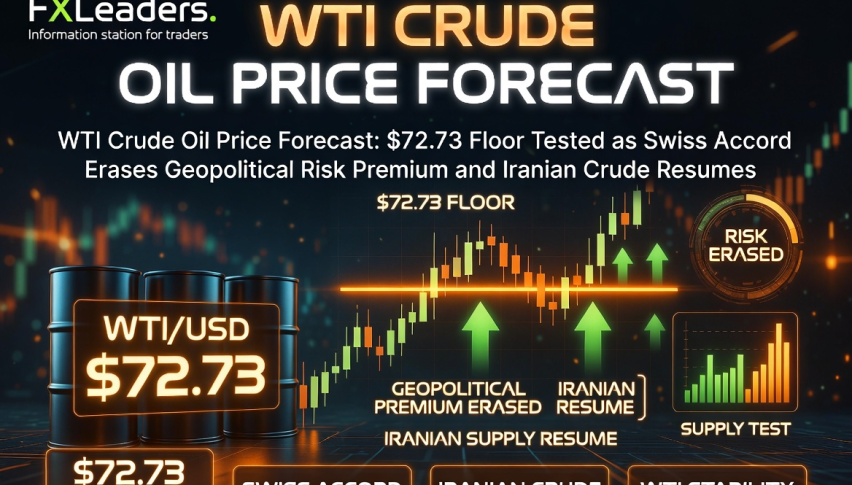
WTI Crude Oil Price Forecast: $72.73 Floor Tested as Swiss Accord Erases Geopolitical Risk Premium and Iranian Crude Resumes
As market participants rapidly begin to price in geopolitical risk and wait for the physical goods to arrive, we're seeing a realignment...
Quick overview
- The global energy complex is realigning rapidly due to geopolitical risks and the recent peace agreement between the US and Iran.
- WTI Crude Oil is trading at $72.73, showing a slight decrease as commercial firms buy into the market to mitigate risks.
- The normalization of the Strait of Hormuz and increased Iranian oil supply are contributing to a more stable supply situation.
- Traders are advised to consider both bullish and bearish setups as the crude oil market approaches a potential rally amid oversold conditions.
As market participants rapidly begin to price in geopolitical risk and wait for the physical goods to arrive, we’re seeing a realignment of the global energy complex taking place more swiftly than anticipated.
On the morning of Wednesday, June 24, 2026, West Texas Intermediate (WTI) Crude Oil (USOIL) continued to trade within a narrow consolidation range during opening trades, quoted at $72.73, representing a modest, intraday decrease of 0.42% at the time of writing.
Commercial trading firms and spot commodity index funds are aggressively trying to shield themselves from downside risk by buying into the initial wave of sellers that have entered the market since the re-opening of the transport network this past weekend.
Hormuz Supply Fears Subside
The overriding reason for the energy complex pulling back from its recent multi-month structural highs is the agreement that has been reached between the US and Iran on the interim basis known as the “Islamabad memorandum of understanding.” Signed in person by both governments with Pakistani assistance at a Swiss conference on June 19, this peace agreement was responsible for the sudden removal of fears of supply disruption that was previously the driver of energy derivatives. Several key factors have now reset the supply situation for prompt-month physical contracts:
- Strait of Hormuz Normalization: The formal cancellation of the U.S. naval blockade of the Strait of Hormuz means that commercial shipping is once again returning to normal seasonal levels, with an estimated 15 million barrels of crude per day once again moving into world supply.
- Iranian barrels enter the marketplace: The Iranians are beginning to empty storage tanks and storage oil tankers, increasing the volume of visible supply into global markets.
- OPEC+ Rollback of Production Cuts: Supply increases as part of OPEC+’s voluntary supply-cut back roll scheduled for July. An additional 188K barrels per day enters the supply market in July. OPEC+ ministers will likely take that number into consideration ahead of their upcoming meeting, where the previous month’s inventory build is expected to be the primary point of discussion.
- Robust Non-OPEC growth: The U.S. is already producing crude at near record levels, and production in Guyana, Brazil, and Canada has also increased. This will keep the oil markets very well supplied in the near future even as growth in global consumption is expected to remain modest at an annual average of 1.2 million barrels per day.
Warsh Policy Ramps Up
Alongside the growing supply is a more restrictive monetary policy as the U.S. economy continues to struggle with a sticky 4.1% core CPI print. Following the June 16 to 17 FOMC meeting, the Federal Reserve maintained its position of higher-for-longer interest rates at a rate that would continue to support the U.S. dollar at multi-month highs.
Given that the dollar is used for the settlement of oil prices, high dollar rates also keep the cost of borrowing for oil traders higher and reduce the profitability of industrial activity in other markets.
WTI Crude Oil Technical Analysis: USOIL Defends Lower Boundary of Descending Channel
The 2H chart of West Texas Intermediate Crude Oil is showing the oil futures index testing an oversold descending channel setup that has been active for months. This chart depicts a descending structural channel with price testing the lower channel support at a key Point D structural base.
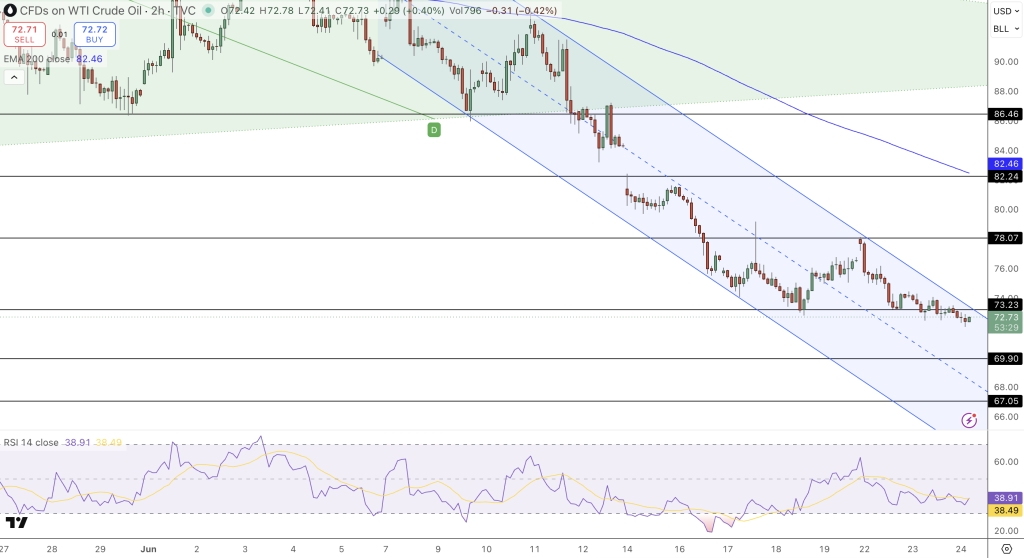
This lower channel support is a short term support zone for physical buyers, and is priced significantly lower than the 2H trailing EMA200 at $82.46. With the 14-period RSI currently at 38.91 and MACD flattening out at low levels, the sell-off associated with the Swiss Peace Agreement looks to be nearing short-term exhaustion.
To trade the lower channel support, traders can choose from one of two distinct trade execution setups.
Bullish Mean-Reversion Setup: Traders should look to enter tactical longs off of 2-hour confirmed price action stabilization within $69.90 to $71.00 support zone. Stops are to be placed $67.05 below this support zone and should aim for a take profit at $75.96 resistance or $78.07 major resistance. Traders may look to build shorts on any weak relief rally back to the $75.96 to $78.07 area on low volume with stops above that level.
Bearish Trend-Continuation Setup: Traders should look to build fresh short positions on any weak, low-volume technical relief rallies back into the $75.96 to $78.07 structural supply block. Place a stop loss at $79.50 above this support zone. The bearish target for the trend should be $65.00 below the lower channel support zone.
Crude oil is recovering from a period of uncertainty and risk that was brought on by geopolitical tension and the expectation of higher-than-normal production.
With the Warsh Fed policy and the recent rise in the U.S. dollar, we see higher than normal financing costs for oil traders, while the 2H lower channel support is a level that is heavily oversold. With this in mind, the crude oil market is likely to have another rally as the late-June trading cycle matures.
- Check out our free forex signals
- Follow the top economic events on FX Leaders economic calendar
- Trade better, discover more Forex Trading Strategies
- Open a FREE Trading Account
- Read our latest reviews on: Avatrade, Exness, HFM and XM

Related Articles

Sidebar rates

Related Posts
 Save
Save