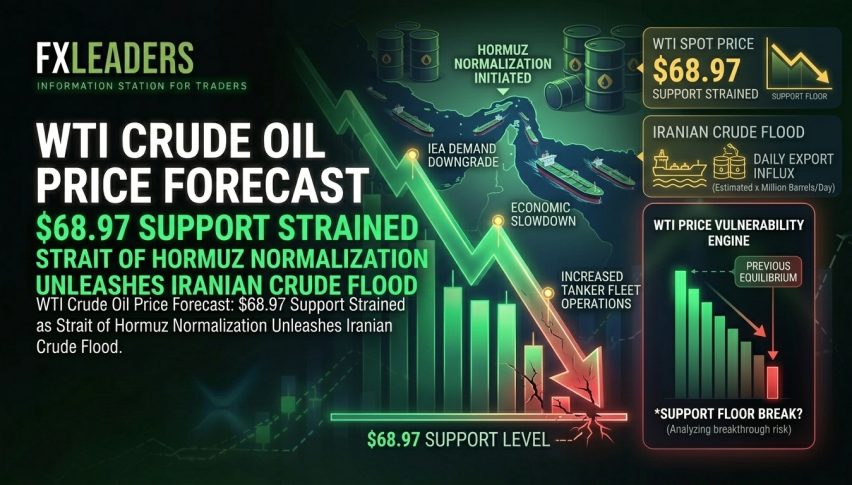
WTI Crude Oil Price Forecast: $68.97 Support Strained as Strait of Hormuz Normalization Unleashes Iranian Crude Flood
With paper markets finally getting rid of whatever risk positions they still had on the books, the physical and structural infrastructure...
Quick overview
- The global energy market is experiencing a significant downward repricing, with WTI Crude Oil trading around $69.75 per barrel.
- The recent peace treaty between the U.S. and Iran has alleviated supply-disruption fears, leading to increased oil supply and reduced war-risk premiums.
- OPEC+ is set to increase production by 188,000 barrels per day, coinciding with record production growth from non-OPEC countries.
- The Federal Reserve's restrictive monetary policy is dampening short-term oil price recovery, as a stronger U.S. dollar raises procurement costs for non-U.S. refiners.
With paper markets finally getting rid of whatever risk positions they still had on the books, the physical and structural infrastructure of the worldwide energy complex has entered a major downward repricing stage. On Monday, June 29, 2026, West Texas Intermediate (WTI) Crude Oil (USOIL) underwent relentless distribution at commercial desks as it hovered near $69.75 a barrel.
Commodities desks and commercial index funds were making significant changes to their books, pushing key crude benchmarks under critical resistance levels. At the same time, physical and multi-million-barrel barrels were starting to displace the speculative and safe-haven premiums.
Swiss Accord Reopens Hormuz Corridor and Deflates the War-Risk Premium
The big reason why the near-term drop in crude benchmarks is happening as aggressively as it is right now is the successful real-world operationalization of the United States’ peace treaty with Iran: the “Islamabad Memorandum of Understanding.” An interim deal signed in Switzerland on June 19 as a product of Pakistani mediation, the agreement eliminated the supply-disruption anxieties that gripped energy derivatives throughout the previous quarter. Key developments included the end of the United States’ naval blockade of Iran as well as the full reopening of the strategically important Strait of Hormuz corridor as it relates to commercial oil traffic. Shipping traffic through the area returned to nearly 85% of its seasonal averages, meaning Iranian floating and land-based storage tanks were now being cleared out into European and Asian refineries.
Also, OPEC+’s voluntary production cut schedule now means the cartel is positioned to proceed with its previously scheduled voluntary production cut rollbacks, which are slated to inject an additional +188,000 barrels per day (BPD) into global markets for July. The timing of this domestic production increase could not have come at a less ideal time for OPEC+ given its need to enforce its production discipline in order to curb the buildup of excess supply inventory at its ministerial meeting in the coming weeks.
Non-OPEC+ production is also growing at record rates as well. In addition to U.S. shale continuing to hit fresh high records, output from Guyana, Brazil and Canada are also increasing from their deepwater drilling programs. This is a massive supply-side situation that has yet to meet up with international oil demand growth. The International Energy Agency and OPEC are both tracking international demand increases for this calendar year at around 1.2 million barrels per day, which reflects demand decreases in the OECD as well as improvements in efficiency worldwide.
OPEC+ Voluntary Cut Rollbacks Intersect Record Non-OPEC Production Buffers
On top of that, the Federal Reserve’s highly restrictive monetary policy as it pertains to its recent June 16, 17 FOMC meeting is also dampening any chance of an oil rebound on a short-term basis. With underlying demand-side pressures still present as well as core U.S. inflation running at 4.1%, Federal Reserve Chairman Kevin Warsh recently adopted a data-driven, highly monetarist position by eliminating near-term expectations of monetary easing. Warsh’s explicit “higher for longer” policy means that U.S. dollar real yields and the U.S. Dollar Index (DXY) have been locked in at fresh multi-month highs.
Since the global pricing mechanism for commodity oil transactions is in U.S. dollars, this makes it significantly more expensive to buy oil as a commodity for non-U.S.-dollar denominated sovereign refineries and keeps the overall industrial profitability outlook damp. This also keeps speculative longs in check.
The Warsh Doctrine Extends High Financing Hurdles for Commercial Commodity Desks
Limiting any immediate demand-led price recoveries is the highly restrictive monetary framework maintained by Federal Reserve Chair Kevin Warsh following the June 16–17 FOMC session. Facing persistent underlying price pressures, with core U.S. inflation sticking firmly at 4.1%, Chair Warsh introduced a data-dependent, strict monetarist posture that effectively eliminated near-term rate-cut expectations.
This explicit “higher-for-longer” baseline has kept real U.S. yields and the U.S. Dollar Index (DXY) locked near fresh multi-month cyclical highs. Because international physical crude transactions are priced globally in USD, a stronger dollar significantly increases localized procurement costs for non-U.S. sovereign refiners, dampening global industrial margins and capping speculative long positions across the energy complex.
Technical Analysis: USOIL Slams Through Lower Boundary of Major Descending Channel
Moving onto the 2-hour chart now, we see WTI crude oil breaking down decisively beneath critical technical levels. On the 2-hour technical chart below, USOIL just broke decisively below the lower boundary line of its multi-week long-term trend, trading at $69.75 and now trading under its trailing long-term trend line 2-hour 200-exponential moving average (EMA) of $79.53.
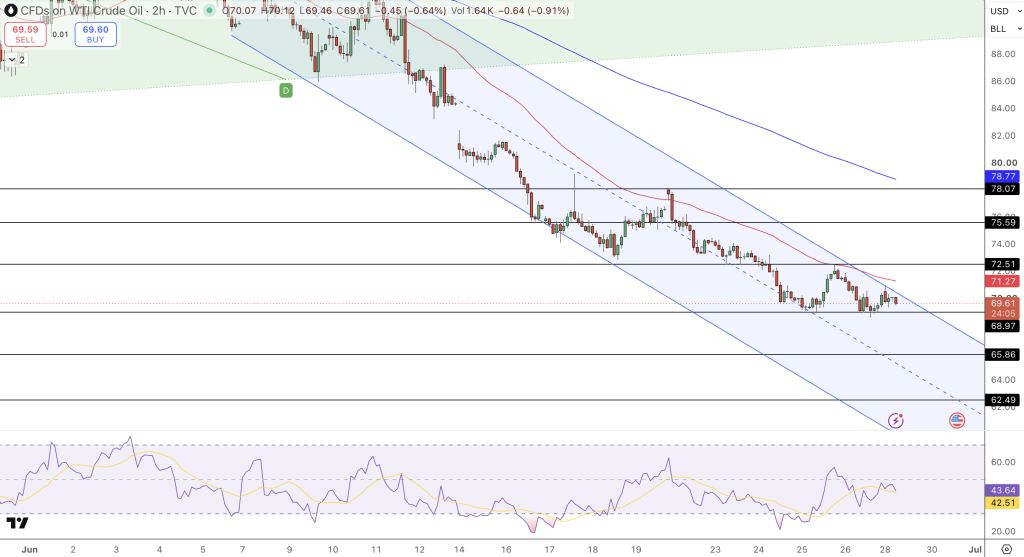
The 14-period relative strength index (RSI) is hovering close to 43.00 with a lot of room to run lower without reaching deeply oversold readings. We see the momentum oscillator MACD histogram also continuing to trend beneath its 0.00 zero line.
However, the recent flatten-out suggests that the speed of breakdown has run into some resistance levels on the near-term basis at the key horizontal $68.97 support level.
Conclusion and Trade Idea
WTI crude oil has now entered a highly aggressive, post-normalization stage, where the removal of any risk premium for war and political uncertainty has returned price discovery to the dominance of global oil supply increases. While Chairman Warsh’s highly restrictive dollar policy creates high financing hurdles for commercial commodity desks to engage in oil speculation, the confirmed breakout below the multi-week trendline means any short-term rallies are likely to get hit with strong resistance.
Look to enter sell orders on any minor price rallies back toward the descending channel trendline support at $78.07, and set a strict stop-loss order above the current short-term volatility structure at $82.24 in order to target a continuation move lower to the immediate $68.97 support level (and the core fundamental support levels around $65.86).
- Check out our free forex signals
- Follow the top economic events on FX Leaders economic calendar
- Trade better, discover more Forex Trading Strategies
- Open a FREE Trading Account
- Read our latest reviews on: Avatrade, Exness, HFM and XM

Related Articles
Sidebar rates

Related Posts
 Save
SaveAva

