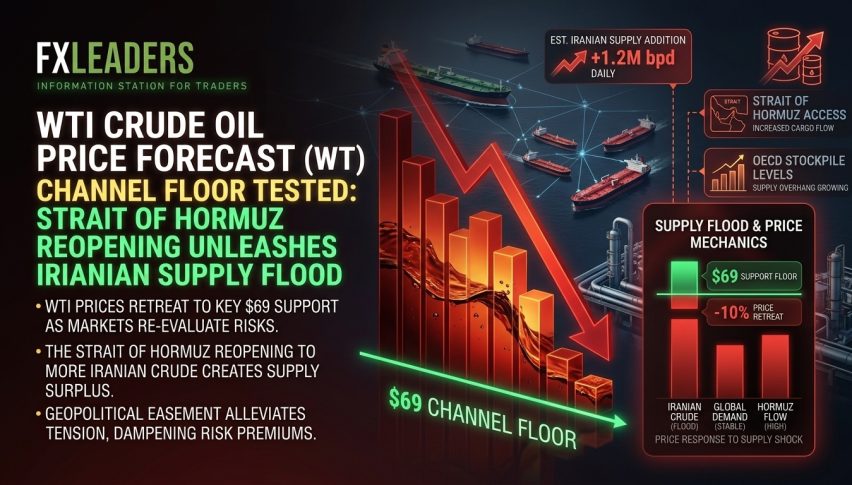
WTI Crude Oil Price Forecast: $69 Channel Floor Tested; Strait of Hormuz Reopening Unleashes Iranian Supply Flood
The real, physical structure of the energy world has moved to an even bigger repricing in the oil market as the paper market finishes...
Quick overview
- The oil market is experiencing significant repricing, with WTI Crude Oil trading around $70.18 per barrel as institutional traders offload positions.
- A recent US-Iran peace deal has led to increased Iranian oil supply and a resumption of tanker traffic in the Strait of Hormuz, contributing to downward pressure on prices.
- OPEC+ is set to increase oil production while non-OPEC+ supplies are at record highs, creating a potential oversupply situation amid modest demand growth.
- WTI Crude Oil is in a negative bias, and traders are advised to consider short positions on rallies to key resistance levels.
The real, physical structure of the energy world has moved to an even bigger repricing in the oil market as the paper market finishes removing the risk from the balance sheet. On Tuesday June 30 2026 WTI Crude Oil (USOIL) saw persistent distribution on institutional desks near $70.18 / Bbl as major traders on the trading floor and the C-TA index managers dump oil under these levels of the next significant cyclical resistance to physical volume of several Million Barrels that begins clearing by end of month.
Swiss Accord Opens the Hormuz Corridor and Squeezes the War Premium
The main fundamental factor behind the current, near-term downward pressure in oil is a well-communicated and successfully executed implementation of the interim United States-Iran peace deal, officially termed the Islamaband Memorandum of Understanding (US-Iran MoU). This 14-point deal was finalized on June 17, 2026 via digital signatures mediated by Pakistani Prime Minister Shehbaz Sharif and put an end to the military conflict in the region that began in late February 2026. Some key updates on the physical balances of the situation that have already transpired include:
- The return of General License X. The deal allows the US Treasury’s Office of Foreign Assets Control (OFAC) to activate a new 60-day, general license. X that ends the naval blockade of US warships and enables the extraction, transportation and the sale with US marine insurance coverage by Iranian oil until August 21 2026.
- A resumption of tanker traffic in the Strait of Hormuz to some 85% of normal levels, allowing Iranian tanks in the water and at the ports to sell oil into Europe and Asia.
- The establishment of a Transnational Reconstruction Fund for the 60-day extension for nuclear discussions that will provide $20 Billion USD to Iran to start the process of the future $300 Billion USD reconstruction and development program for the Middle East.
Voluntary OPEC+ Cuts being Reversed while Non-OPEC+ Supplies Record Highs
On top of the Iranian supply influx, the supply side of the OPEC+ side of the equation has become increasingly tight as well. OPEC+ has the supply cuts set to begin on a voluntary basis and will begin pumping an additional +188k BPD more oil into the market this month for July. The supply increases that will happen next month puts a lot of the supply side of OPEC+ under stress with a high probability that they must be able to agree to a deal at their June meeting to avoid an even larger inventory buildup.
The rest of the world continues to produce oil at record amounts as US shale is currently at record output levels in the states and major increases from the non-OPEC+ producers such as Guyana, Brazil and Canada continues to break records. With modest international demand growth of only 1.2 million BPD for the year as expected by both the IEA and OPEC owing to a slowdown in OECD economic activity and energy conservation, the global supply wall will be more than enough.
The Warsh Doctrine: Commodity Commercial Trading Desks Face High Cost of Capital
Limiting near-term demand-driven price recovery has been the tight, data-dependent, monetarist policy framework put in place by newly inaugurated Federal Reserve Chair Kevin Warsh after the June 16, 17 FOMC meeting as he responded to sticky core U.S. inflation at 4.1% by eliminating expectations of rate cuts over the near to medium-term. This explicit “higher-for-longer” stance has pinned real U.S. rates and the U.S. Dollar Index (DXY) to fresh multi-month cyclical highs. Since international physical crude trades are denominated in USD, higher prices for non-U.S. sovereign refiners to acquire their product are dampening global margins and speculative long exposure in energy assets.
Technical: WTI Crude Sinks Below Describing Line of 2-hour Structure
Looking past policy changes by the Fed at the 2-hour timeframe, WTI Crude Oil has broken below its structural floor with vigor. The commodity has broken decisively below its multi-week descending channel, trading at $70.18 and validating the selling pressure in the 2-hour trailing macro 200-EMA at $79.53.
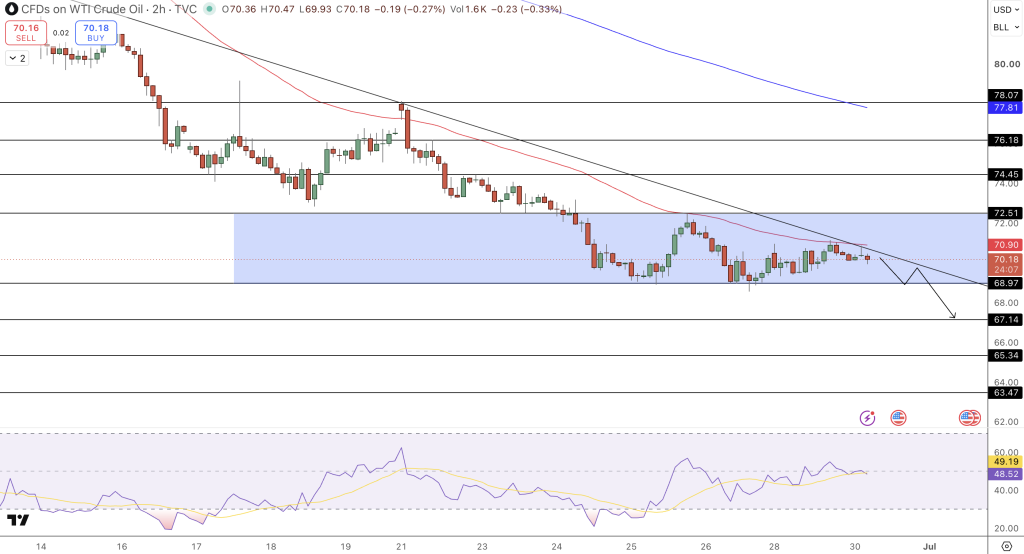
The 14-period RSI has leveled off near 48.52, indicating weak momentum while remaining comfortably above deeply oversold territory, which technically preserves room for a secondary flush lower. The MACD histogram remains in a bearish alignment but is flattening near the zero-line to support a consolidation near the horizontal structure at $68.97.
Conclusion: WTI Crude Is in Negative Bias; Consider Short on Rallies to Supply Walls
WTI Crude Oil is in a violent post-geopolitical reset phase with the removal of the war risk premium in its pricing structure, leaving it vulnerable to excess inventory growth from expanding global crude supply. With the Warsh monetary framework keeping commodity financing costs high on commercial trading desks and a breakdown below the multi-week descending channel, any near-term rallies will likely meet selling pressure above the support levels.
Strategy: Short on Rallies to $72.51 and/or $74.45
Initiate short positions on any weak rallies to $72.51, a potential horizontal wall of supply above, or to $74.45, the lower boundary of the descending channel. Protect against downside moves by setting a stop-loss order at $75.50, a high volatility point above the horizontal channel floor. Target a trend-continuation lower move at the key fundamental value support level at $68.97, with further downside at $67.14 to capture liquidity in the broader WTI Crude Oil contract.
- Check out our free forex signals
- Follow the top economic events on FX Leaders economic calendar
- Trade better, discover more Forex Trading Strategies
- Open a FREE Trading Account
- Read our latest reviews on: Avatrade, Exness, HFM and XM

Related Articles

Sidebar rates

Related Posts
 Save
SaveAva

