Ford Stock Stalls Near $14 as Quality Win Fails to Offset Recall Concerns
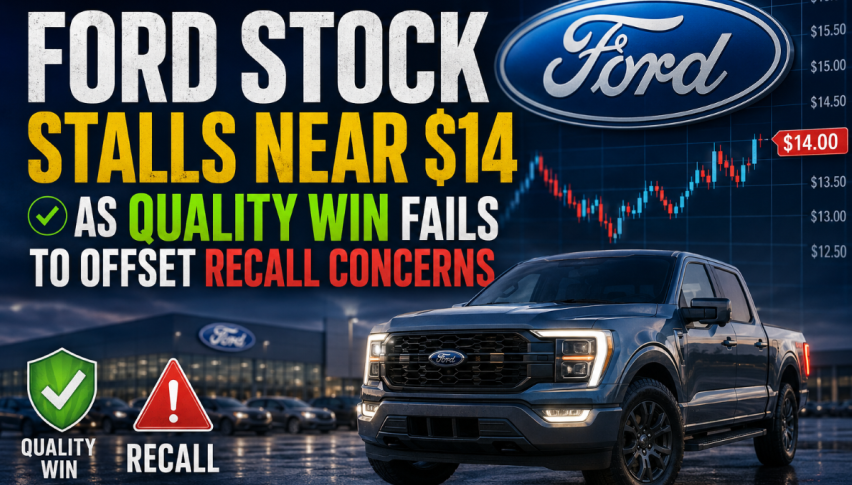
Ford Motor stock F slips to $14.02 as quality gains clash with recall pressure; 4H chart needs $14.60 break to turn bullish.
Quick overview
- Ford's stock closed lower at $14.02 despite a significant quality ranking improvement, reflecting investor skepticism.
- The company topped J.D. Power's U.S. Initial Quality Study, but ongoing recall issues continue to pressure its quality narrative.
- Ford has rehired 300 quality engineers after AI quality checks fell short, indicating a shift back to human oversight.
- Analysts suggest limited near-term upside for Ford's stock, with key resistance levels around $14.08-$14.22 needing to be overcome.
Ford (F) closed lower at $14.02 despite a major quality-study win, as recall costs, AI quality-control setbacks, and weak 4-hour resistance keep bulls cautious.
Ford Quality Progress Meets Market Skepticism
Ford Motor Co. (NYSE: F) ended Monday’s session lower even as the broader market rallied, highlighting the tension between the company’s improving quality story and lingering execution concerns.
Shares closed at $14.02, down 0.78%, while after-hours trading nudged the stock to $14.06. The move came despite Ford’s strongest quality ranking in years, suggesting investors still want proof that better vehicle scores will translate into lower warranty costs and stronger earnings.
Ford Tops J.D. Power, But Recalls Still Weigh
Ford recently returned to the top of J.D. Power’s U.S. Initial Quality Study among mainstream automakers, its first such win since 2010. The company improved its score to 152 problems per 100 vehicles from 193 a year earlier, a roughly 21% improvement.
That is a meaningful operating signal. Better early-quality scores can support brand perception, reduce warranty expenses, and help Ford defend pricing on core models such as the F-150, Mustang, and Super Duty.
However, the stock reaction shows investors remain cautious. Ford still leads the industry in recall volume, and recent large recalls have kept pressure on the company’s quality-cost narrative. The concern is simple: initial quality may be improving, but the market wants to see recall and warranty costs fall consistently.
Human Engineers Return After AI Quality Checks Fall Short
Another part of Ford’s turnaround is more unusual: the company has rehired roughly 300 veteran quality engineers after automated systems failed to match experienced human judgment.
Ford had deployed AI tools and camera systems across parts of its industrial operations to detect quality issues earlier in the process. But executives acknowledged that AI-driven checks were only as good as the data and expertise used to train them.
That message cuts both ways. On the positive side, Ford is correcting the problem and rebuilding quality discipline with experienced engineers. On the negative side, it shows that earlier automation efforts may have underestimated the value of human inspection and product-cycle experience.
For investors, the key question is whether this talent refresh can bring down warranty costs faster than recall headlines damage sentiment.
Analyst Targets for Ford Stock Leave Limited Near-Term Upside
Ford’s current trading range also reflects a valuation issue.
The stock is sitting close to the middle of Wall Street’s target range, with average analyst targets only modestly above the current price. That leaves Ford needing fresh catalysts, likely from earnings, guidance, warranty-cost improvements, or stronger demand signals.
The next major test is second-quarter earnings, expected in late July. Investors will watch adjusted EBIT guidance, recall expenses, pricing, inventory discipline, EV losses, and Ford Pro momentum.
Ford (F) Technical Analysis: 4-Hour Chart Still Capped Below $14.60
From a technical perspective, Ford’s 4-hour chart remains mixed.
The stock is trading just above its 100 EMA at $13.99, 100 SMA at $13.81, 200 EMA at $13.53, and 200 SMA at $13.24. These longer-term averages are flashing buy signals and form the main support structure below current price.
That means the $13.80-$14.00 area is the first zone buyers need to defend. A break below that level would weaken the setup and expose $13.53, then $13.24.
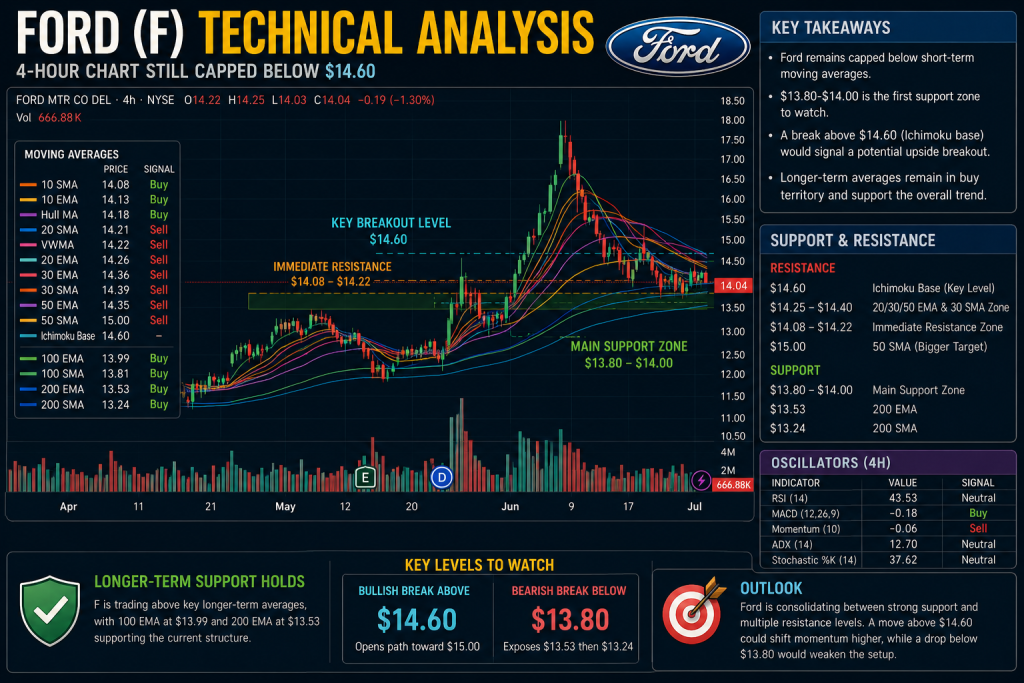
F Chart 4H – Longer-Term Support Holds, But Short-Term Averages Block the Bounce
The problem is overhead resistance. Ford remains below nearly all short-term moving averages.
- The 10 SMA sits at $14.08, the 10 EMA at $14.13, the Hull Moving Average at $14.18, the 20 SMA at $14.21, and the VWMA at $14.22. This creates immediate resistance around $14.08-$14.22.
- Above that, the 20 EMA at $14.26, 30 EMA at $14.36, 30 SMA at $14.39, and 50 EMA at $14.35 create another resistance band near $14.25-$14.40. The 50 SMA at $15.00 is the bigger upside target if buyers regain control.
- The Ichimoku base line at $14.60 is the key technical level. A clean move above $14.60 would suggest Ford is finally escaping short-term pressure.
Oscillators are mostly neutral. RSI stands at 43.53, showing neither oversold nor overbought conditions. MACD is slightly negative at -0.18 but carries a buy signal, while Momentum at -0.06 is still flashing sell. ADX at 12.70 shows weak trend strength, meaning Ford may continue to chop until a clearer catalyst arrives.
How to Trade Ford Motor (F) Stock This Week
The first support zone is $13.81-$13.99. Below that, traders will watch $13.53 and $13.24.
On the upside, Ford needs to reclaim $14.08-$14.22 first.
A stronger recovery requires a break above $14.40, then $14.60. If buyers clear that area, $15.00 becomes the next major target.
For now, Ford’s quality story is improving, but the stock still needs confirmation. Until recall costs fall and the chart breaks above $14.60, F may remain stuck in a narrow range around $14.
- Check out our free forex signals
- Follow the top economic events on FX Leaders economic calendar
- Trade better, discover more Forex Trading Strategies
- Open a FREE Trading Account
- Read our latest reviews on: Avatrade, Exness, HFM and XM

Related Articles
Sidebar rates

Related Posts
 Save
SaveAva

