WMT Stock Risks Falling Below $100 as Industry Report Sparks Fresh Concerns for Walmart
Walmart stock extended the decline after a cautious industry report fueled concerns that slowing consumer demand and margin pressure could weigh on sales in the months ahead.

Quick overview
- Walmart shares fell over 4% amid concerns about slowing consumer demand and margin pressures.
- A bearish industry report indicated weakened domestic sales momentum, raising risks for future sales expectations.
- Despite strong e-commerce growth, rising costs and cautious consumer behavior have shifted investor sentiment negatively.
- Walmart's Q1 results exceeded revenue expectations, but a cautious earnings forecast has added to broader economic concerns.
Walmart stock extended the decline after a cautious industry report fueled concerns that slowing consumer demand and margin pressure could weigh on sales in the months ahead.
Walmart Shares Tumble as Consumer Spending Outlook Darkens
Walmart Inc. shares fell more than 4% on Wednesday, extending their recent decline after breaking below an important technical support level. The latest selloff has raised concerns that the stock could continue moving toward the $100 level after reversing sharply from its record high of $135 reached in May.
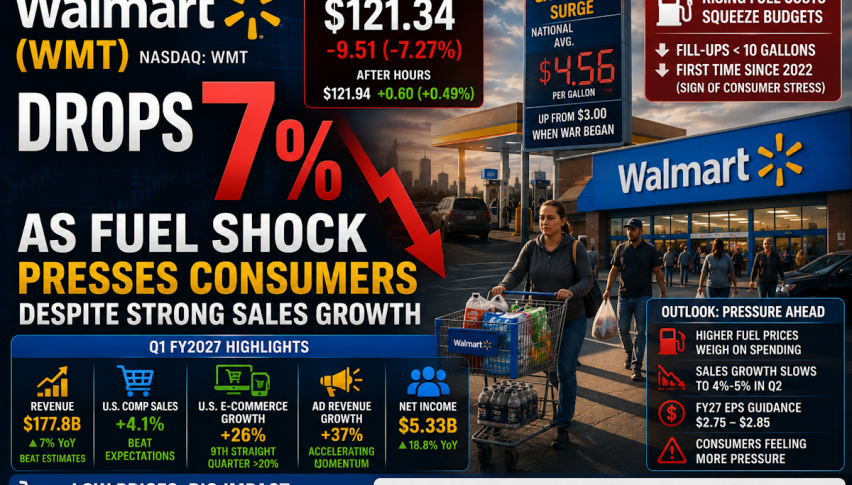
Despite another solid quarterly performance driven by strong e-commerce growth and value-focused shoppers, investors have become increasingly concerned about Walmart’s near-term sales outlook. The decline was triggered by a bearish industry report from Cleveland Research, which suggested that U.S. comparable store sales have begun to slow.
Industry Report Raises Red Flags
According to the research note, Walmart’s domestic sales momentum appears to have weakened, creating downside risk for current Wall Street expectations if consumer spending fails to improve during the remainder of July.
The report also indicated that Walmart has relied on targeted price reductions to move excess inventory, using tariff refunds to help offset lower selling prices and protect profit margins. The cautious assessment prompted investors to adopt a more defensive stance, driving broad-based selling in the retailer’s shares.
Rising Costs Continue to Pressure Consumers
Management has repeatedly highlighted that inflation continues to squeeze household budgets, making shoppers increasingly selective with discretionary purchases. Higher gasoline prices, which have climbed following geopolitical tensions earlier this year, have added another layer of financial pressure.
One notable indicator of consumer stress emerged at Walmart and Sam’s Club fuel stations, where customers purchased fewer than 10 gallons per visit on average for the first time since 2022. Chief Financial Officer John David Rainey described the trend as evidence that many households are carefully managing everyday expenses.
At the same time, higher fuel prices are increasing Walmart’s own transportation and logistics costs, placing additional pressure on operating margins.
WMT Chart Daily – Uptrend Is Under Threat

On the daily chart, WMT stock has been on an uptrend and reached a new record high above $135 on Tuesday, but opened with a gap lower today and continued to slip lower to $120. Now the next support comes at $115 where the 200 (purple) SMA stands.
On the weekly chart, the stock has been supported by MAs, particularly the 20 SMA (gray), but that moving average was broken today. The next support comes at the 50 weekly SMA (yellow) above 110 and then at $100 where the 100 SMA(green) stands.
WMT Chart Weekly – Breaking the 20 SMA

Wealthier Customers Cannot Fully Offset Weakness
While Walmart continues to gain market share among households earning more than $100,000 annually, lower-income consumers remain under growing financial strain. Many are reducing discretionary spending and concentrating purchases on essential goods, reinforcing the widening gap between stronger and weaker consumer segments.
Although Walmart remains one of the retail sector’s strongest operators, slowing comparable sales, cautious consumer behavior, and mounting cost pressures have shifted investor sentiment. With shares now trading below a key technical level, markets will be watching closely for signs that consumer demand is stabilizing before confidence returns.
🚚 E-Commerce Growth Remains Strong
Walmart’s digital business remained a bright spot.
- US comparable sales increased 4.1%
- US e-commerce sales surged 26%
The company highlighted improvements in delivery speed, with roughly 60% of online orders arriving within 30 minutes.
However, even strong operational execution could not offset concerns about future demand trends.
⚠️ Soft Guidance Raises Broader Economic Concerns
For the second quarter, Walmart projected earnings of 72 to 74 cents per share, below analyst expectations of 75 cents.
The cautious forecast added to concerns already raised by other retailers including Target, Home Depot, and Lowe’s, many of which warned that consumers may pull back further once temporary support from tax refunds fades.
With consumer spending remaining the primary engine of the US economy, Walmart’s warning signals may reinforce fears that inflation and soaring living costs are beginning to weigh more heavily on broader economic activity.
Key Takeaways
- Walmart’s Q1 revenue exceeded expectations by $2.97 billion.
- EPS matched forecasts at $0.66, indicating stable profitability.
- Stock price fell 3.58% in premarket trading despite strong revenue.
- E-commerce sales continued robust growth, up 26% globally.
- Operating income faced headwinds from increased fuel costs.
Company Performance
Walmart demonstrated strong performance in Q1 FY2027, with a 6% sales growth in constant currency, surpassing its full-year guidance range. The retail giant, with a market capitalization of $1.04 trillion, maintains a “GOOD” financial health score. The company’s focus on e-commerce and marketplace sales contributed to this success, with U.S. e-commerce sales growing for the ninth consecutive quarter. Notably, Walmart has raised its dividend for 31 consecutive years and maintained payments for 54 consecutive years, underscoring its commitment to shareholder returns even amid operational challenges.
Financial Highlights
- Revenue: $177.8 billion, up nearly $10 billion YoY
- Earnings per share: $0.66, meeting expectations
- U.S. comparable sales increased by 4.1%
- Global e-commerce sales rose by 26%
- Operating income grew by 5% in constant currency
Earnings vs. Forecast
Walmart’s Q1 results met EPS forecasts and surpassed revenue expectations. The revenue surprise was 1.7%, marking a positive deviation from predictions. This performance aligns with Walmart’s historical trend of strong revenue growth, although EPS remained stable.
- Check out our free forex signals
- Follow the top economic events on FX Leaders economic calendar
- Trade better, discover more Forex Trading Strategies
- Open a FREE Trading Account
- Read our latest reviews on: Avatrade, Exness, HFM and XM

Related Articles
Sidebar rates

Related Posts
 Save
Save