IREN Stock Eyes $30 as Dilution Fears and Rising Competitive Intensity in Cloud Market
IREN stock and broader neocloud equities came under heavy pressure as Meta Platforms’ evolving compute strategy intensified fears of structural demand compression in AI infrastructure markets.
Quick overview
- IREN stock and neocloud equities faced significant declines due to Meta Platforms' shift in its compute strategy, raising fears of reduced demand for independent AI infrastructure providers.
- Meta's expansion into reselling excess AI compute capacity signals a transition from being solely consumers of cloud resources to also acting as suppliers, impacting smaller AI infrastructure companies negatively.
- IREN's stock decline was exacerbated by concerns over a large RSU grant to its co-CEOs, leading to investor frustration regarding governance and dilution risks.
- The overall sentiment in the neocloud sector is fragile, as investors question the sustainability of demand amidst rising competition from hyperscalers and potential misallocation of capital by IREN.
IREN stock and broader neocloud equities came under heavy pressure as Meta Platforms’ evolving compute strategy intensified fears of structural demand compression in AI infrastructure markets.
Meta Compute Strategy Shifts Sentiment
Shares of Meta Platforms have triggered a sharp repricing across AI infrastructure equities after reports that the company is expanding its internal “Meta Compute” initiative, including the potential to resell excess AI compute capacity. The move signals a shift from pure consumption of cloud resources toward a hybrid model where hyperscalers increasingly act as both buyers and suppliers of compute power.
The immediate market reaction was severe. Nebius Group and CoreWeave saw double-digit declines in early trading, while IREN also moved sharply lower. The asymmetric response highlighted a clear divergence: Meta gained nearly 9% on improved strategic optionality, while smaller AI infrastructure providers absorbed the downside of potential market displacement.
Investors are increasingly concerned that this shift could alter the demand curve for independent “neocloud” providers just as GPU scarcity dynamics begin to normalize. The core fear is not just cyclical softness, but a structural re-rating of the entire AI compute ecosystem.
Neocloud Model Faces Structural Pressure
The neocloud sector originally emerged as a high-growth layer between hyperscalers and AI developers, built on rapid deployment of GPU clusters, flexible capacity leasing, and AI-optimized infrastructure. Companies in this space benefited from explosive demand for accelerated computing that traditional cloud providers struggled to absorb efficiently.
However, Meta’s potential entry into compute resale introduces a structural complication. If hyperscalers begin internal redistribution of excess capacity, they effectively compress the addressable market for independent providers. Instead of acting solely as demand anchors, hyperscalers become direct competitors within the same supply chain.
This raises a critical question for the sector: whether neocloud operators are scaling into a durable infrastructure layer or operating within a temporary arbitrage window created by early-stage AI compute shortages. The latest selloff suggests investors are increasingly leaning toward the latter interpretation.
IREN Selloff Driven by Dilution and Sentiment Shock
For IREN, the decline was amplified by company-specific concerns layered on top of sector weakness. A recent regulatory filing disclosed an unusually large restricted stock unit (RSU) grant of approximately $800 million to its co-CEOs, intensifying investor frustration over governance and dilution risks.
Market participants noted that the grant represents a significant portion of the firm’s projected cumulative adjusted earnings over the coming years, raising questions about long-term shareholder alignment. This comes on top of an already expanded equity base following multi-billion-dollar financing programs used to scale its data center footprint.
IREN’s AI Pivot Under Pressure
IREN [IREN Limited] has taken a different strategic path, shifting from Bitcoin mining into AI and high-performance computing data centers powered by renewable energy.
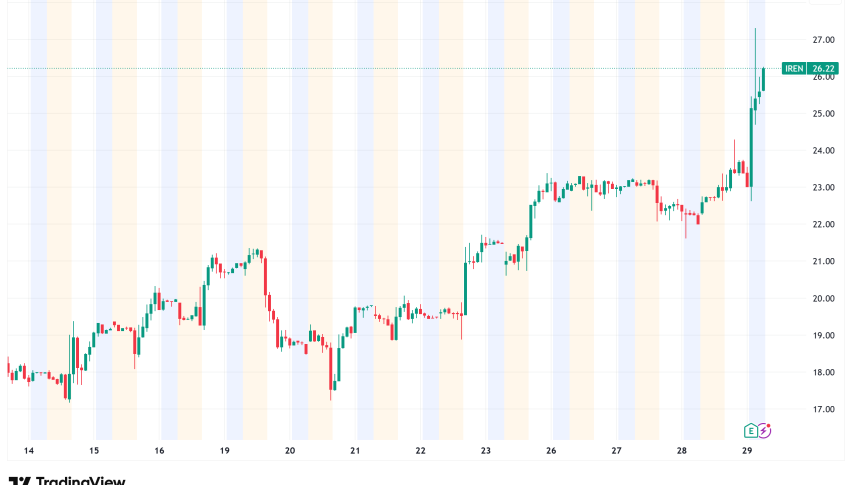
Despite this pivot, the stock has come under sustained selling pressure over the past two weeks. On the weekly chart, IREN is now testing its 50-week moving average. A decisive break below this level could expose the stock to further downside risk, with a potential move toward the March lows near $30.
IREN Stock Chart Weekly – Breaking Below the 50 SMA

Capital Allocation Concerns Add to Downside Pressure
Beyond compensation concerns, investors are increasingly scrutinizing IREN’s capital allocation strategy. The company’s aggressive expansion plans have already required heavy financing, and recent high-profile spending decisions—such as large-scale sponsorship commitments—have added to perceptions of misaligned priorities.
With rising competition from hyperscalers and increasing skepticism around neocloud demand durability, investors are beginning to question whether capital is being deployed efficiently into core infrastructure build-outs and long-term compute contracts.
The result is a more fragile sentiment environment, where sector-wide repricing and company-specific governance concerns are reinforcing each other, driving sharper downside volatility across the stock.
Outlook: Momentum Trade Faces Reality Check
The broader question now is whether the neocloud trade was a structural shift in computing demand or a temporary expansion phase driven by supply shortages. Meta’s actions suggest the latter may be more dominant than previously assumed, putting pressure on valuations that were heavily reliant on sustained scarcity in AI compute.
- Check out our free forex signals
- Follow the top economic events on FX Leaders economic calendar
- Trade better, discover more Forex Trading Strategies
- Open a FREE Trading Account
- Read our latest reviews on: Avatrade, Exness, HFM and XM

Related Articles
Sidebar rates

Related Posts
 Save
SaveAva