JSE Top 40 Forecast: Can Commodity Strength Offset South Africa’s Economic Challenges?
South Africa's JSE Top 40 Index remained under pressure in mid-July 2026, despite global commodity demand remaining firm, as investors...

Quick overview
- The JSE Top 40 Index is under pressure due to domestic economic challenges, despite strong global commodity demand.
- Mining stocks dominate the index, accounting for 45-50% of its market cap, with South Africa being a leading producer of critical minerals.
- Falling oil prices may reduce transportation costs and inflation, but high unemployment and restrictive monetary policy continue to hinder economic growth.
- The future direction of the JSE Top 40 will depend on rand stability, global capital flows, and key economic indicators from China.
South Africa’s JSE Top 40 Index remained under pressure in mid-July 2026, despite global commodity demand remaining firm, as investors focused on domestic economic headwinds. The index was trading just above 101,675, representing South Africa’s dependence on mining exports, financial services, and consumer spending. While geopolitical tensions have eased, oil prices have declined, and so have inflation expectations.
However, the JSE Top 40 has seen its upside limited by restrictive global monetary policy and a strong USD, as well as sluggish economic growth in South Africa. But given South Africa’s natural resource wealth and the global demand for critical minerals, the JSE Top 40 remains supported structurally, and investors are watching closely for international commodity price moves and economic reform in South Africa for the next big trigger to move the top 40.
Mining continues to fuel the FTSE/JSE Top 40 Mining stocks account for around 45-50% of the FTSE/JSE Top 40 by market cap. Key holdings include:
- Anglo American
- BHP
- Glencore
- Gold Fields
- Anglo American Platinum
- Impala Platinum
- Sibanye-Stillwater
South Africa is the largest producer of platinum group metals in the world and accounts for almost 70% of world platinum supply and is a major global exporter of gold, manganese, chrome, coal and iron ore. These resources remain increasingly important as demand continues to grow from electric vehicles, hydrogen fuel cells, renewable energy infrastructure, battery storage, and AI-driven data centers. China is South Africa’s largest export destination and accounts for 10-12% of South Africa’s exports.
Thus, economic activity in China, specifically manufacturing, infrastructure investment, industrial output and the real estate market will remain key drivers of South African mining company earnings. Commodity prices have fallen from early 2026 peaks but long term demand for critical minerals will continue to support earnings outlooks for major resource companies in South Africa.
Lower Oil Prices Provide Relief but Domestic Challenges Persist
Since the US-Iran interim agreement energy markets have improved and trade through the Strait of Hormuz has reopened while Iranian exports have resumed. Consequently, oil prices have fallen, particularly Brent which means South Africa, an oil importer, has improved transportation costs and is likely to have lower fuel prices, and thus lower costs for mining, manufacturing, logistics and consumer products. Lower costs should reduce inflation and improve company profitability.
But there will be limited near-term benefits from falling global oil prices as the South African economy will grow by less than 2% and unemployment is high at around 31-32%, although the country now has fewer problems with power supply compared with the past few years but it is still a problem.
In addition, the South African Reserve Bank has maintained a restrictive monetary policy, as the inflation rate remains close to the upper bound of its 3-6% annual target range. High interest rates will remain a persistent drag on consumer expenditure, property purchases, and corporate capital spending. This macro headwind should continue to act as a drag on retailers, property companies, and home-grown, domestically focused businesses.
Rand Stability and Global Capital Flows Will Shape the Next Move
Apart from commodities, South Africa’s rand will continue to be a key indicator of the direction of the JSE Top 40. Typically, a weaker rand plays well for mining companies, as the prices of minerals are often set in U.S. dollars, whereas the operational expenditures of these companies are denominated in South African currency. However, while a cheaper rand may increase revenues from commodity exports, sustained weakness can result in higher levels of imported inflation.
This can drive up debt servicing costs for companies with foreign borrowings, and erode the spending power of South African households. The rand is also impacted by movements in global investor sentiment. The South African rand may continue to suffer if global investors remain cautious about emerging markets in the face of the Federal Reserve’s continued higher-for-longer interest-rate stance.
The JSE Top 40 is likely to remain under pressure in the face of elevated U.S. Treasury yields, which may support a strong U.S. dollar, and which can reduce capital flows into South African assets. A subsequent move to a lower-for-longer U.S. Fed rate cycle in late 2026 could trigger the return of bullish global sentiment, a rally in the rand, and a broad upside move in the JSE Top 40.
JSE Top 40 Technical Analysis: Bears Defend 103,756 Resistance
The JSE Top 40 trades at 101,674.5 on the 2-hour chart following its descent below the long-term descending trendline. The JSE Top 40 continues to form lower highs and lower lows, which suggest that sellers continue to lead the way, despite recent indications that price consolidation may be forming.
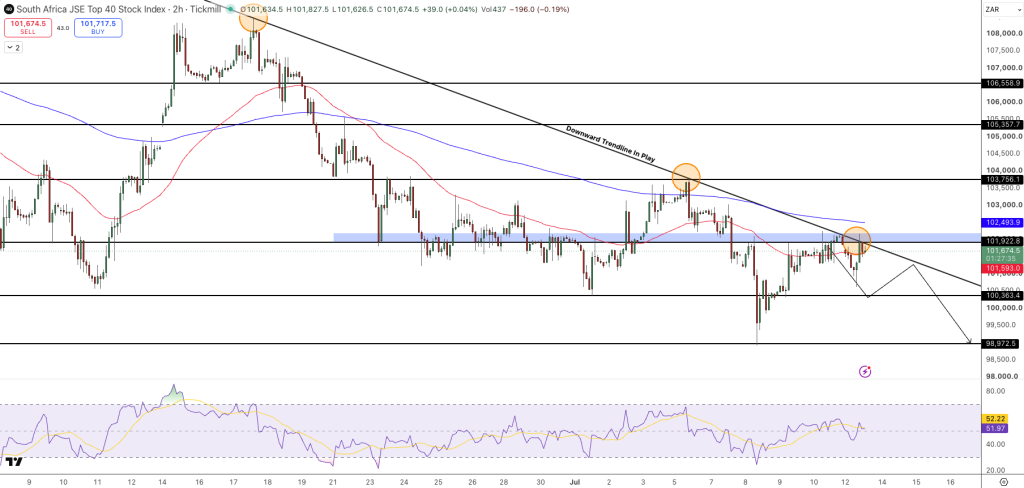
The next level of significant resistance appears to be at 103,756. This level is where the descending trendline converges with the 200-period exponential moving average (EMA).
A successful breakout and close above 103,756 can then see the index target 105,358 and then 106,559. However, if the index continues to trade below the descending trendline, then initial support is expected to be seen at 100,364. A decisive loss of the 100,364 level could allow the JSE Top 40 to target 98,973, before finding support at 97,497. The relative strength index (RSI) trades at 51.97 in the neutral zone, while the MACD histogram continues to trade below zero and flattening out, which suggests that bearish momentum is slowly diminishing.
JSE Top 40 Price Outlook
The JSE Top 40 continues to trade at the cross-roads between global commodity cycles and local domestic economic fundamentals. Although solid fundamentals for critical minerals, falling oil prices, and improving sentiment in global trade continue to lend support, global rates in higher-for-longer territory, a weak domestic economic environment, and ongoing structural challenges will continue to weigh on the broader JSE Top 40. From a technical perspective, a decisive loss below 100,364 would see the bears reassert their dominance in the JSE Top 40 as the next levels of support appear at 98,973 and 97,497. Conversely, if bulls can regain control of the 103,756 level, the index could subsequently move on to targets at 105,358 and 106,559. Investors should monitor Chinese data, commodity prices, fluctuations in the rand, SARB decisions, and company earnings reports, which should all have an influence on the future direction of the JSE Top 40.
- Check out our free forex signals
- Follow the top economic events on FX Leaders economic calendar
- Trade better, discover more Forex Trading Strategies
- Open a FREE Trading Account
- Read our latest reviews on: Avatrade, Exness, HFM and XM

Related Articles



Sidebar rates

Related Posts
 Save
Save