Ethereum Slides Under $2,000 as Whale Distribution, Derivatives Deleveraging, and Macro Headwinds Converge
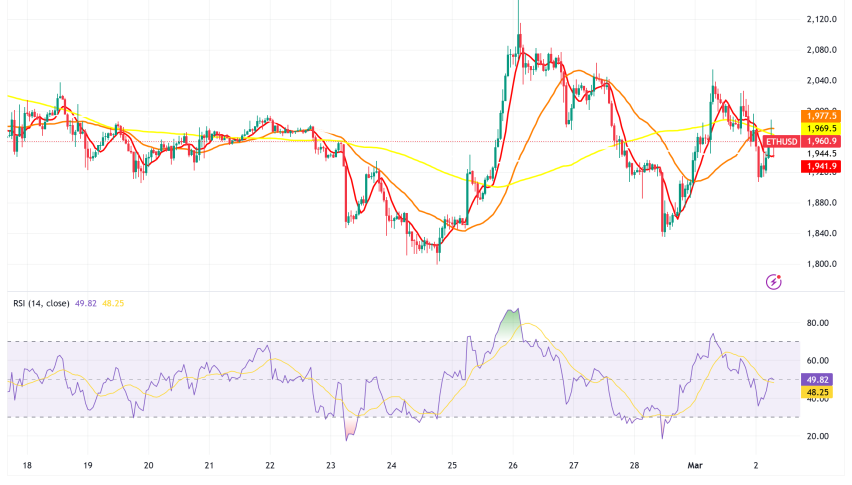
Ethereum (ETH), is currently trading at about $1,963, down 3.8% over the last day due to a combination of bearish factors, including large
Quick overview
- Ethereum (ETH) is currently trading at approximately $1,963, down 3.8% in the last day due to bearish market conditions.
- Large holders are reducing their ETH holdings, contributing to a significant decline in the derivatives market and overall trading volume.
- The macroeconomic environment remains challenging, with high inflation data and geopolitical tensions impacting investor sentiment.
- Despite short-term struggles, Ethereum's long-term development plans, including major architectural changes proposed by Vitalik Buterin, offer potential for future scalability.
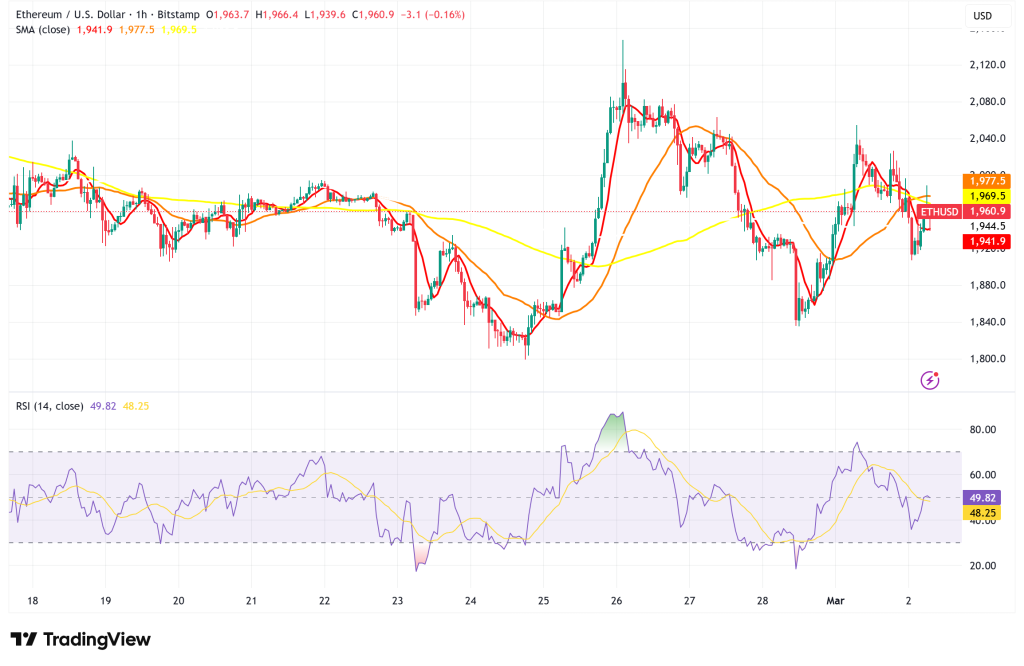
Ethereum ETH/USD, is currently trading at about $1,963, down 3.8% over the last day due to a combination of bearish factors, including large holder selling, a collapsing derivatives market, and a risk-off macro environment.
Altcoins Bear the Brunt as Bitcoin Outperforms
Although general market weakness is a backdrop for Ethereum’s collapse, ETH is being struck more severely than most. Ethereum is significantly underperforming its beta, as evidenced by the fact that Bitcoin plummeted about 2.73% over that time, while the total cryptocurrency market capitalization decreased about 2.62%. A flight away from riskier assets and general investor caution are reflected in the CMC Fear & Greed Index’s decline to a “Extreme Fear” value of 15.
Crucially, the movement doesn’t seem to be being driven by any extraordinary derivatives event or Ethereum-specific on-chain stimulus, such a significant liquidation cascade or an excessive funding rate. Additionally, trading volume has decreased by about 8.75%, indicating that there is little conviction in the selling. This suggests a macro-led, sentiment-driven rotation as opposed to an Ethereum-specific structural issue.
ETH Whales Quietly Unwind, Derivatives Market Shrinks
Data that presents a more alarming picture is beginning to surface beneath the surface. Wallet addresses holding between 100,000 and 1,000,000 ETH have drastically decreased their holdings over the last 90 days, according to cryptocurrency expert Joao Wedson on X. Importantly, non-exchange wallets are responsible for a large portion of this decrease. This implies that significant institutions, early investors, or private holders are actively lowering their exposure, perhaps in reaction to macroeconomic uncertainty or in anticipation of future volatility.
That opinion is being supported by the derivatives market. All exchanges’ Open Interest (OI) has drastically decreased, falling from 7.79 million ETH to 5.8 million ETH. The deleveraging has been significantly more pronounced in terms of dollars: Bybit’s Notional OI was reduced by over two-thirds to $1.9 billion, while Binance’s fell from nearly $12.6 billion to $4.1 billion. There is a general retreat from ETH exposure as traders are cutting leverage and closing holdings.
Macro Pressure: Inflation Data and Geopolitical Shock
Ethereum is not benefiting from the macroeconomic environment. Core Producer Price Index (PPI) data showed a month-over-month increase of +0.8%, indicating that wholesale inflation is still high and that the Fed is unlikely to lower interest rates anytime soon. Cryptocurrency and other risky assets generally do poorly in higher-for-longer rate situations.
The news of US and Israeli military action against Iran over the weekend added to the pressure and sent markets into a tailspin of geopolitical uncertainty, which led to a weekend crypto sell-off from which ETH has yet to recover.
A Silver Lining: Buterin’s Ambitious Execution Layer Overhaul
Ethereum’s long-term development story is still intriguing in spite of the short-term challenges. This week, Vitalik Buterin released a thorough analysis of two fundamental architectural adjustments that he believes are necessary for Ethereum’s future: the ultimate replacement of the EVM with RISC-V and the move to a binary state tree (via EIP-7864).
Light clients would consume significantly less bandwidth thanks to the binary tree update, which would result in Merkle branches that are four times shorter than the current structure. Proving efficiency could increase by 3x to 100x when paired with a more effective hash function. Separately, Ethereum’s execution layer would be in line with the set of instructions that the majority of ZK provers already utilize internally under the RISC-V proposal, which Buterin plans to implement in three stages before the EVM is completely retired.
Since the state tree and virtual machine (VM) together are responsible for over 80% of the network’s proving bottleneck, Buterin has described these modifications as “basically mandatory” for Ethereum’s scalability. The most likely vehicles for these modifications are the Hegota upgrade later in the year and the Glamsterdam update, which is anticipated in the first half of 2026.
ETH/USD Technical Analysis: Bears in Control Below Key Moving Averages
Technically speaking, there are a lot of danger signs on Ethereum’s chart. Short-term negative momentum is in control as ETH is trading below both its 30-day simple moving average (around $2,034) and its 7-day simple moving average (about $1,946). At about 40.2, the Relative Strength Index (RSI) is in oversold territory, but not to the extent that would normally encourage aggressive dip-buying.
The latest swing low at $1,748.63 is the closest noteworthy support. Selling pressure would probably increase if that level were broken; the next significant zone is between $1,600 and $1,700. The first indication of short-term stabilization would be a regain of the 7-day SMA around $1,946; nonetheless, the path of least resistance stays lower until that level is defended.
Ethereum Price Prediction: Caution Warranted in the Near Term
The view for ETH in the upcoming days is, at best, cautious given the existing circumstances. Ethereum may settle in the $2,100–$2,300 range if Bitcoin is able to find a bid and the macro attitude stabilizes. However, ETH might challenge $1,750 quickly if the risk-off rotation continues, especially if global tensions increase or inflation data supports a hawkish Fed.
A deeper correction toward the $1,600–$1,700 range, which hasn’t been seen since late 2024, would be possible if there was a break below $1,748. For bulls to regain momentum, they must witness a clear recovery of $2,034 (the 30-day SMA).
- Check out our free forex signals
- Follow the top economic events on FX Leaders economic calendar
- Trade better, discover more Forex Trading Strategies
- Open a FREE Trading Account
- Read our latest reviews on: Avatrade, Exness, HFM and XM

Related Articles



Sidebar rates

Related Posts
 Save
Save