Oracle (ORCL) Falls 3% Ahead of Earnings as AI Cloud Boom Faces $124B Debt Test and $553B Backlog Scrutiny
Oracle earnings: Oracle nears earnings with AI cloud growth surging, but investors are watching debt, capex, and backlog conversion risks.
Written by:
Arslan Ali Butt•Wednesday, June 10, 2026•3 min read
•Last updated: Wednesday, June 10, 2026
Quick overview
Oracle shares fell nearly 3% ahead of a crucial earnings report, reflecting investor concerns over rising capital expenditures and debt obligations.
The company has a significant $553 billion backlog, indicating strong customer demand for its AI infrastructure services.
Analysts remain optimistic, with expectations of substantial revenue growth and a bullish consensus rating ahead of the earnings announcement.
Oracle's long-term outlook hinges on its ability to convert its backlog into revenue while managing heavy debt and competitive pressures.
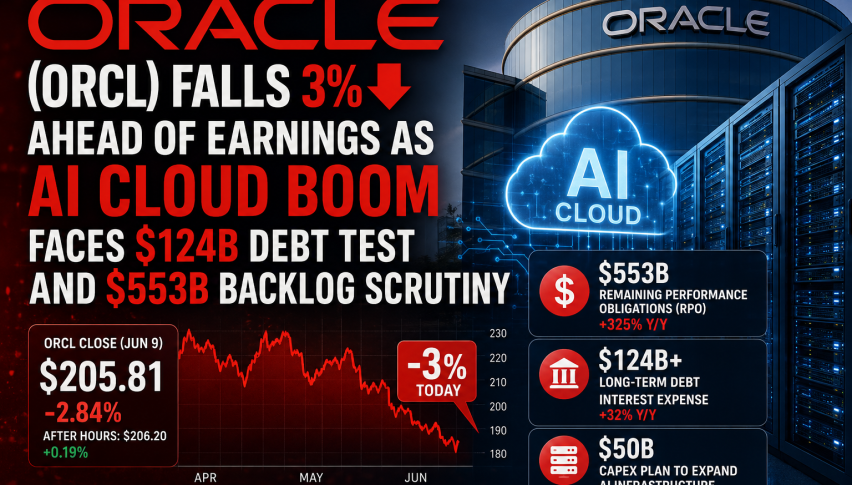
Oracle shares fell nearly 3% on Tuesday ahead of one of the company’s most closely watched earnings reports in years, as investors weighed booming AI-driven cloud demand against rising capital expenditures, growing debt obligations, and questions about long-term profitability.
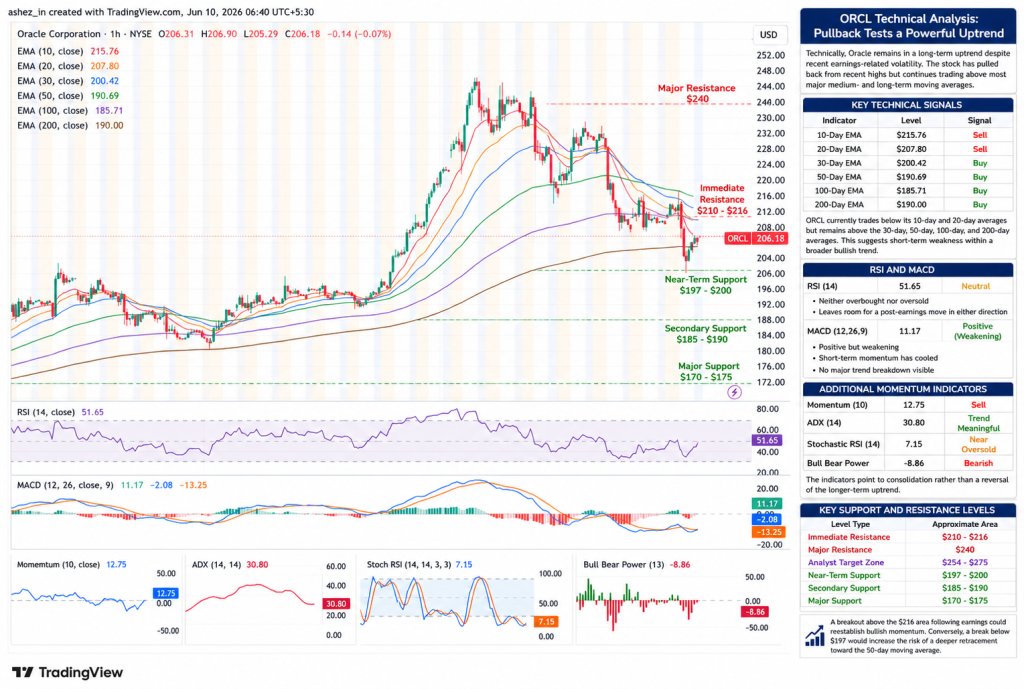
The ORCL stock closed at $205.81, down 2.84%, before recovering slightly in after-hours trading. Despite the recent pullback, Oracle remains one of the strongest-performing large-cap AI infrastructure plays over the past year, benefiting from explosive demand for cloud computing capacity.
The upcoming earnings report could offer one of the clearest signals yet on enterprise AI spending trends and whether Oracle can convert its massive backlog of contracts into sustainable revenue growth.
Oracle’s AI Growth Story Is Accelerating
Oracle has increasingly repositioned itself as an AI infrastructure provider rather than simply a database software company.
The company’s cloud business continues benefiting from soaring demand for AI training and inference workloads.
Analysts expect:
Q4 revenue of approximately $19.1 billion, up about 20% year-over-year
Adjusted EPS of roughly $1.96-$2.00, representing about 15% growth
Cloud infrastructure growth approaching 50%
Continued expansion in Oracle Cloud Infrastructure (OCI)
Several analysts remain bullish ahead of earnings.
Recent price targets include:
Firm
Rating
Price Target
Bank of America
Buy
$240
Oppenheimer
Outperform
$275
Citi
Buy
Raised recently
Consensus
Strong Buy
$254
The bullish case centers on Oracle’s role as one of the primary beneficiaries of hyperscale AI spending.
The $553 Billion Backlog Investors Can’t Ignore
One of Oracle’s most important metrics remains its Remaining Performance Obligations (RPO).
Earlier this year, Oracle reported:
RPO of $553 billion
325% year-over-year growth
One of the largest AI-related contract backlogs in the software industry
That figure suggests customer demand remains exceptionally strong.
However, investors are increasingly focused on whether Oracle can convert those commitments into recognized revenue quickly enough to justify its aggressive spending plans.
Cloud margins, new AI compute agreements, and capacity expansion updates could become the most important parts of the earnings call.
Debt and Capex Are Becoming the Bigger Story
While demand remains robust, Oracle’s balance sheet is attracting increasing scrutiny.
Key figures include:
Long-term debt exceeding $124 billion
Interest expense up roughly 32% year-over-year
Negative trailing free cash flow of approximately $24.7 billion
Up to $50 billion in planned financing initiatives
Roughly $261 billion in additional data-center lease commitments
The company is spending aggressively to build AI infrastructure.
Investors increasingly want evidence that returns will justify the capital being deployed.
Any indication of slowing capacity growth, weaker cloud demand, or rising funding needs could pressure the stock despite strong revenue growth.
Oracle Is Competing Directly in the AI Infrastructure Race
Oracle’s cloud strategy increasingly places it in competition with:
For now, Oracle’s earnings report will likely determine whether investors continue viewing the company as one of the most compelling AI infrastructure stories in the market—or begin focusing more heavily on the costs required to sustain that growth.
Lead Markets Analyst – Multi-Asset (FX, Commodities, Crypto)
Arslan Ali Butt serves as the Lead Commodities and Indices Analyst, bringing a wealth of expertise to the field. With an MBA in Behavioral Finance and active progress towards a Ph.D., Arslan possesses a deep understanding of market dynamics.
His professional journey includes a significant role as a senior analyst at a leading brokerage firm, complementing his extensive experience as a market analyst and day trader. Adept in educating others, Arslan has a commendable track record as an instructor and public speaker.
His incisive analyses, particularly within the realms of cryptocurrency and forex markets, are showcased across esteemed financial publications such as ForexCrunch, InsideBitcoins, and EconomyWatch, solidifying his reputation in the financial community.





 Save
Save