MSFT Stock Tests the Last Support Slipping Toward $445, as Legal Challenges and Competition Pressure Shares
Microsoft shares remain under heavy pressure as investors grow increasingly concerned that soaring AI spending, intensifying competition, and tighter monetary policy could weigh on future profitability.
Quick overview
- Microsoft shares are under pressure due to concerns over rising AI spending, competition, and tighter monetary policy affecting future profitability.
- Despite strong earnings and significant AI deployments, investor sentiment remains cautious, focusing on the high costs of maintaining leadership in cloud and AI.
- The Federal Reserve's hawkish stance has further impacted technology stocks, with Microsoft facing skepticism regarding its AI investment strategy.
- Legal challenges and increasing competition from rivals are adding to the uncertainty surrounding Microsoft's future growth and profitability.
Microsoft shares remain under heavy pressure as investors grow increasingly concerned that soaring AI spending, intensifying competition, and tighter monetary policy could weigh on future profitability.
Microsoft Shares Continue to Slide
Microsoft’s stock remains trapped in a persistent downtrend, with every recovery attempt failing to gain traction as investors continue reducing exposure to high-growth technology companies. Shares have fallen below the $380 level as concerns surrounding artificial intelligence spending, elevated valuations, intensifying competition, and a more hawkish Federal Reserve continue to overshadow the company’s otherwise solid operating performance.
The recent weakness reflects a noticeable shift in investor priorities. Rather than rewarding Microsoft’s leadership in cloud computing and artificial intelligence, markets are increasingly focused on the enormous cost of maintaining that leadership and the uncertain timeline for generating attractive returns on those investments.
Hawkish Federal Reserve Adds Pressure
The broader technology sector came under renewed pressure following the Federal Reserve’s latest policy meeting under Chair Kevin Warsh.
Although interest rates remained unchanged, policymakers adopted a more hawkish tone regarding inflation, leading investors to expect borrowing costs could remain elevated for longer. Treasury yields moved higher while the U.S. dollar strengthened, reducing demand for richly valued growth stocks.
Technology companies, whose valuations depend heavily on future earnings growth, were among the hardest hit. Microsoft, already facing skepticism over its AI investment strategy, extended its decline as investors became increasingly cautious toward the sector.
AI Pricing Changes Highlight Rising Costs
Microsoft also introduced an important strategic change to its artificial intelligence business.
The company announced that its Copilot Cowork platform will transition to a usage-based pricing model designed to better reflect the computational resources consumed by enterprise customers. While the move is intended to improve long-term economics and better align pricing with infrastructure costs, it also serves as a reminder of just how expensive large-scale AI deployment has become.
Microsoft continues investing aggressively in data centers, specialized AI hardware, networking infrastructure, and advanced language models. These investments are essential to maintaining competitiveness, but they have also raised concerns that capital spending is growing much faster than monetization opportunities.
Reports that Microsoft is exploring an Azure-hosted version of DeepSeek to reduce computing costs have added another layer of complexity, introducing potential geopolitical and cybersecurity considerations that investors continue to monitor.
Legal Challenges and Insider Concerns Persist
Investor sentiment has also been weighed down by ongoing legal issues.
Attention has returned to a pending shareholder class-action lawsuit alleging that Microsoft overstated the commercial success and adoption of its Copilot products while understating capacity constraints within its Azure cloud infrastructure.
Although the legal proceedings remain unresolved, the continued headlines have contributed to an already cautious market environment, reinforcing concerns about execution and transparency during one of Microsoft’s largest strategic transitions.
MSFT Stock Weakness – Breaks Key Support
Microsoft shares slipped below the critical $400 level last month but has reclaimed this level again after the surge last week, climb above $465. This area represents both psychological and technical resistance where a number of moving averages stand, making it an important line in the sand. Buyers failed to break above MAs on the weekly chart and we’ve seen 2 week pullback, with MSFT down to $380 again however today buyers are attempting to push MSFT above $400.
MSFT Chart Daily – The Price Returns Lower Again
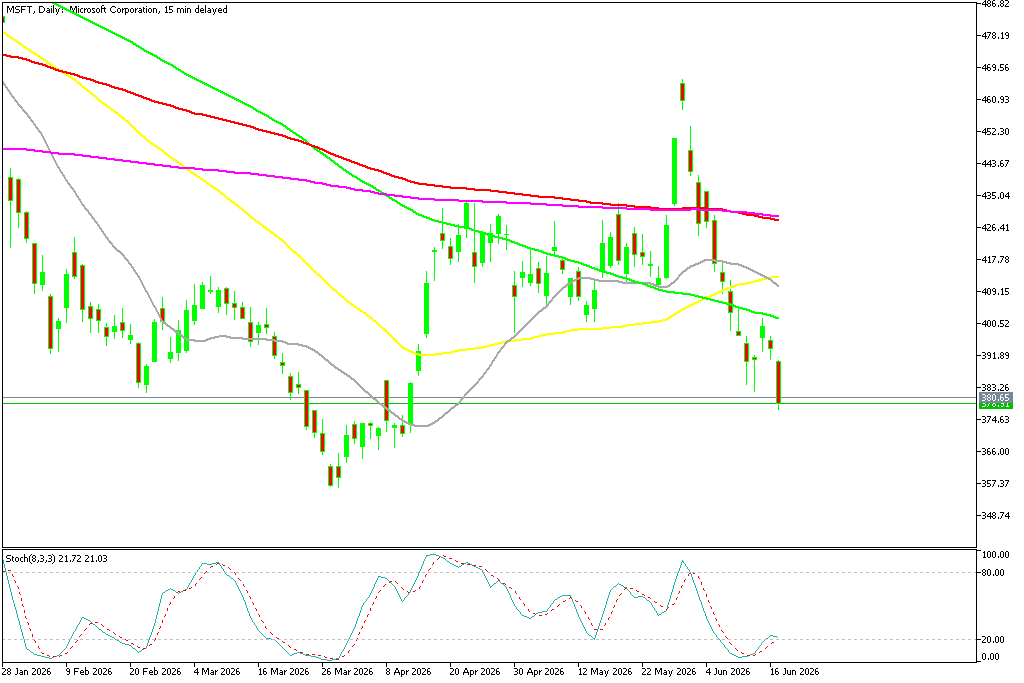
Microsoft’s stock has undergone a notable repricing in recent months, signaling a broader reset in how investors are assessing mega-cap technology leaders. After peaking above $555 in October, shares retreated sharply, shedding around $200.
MSFT Chart Weekly – The 100 SMA Is Giving Up as Support

However the 50 monthly SMA (yellow) held as support once again and we saw a strong rebound in April and May. But, buyers gave up and sellers returned and MSFT stock has fallen to the 50 SMA again which will likely break this time.
MSFT Chart Monthly – The Rebounding Off the 50 SMA Ran into the 20 SMA

Strong AI Adoption Fails to Lift Shares
Ironically, Microsoft’s shares weakened despite announcing one of its most significant enterprise AI deployments to date.
NHS England confirmed plans to roll out Microsoft 365 Copilot to approximately 505,000 clinicians and healthcare staff, making it one of the largest workplace AI implementations globally. The deployment follows successful pilot programs that demonstrated meaningful productivity improvements, with participants reporting substantial time savings on administrative work.
The agreement also includes Copilot Studio, allowing healthcare organizations to build customized AI assistants for workflow automation, financial management, patient support, and operational efficiency.
Despite representing an important validation of Microsoft’s enterprise AI strategy, investors largely overlooked the announcement. Instead, markets remained focused on whether contracts of this scale will generate sufficient profits to justify the company’s rapidly expanding infrastructure investments.
Competition and OpenAI Relationship Create New Uncertainty
Microsoft’s competitive landscape has become increasingly challenging.
Its long-standing partnership with OpenAI has historically been viewed as one of the company’s greatest strategic advantages. However, reports suggesting OpenAI is becoming more flexible in working with multiple cloud providers have prompted investors to reassess the exclusivity and long-term value of that relationship.
At the same time, rivals continue accelerating investments in cloud computing, generative AI, and enterprise software, increasing competitive pressure across Microsoft’s core businesses.
Meanwhile, regulators continue examining Microsoft’s cloud operations, software bundling practices, and AI integration efforts, creating additional uncertainty at a time when investors are already demanding stronger evidence of future profitability.
Massive Investment Budget Dominates Investor Focus
Although Microsoft’s underlying business remains fundamentally strong, its ambitious investment plans continue to dominate the market narrative.
Azure continues delivering robust cloud growth, and the company has consistently exceeded earnings expectations. Nevertheless, investors are increasingly concerned about the scale of planned capital expenditures, with quarterly spending expected to approach $40 billion and total fiscal 2026 investment potentially reaching nearly $190 billion.
Outside cloud computing, Microsoft’s gaming division has also remained under pressure, with Xbox hardware revenue declining for a second consecutive quarter.
Taken together, rising AI infrastructure costs, intensifying competition, regulatory scrutiny, legal uncertainty, and a more restrictive interest-rate environment have significantly weakened investor confidence. Until Microsoft demonstrates that its massive AI investments can generate sustainable earnings growth and stronger margins, rallies are likely to continue attracting sellers, leaving the stock vulnerable to further downside despite its strong long-term business fundamentals.
Microsoft Q3 2026 Earnings Highlights
Revenue beats expectations:
- Microsoft Corporation reported $82.9 billion in revenue, up 18% year-over-year, marking a record quarter and surpassing forecasts.
Profitability strengthens:
- Operating income rose 20% to $38.4 billion, while net income increased 23% to $31.8 billion, reflecting strong margin performance.
Earnings growth remains robust:
- Diluted earnings per share came in at $4.27, up 23% on a GAAP basis, signaling consistent bottom-line expansion.
Cloud Segment Drives Growth
Cloud revenue surges:
- Microsoft Cloud generated $54.5 billion, up 29% year-over-year, remaining the key growth engine.
Azure leads momentum:
- Azure and other cloud services grew 40%, highlighting strong enterprise demand for cloud infrastructure and advanced computing services.
- Check out our free forex signals
- Follow the top economic events on FX Leaders economic calendar
- Trade better, discover more Forex Trading Strategies
- Open a FREE Trading Account
- Read our latest reviews on: Avatrade, Exness, HFM and XM

Related Articles
Sidebar rates

Related Posts
 Save
Save