Will SNDK Stock Fall Below $1,500 as Memory Selloff Erases SanDisk’s June Gains?
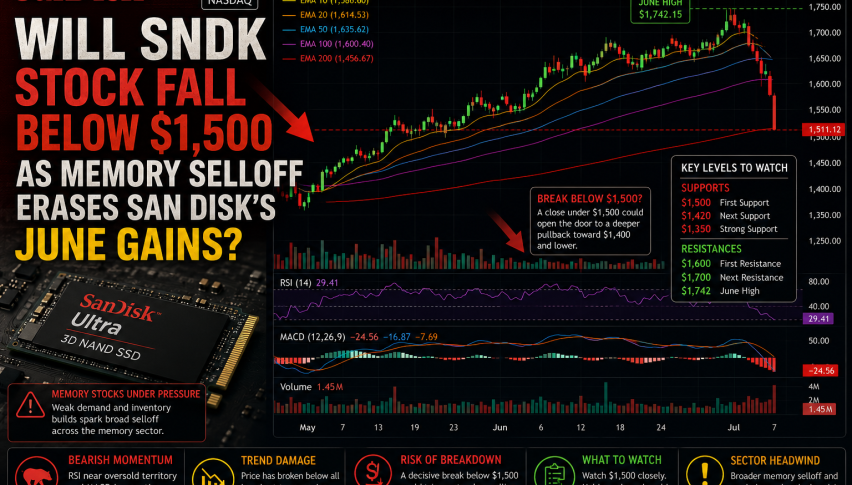
SanDisk stock SNDK slides toward $1,600 as memory profit-taking hits, with $1,578-$1,637 now key support for bulls.
Quick overview
- SanDisk's stock has experienced a significant selloff after a historic rally, raising concerns about the durability of the memory cycle.
- Despite strong fiscal Q3 results, investors are questioning whether current margins can withstand new capacity additions in the memory market.
- The company's long-term contracts are crucial for stabilizing pricing, but a majority of supply remains exposed to market fluctuations.
- Technical indicators suggest that SanDisk is at a critical support level, with potential for further declines if key price thresholds are breached.
SanDisk shares extended their sharp correction as investors took profits across AI-linked memory stocks, testing whether long-term NAND contracts can protect margins after a historic rally.
SanDisk Selloff Deepens as Memory Rally Cools
SanDisk stock remains under heavy pressure after one of the strongest rallies in the market this year. The selloff reflects profit-taking, concerns about memory-cycle durability, and fears that NAND supply tightness may not last as long as bulls expect.
Profit-Taking Hits After Huge AI Memory Rally
SanDisk had become one of the biggest winners of the AI storage trade, with the stock surging more than 7x year to date and at one point approaching a gain of nearly 900%.
That kind of move left the stock vulnerable to violent reversals. After peaking above $2,350, SNDK has fallen back toward the $1,600 region, erasing much of its recent momentum.
The latest decline came as memory and storage stocks weakened broadly, including Micron, Western Digital, Seagate, Samsung, and SK Hynix. Investors are no longer just asking whether AI demand is strong. They are asking whether current margins and pricing can survive new capacity additions.
Samsung Selloff Raises Sector-Wide Questions
Samsung’s record Q2 guidance initially looked bullish for the memory sector, but the market reaction was negative.
Samsung shares fell sharply in Seoul, while SK Hynix and the broader KOSPI also dropped. That reaction suggested investors had already priced in strong earnings and were now focused on whether DRAM and NAND price gains can continue.
For SanDisk, this matters because the bull case depends on tight supply, rising enterprise SSD demand, and AI data-center storage growth. If investors begin to believe the memory cycle is peaking, even strong current earnings may not be enough to support the valuation.
SanDisk Fundamentals Still Look Strong
The selloff is not being driven by weak company results.
SanDisk’s fiscal Q3 revenue reached $5.95 billion, up 97% sequentially. Data-center revenue rose to $1.47 billion, while Edge revenue reached $3.66 billion. Consumer revenue was softer at $820 million, but still up year over year.
The company also guided Q4 revenue to $7.75 billion to $8.25 billion, with non-GAAP EPS expected between $30 and $33.
SanDisk’s remaining performance obligations stood near $41.6 billion, highlighting the strength of multi-year customer commitments. However, only about 15% of that amount is expected to convert into revenue over the next 12 months.
SanDisk’s Long-Term Contracts Are the Key Test
Management has emphasized a shift toward multi-year agreements designed to reduce cyclicality.
That is important because NAND has historically been a boom-and-bust market. Long-term contracts can stabilize pricing and demand, but they do not yet cover all future supply. Reports suggest SanDisk has locked in more than a third of fiscal 2027 bit supply under multi-year partnerships, leaving a majority still exposed to market pricing.
This is the central debate for investors. If SanDisk can expand the share of committed supply, the market may treat it as a more predictable AI storage business. If not, the stock could continue trading like a cyclical memory name.
SNDK Technical Analysis: Breakdown Tests the 100 SMA
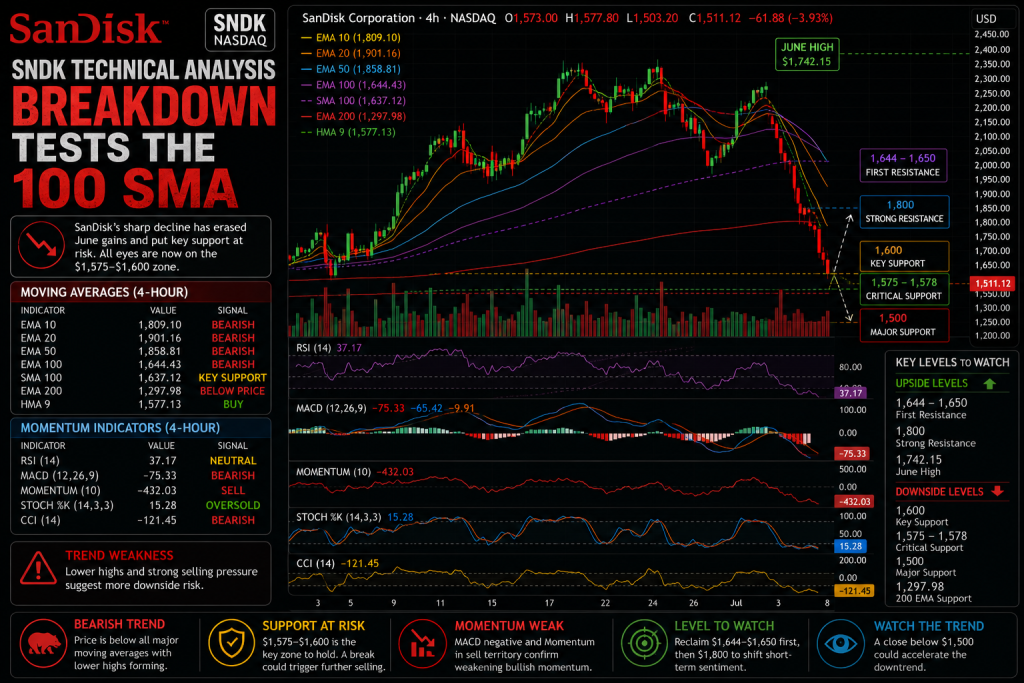
From a technical perspective, SanDisk’s 4-hour chart has weakened sharply.
SNDK is trading below the 10 EMA at $1,809.10, 20 EMA at $1,901.16, and 50 EMA at $1,858.81, showing sellers control the short-term trend. The stock is also below the 100 EMA at $1,644.43 and near the 100 SMA at $1,637.12, making this zone a key battleground.
Momentum remains weak. MACD is negative at -75.33, while Momentum shows a sell signal at -432.03. RSI sits at 37.17, not deeply oversold yet, but close enough for traders to watch for a possible relief bounce.
The Hull Moving Average at $1,577.13 is flashing a buy signal, aligning closely with after-hours pricing near $1,578. That makes the $1,575-$1,600 region the immediate support zone.
Key Levels: $1,600, $1,500 and $1,800
The first support level is $1,600, followed by $1,575-$1,578. If that area breaks, SNDK could fall toward $1,500, where dip buyers may attempt to stabilize the stock.
Below $1,500, the next major support sits near the 4-hour 200 EMA at $1,297.98, though a move that deep would represent a major valuation reset.
On the upside, bulls need to reclaim $1,644-$1,650 first. A stronger recovery would need a move above $1,800, where short-term moving averages begin to cluster.
SanDisk Has Had Blowout Growth, But Cycle Risk Returns
SanDisk’s business remains supported by AI data-center storage demand, long-term customer contracts, BiCS10 NAND progress, and strong cash generation.
However, the stock’s valuation and recent price action show that investors are becoming less willing to ignore memory-cycle risk. After such a massive rally, even excellent results may not be enough if traders believe supply growth will eventually pressure NAND pricing.
For now, $1,575-$1,600 is the level bulls need to defend. A break below that range could put $1,500 in play, while a rebound above $1,800 would be needed to show that the correction is losing force.
- Check out our free forex signals
- Follow the top economic events on FX Leaders economic calendar
- Trade better, discover more Forex Trading Strategies
- Open a FREE Trading Account
- Read our latest reviews on: Avatrade, Exness, HFM and XM

Related Articles
Sidebar rates

