IBM Stock Crashes 25% as Q2 Warning Breaks Support and Raises AI Software Fears
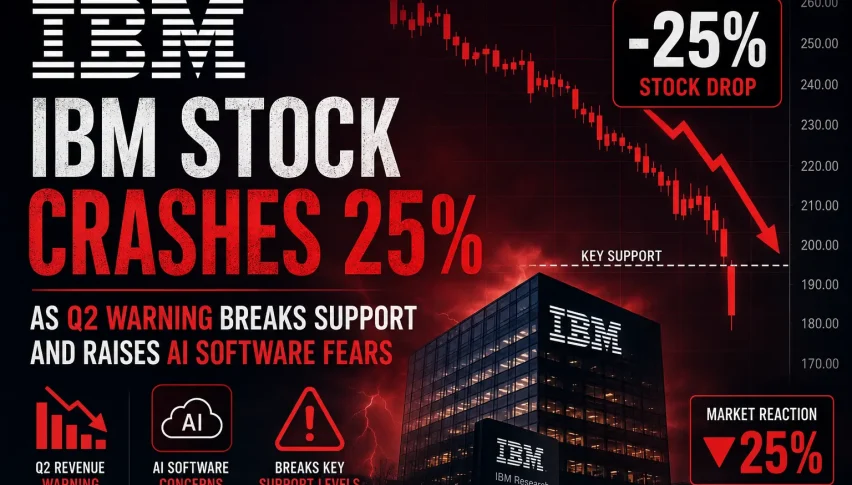
IBM stock crashes 25% after a Q2 warning as software weakness and AI-driven hardware spending shift trigger a technical breakdown.
Quick overview
- IBM shares experienced their worst single-day decline on record, dropping over 25% after disappointing preliminary Q2 results.
- The company's revenue of $17.2 billion and EPS of $2.93 fell short of market expectations, leading to investor shock.
- A shift in client spending towards AI infrastructure hardware has negatively impacted IBM's software and infrastructure deals.
- Despite the selloff, IBM's management must demonstrate that their software and consulting services can still capture enterprise spending amidst changing priorities.
IBM shares suffered their worst day on record after preliminary Q2 results missed expectations, as clients shifted spending away from software toward AI infrastructure hardware.
IBM Plunges as Earnings Warning Sparks Software Sector Selloff
International Business Machines shares plunged on Tuesday after the company released preliminary second-quarter results that badly disappointed investors.
IBM closed at $217.07, down more than 25%, before rebounding slightly to $219.51 in after-hours trading. The move marked the stock’s worst single-day decline on record, even surpassing its drop during the 1987 Black Monday crash.
According to TradingView, IBM’s latest reported Q2 revenue was $17.2 billion, with EPS of $2.93. Both figures fell short of market expectations, with analysts looking for revenue closer to $17.86 billion and adjusted EPS around $3.01-$3.02.
The warning shocked investors because IBM had recently been viewed as a steadier software, consulting and hybrid-cloud name within the broader technology sector.
Clients Shift Spending Toward AI Hardware
The central issue was not a collapse in enterprise technology demand, but a shift in where that demand is going.
CEO Arvind Krishna said customers redirected late-quarter capital spending toward servers, storage and memory purchases to secure supply-constrained infrastructure ahead of expected price increases.
That shift hurt IBM because customers delayed or paused large software and infrastructure deals that the company expected to close during the quarter.
This is a major signal for investors. The AI infrastructure boom is still creating huge spending across technology, but the beneficiaries are increasingly memory-chip makers, storage providers and server suppliers rather than traditional enterprise software vendors.
That is why IBM’s warning also pressured other software names, including Microsoft, Salesforce, ServiceNow and Intuit.
AI Disruption Fears Return to Software Stocks
IBM’s warning revived a larger concern that has been building across the software sector: artificial intelligence may change customer spending priorities faster than expected.
Enterprise clients are racing to secure infrastructure needed for AI workloads, including memory chips, servers and data center capacity. At the same time, some customers are pausing software purchases as they evaluate how new AI tools may alter future needs.
Krishna pushed back against the idea that IBM’s software is being disrupted directly by AI, saying the company does not see its software business being displaced. However, he acknowledged that clients are reassessing spending patterns, especially around cybersecurity and infrastructure decisions.
That distinction may not be enough for investors in the short term. The market is now asking whether AI is pulling budget away from higher-margin software and toward lower-margin or more cyclical infrastructure spending.
Hardware Winners Highlight IBM’s Problem
The contrast with memory and AI infrastructure companies is becoming more obvious.
While IBM sold off, memory names such as Micron and SK Hynix have been among the biggest beneficiaries of the AI buildout, as demand for high-bandwidth memory, servers and storage has surged.
That creates a difficult narrative for IBM. Investors are not rejecting technology spending; they are rotating toward the areas where AI demand is strongest.
For IBM to regain confidence, management will need to show that software, consulting, hybrid cloud and AI services can still capture meaningful enterprise spending even as clients prioritize infrastructure purchases.
IBM’s Q1 Strength Makes the Reversal More Painful
The magnitude of the selloff was amplified because IBM had entered the quarter with relatively strong momentum.
In Q1, IBM reported better-than-expected results, with software revenue growing 11% to $7.05 billion. Adjusted EPS of $1.91 beat expectations, while revenue of $15.92 billion also came in ahead of estimates.
That performance had supported confidence in IBM’s software-led growth strategy.
The Q2 warning challenged that view. Revenue growth of only about 1% year over year suggested that the company’s execution was weaker than investors expected, especially given the strong technology spending environment elsewhere.
Krishna admitted that IBM “faltered” and did not adapt quickly enough as several large deals failed to close on expected timelines.
IBM Technical Analysis: Massive Gap Below Moving Averages
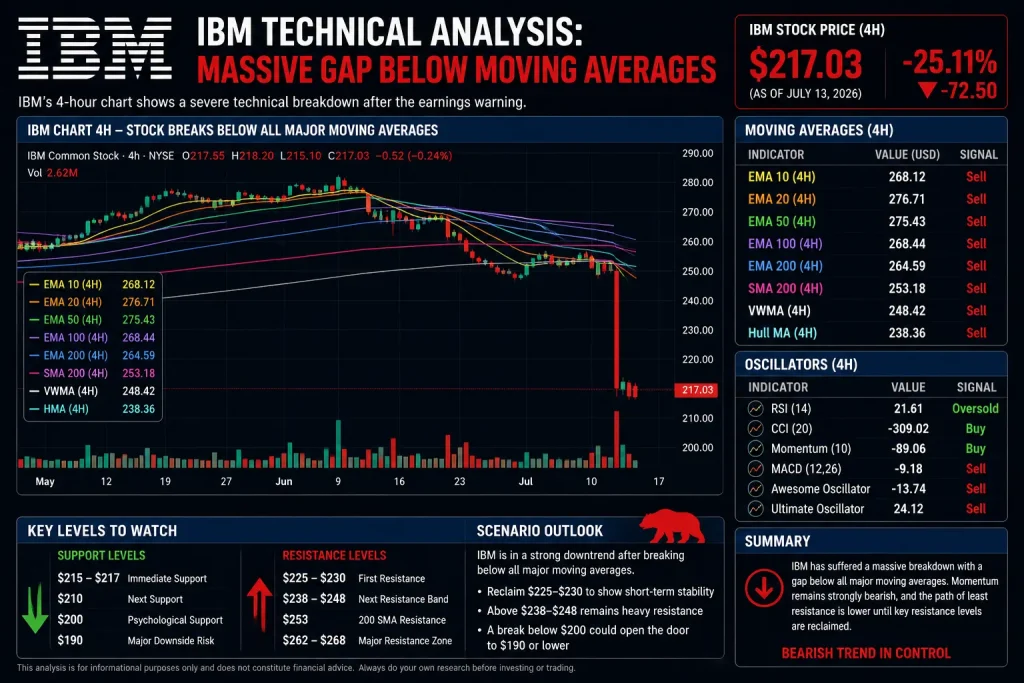
IBM’s 4-hour chart shows a severe technical breakdown after the earnings warning.
IBM Chart 4H – Stock Breaks Below All Major Moving Averages
IBM is trading far below every major moving average listed on the 4-hour chart. The 10-period EMA sits near $268.12, while the 20-period EMA is around $276.71. These levels are now far above the current price and represent major overhead resistance.
The 50-period EMA near $275.43, 100-period EMA near $268.44 and 200-period EMA near $264.59 all confirm that the prior trend has been broken. The 200-period SMA near $253.18 is now the first major long-term moving-average resistance if IBM attempts a rebound.
The VWMA near $248.42 and Hull Moving Average near $238.36 also sit above current levels, showing that even shorter-term recovery levels are now well overhead.
Oscillators show extreme downside pressure. RSI is at 21.61, indicating deeply oversold conditions, while the CCI at -309.02 and Momentum at -89.06 are flashing buy signals that may reflect short-term exhaustion. However, MACD, Awesome Oscillator and Ultimate Oscillator remain on sell, confirming that bearish momentum has not yet fully reversed.
Key Levels to Watch
The first immediate support level is the $215-$217 area, where the stock closed after the collapse. If that zone fails, sellers could target $210, followed by the psychological $200 level.
A break below $200 would represent another major technical and sentiment blow, potentially opening the door toward $190.
On the upside, IBM needs to reclaim $225-$230 first to show any short-term stabilization. Above that, $238-$248 becomes the next resistance band, followed by the 200-period SMA near $253.
A move back above $253 would help reduce some downside pressure, but IBM would still face heavy resistance near $262-$268, where several longer-term averages are clustered.
Oversold Bounce Possible for IBM, but Confidence Is Damaged
IBM’s stock is now deeply oversold after a historic one-day collapse, which means a short-term rebound is possible if bargain hunters step in.
However, the broader issue is confidence. Investors were not only reacting to a quarterly miss. They were reassessing whether IBM’s software and infrastructure strategy can keep pace as enterprise budgets shift toward AI hardware, memory, storage and cybersecurity priorities.
The company still has meaningful strengths, including hybrid cloud, consulting relationships, enterprise software and a dividend yield above 2%. But after Tuesday’s warning, the market will likely demand proof that large deals are closing again and that Q2 weakness was not the start of a longer spending shift.
For now, IBM remains technically vulnerable below $238-$248. Holding $215 is critical for stabilization, while a break below $200 would confirm another leg lower. A recovery above $253 would be needed before investors can begin treating the selloff as a temporary overreaction rather than a deeper reset.
- Check out our free forex signals
- Follow the top economic events on FX Leaders economic calendar
- Trade better, discover more Forex Trading Strategies
- Open a FREE Trading Account
- Read our latest reviews on: Avatrade, Exness, HFM and XM

Related Articles

Sidebar rates

Related Posts
 Save
Save