AMD Stock Heads Toward $500 Ahead of Earnings as MSFT and Palantir Revive Optimism
AMD shares have rebounded sharply toward $500 after falling near $400, with stronger Microsoft Azure growth and Palantir's upbeat results restoring confidence in AI infrastructure demand, although elevated expectations and semiconductor risks remain ahead of earnings.
Quick overview
- AMD shares have sharply rebounded toward $500 after falling to around $400, driven by strong Microsoft Azure growth and positive Palantir earnings.
- The recovery has raised investor expectations ahead of AMD's earnings report, with concerns about semiconductor valuations and competition from China still looming.
- Microsoft's Azure growth indicates continued investment in AI infrastructure, which is crucial for AMD's data-center business strategy.
- While the recent developments are positive, the sustainability of AI spending remains a critical question for AMD's future growth.
AMD shares have rebounded sharply toward $500 after falling near $400, with stronger Microsoft Azure growth and Palantir’s upbeat results restoring confidence in AI infrastructure demand, although elevated expectations and semiconductor risks remain ahead of earnings.
AMD Shares Stage a Sharp Recovery
AMD stock has staged another dramatic reversal ahead of its earnings report, recovering toward the $500 level after falling to around $400 last week.
The rebound accelerated as stronger-than-expected Microsoft Azure growth and Palantir’s latest results eased concerns that the enormous AI infrastructure spending cycle could be losing momentum. The improved sentiment has helped semiconductor stocks recover, with AMD once again approaching levels that appeared increasingly difficult to reach only days ago.
However, the speed of the recovery also creates a more complicated setup for investors.
AMD’s shares are now entering earnings with considerably higher expectations, while concerns surrounding semiconductor valuations, Chinese competition and the sustainability of hyperscaler capital spending have not disappeared.
The upcoming results could therefore determine whether the latest rally develops into a broader recovery or simply becomes another volatile move within a larger correction.
Microsoft Azure Revives Memory Infrastructure Optimism
Microsoft’s latest results provided an important boost to the semiconductor sector.
Stronger Azure growth indicated that cloud customers continue committing substantial amounts of capital to data centers and the infrastructure required to support expanding AI workloads.
That includes processors, accelerators, networking equipment, storage, power systems and cooling infrastructure.
For AMD, the development is particularly important because the company’s growth strategy increasingly depends on its data-center business.
AMD is competing for a larger share of the market for server CPUs while simultaneously expanding its Instinct AI accelerator business. Continued spending from hyperscalers therefore provides an important foundation for future revenue growth.
The positive Azure numbers have helped calm fears that AI-related capital expenditure could be approaching a peak.
Still, investors should distinguish between a temporary improvement in sentiment and evidence that the current spending cycle can continue indefinitely.
Microsoft’s strong growth may delay concerns about an eventual slowdown, but it does not eliminate them.
Palantir Earnings Add to the Positive Signal
Palantir’s latest earnings report provided another reason for technology investors to become more optimistic.
The company’s strong commercial growth and increased remaining deal value reinforced the argument that businesses are moving beyond AI experimentation and deploying the technology at greater scale.
For AMD, stronger enterprise AI adoption could translate into increased demand for the computing infrastructure required to operate these workloads.
The combination of robust Azure growth and Palantir’s strong commercial performance has therefore created a more favorable backdrop heading into AMD’s earnings announcement.
But the positive developments also raise the bar.
After AMD’s sharp rebound, investors may now expect particularly strong results and guidance. A merely solid quarter could potentially disappoint if the market has already priced in much of the anticipated improvement.
Data Center which Faces Lots of Opposition Growth Remains Central to AMD
Wall Street expectations for AMD’s data-center business have continued to strengthen.
CEO Lisa Su previously increased the company’s estimate for the AI server CPU total addressable market to approximately $220 billion by 2030, up from the earlier $120 billion estimate.
The expansion reflects expectations that AI agents and increasingly complex workloads will require significant CPU resources alongside specialized AI accelerators.
Analysts have also highlighted the potential for AMD’s server CPUs and data-center GPUs to outperform earlier expectations.
Susquehanna analyst Christopher Rolland has maintained a bullish view and raised his AMD price target to $500 from $450, citing stronger expectations for the company’s data-center operations.
Potential customer wins and the ramp-up of AMD’s MI450 data-center GPU platform could provide additional catalysts.
Yet these optimistic forecasts also illustrate the problem facing the stock: expectations are becoming increasingly ambitious.
AI Spending Remains the Biggest Question
The central issue for AMD remains the sustainability of the AI investment cycle.
Hyperscalers have committed enormous sums toward data centers, advanced processors, networking, electricity, cooling and related infrastructure.
AMD is positioned to benefit from this spending, particularly if customers diversify their hardware suppliers and seek alternatives in both CPUs and AI accelerators.
However, the current valuation assumes that the spending boom can remain powerful for an extended period.
That creates vulnerability.
If cloud companies eventually slow capital expenditure, postpone data-center projects or demand stronger returns from AI investments, semiconductor growth expectations could be revised quickly.
There is also the possibility that AI infrastructure spending becomes less capital intensive as models and computing systems become more efficient.
That would not necessarily eliminate demand for AMD’s products, but it could reduce the pace of growth investors currently expect.
Share Price Rebounds Again Swiftly
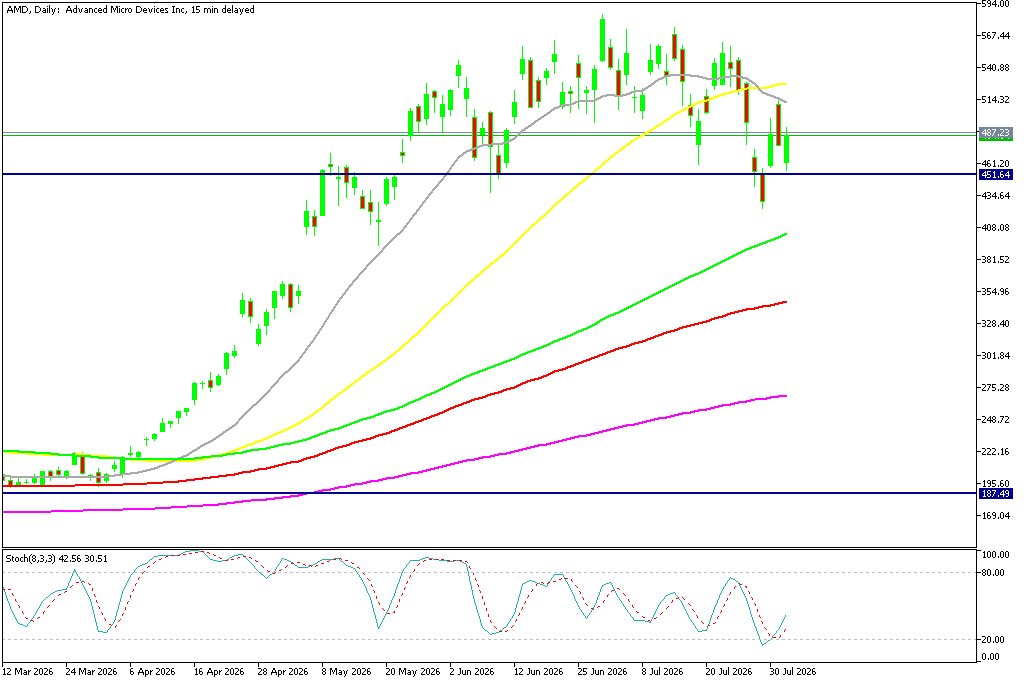
AMD shares fell sharply, sliding roughly 20% in January and pushing the stock below the $200 level. But the 100 SMA (red) acted as support on the daily chart. The price soared higher for three months, with the 20 daily SMA (gray) and reaching a high of $584 in late June before reversing lower and falling below $500 this week, breaking the 50 daily SMA as well, which opened the door for further declines toward $450 support, which was also broken last week but we’re seeing a strong jump higher, although the earnings will decide tomorrow.
AMD Chart Daily – Heading to the 100 SMA
China Competition Remains a Long-Term Risk
AMD must also navigate an increasingly complicated global semiconductor environment.
China continues investing heavily in domestic chip manufacturing as it attempts to reduce its dependence on foreign technology.
Although AMD is not primarily a memory manufacturer, stronger domestic Chinese semiconductor capabilities could eventually influence the wider industry through pricing, supply chains and competition.
Improving Chinese technology could also create additional pressure across multiple semiconductor categories.
The impact on AMD may remain limited in the near term, but investors cannot ignore the possibility that China’s expanding chip ecosystem will become a more significant competitive factor over time.
Valuation Leaves Little Room for Disappointment
AMD’s rapid recovery toward $500 has restored bullish momentum, but it has also increased the importance of valuation.
The stock’s recent volatility demonstrates how quickly sentiment can change when investors question AI spending expectations.
After such a strong rebound, AMD now needs to deliver more than simply good quarterly numbers.
Investors will be watching revenue growth, data-center performance, AI accelerator demand, gross margins and forward guidance.
Management commentary on hyperscaler spending will likely be particularly important.
Any indication that customers are becoming more cautious could quickly revive concerns about the sustainability of the rally.
Conclusion: Stronger Momentum, Higher Expectations
AMD enters its earnings report with a considerably more favorable market backdrop than it faced only a few sessions ago.
Stronger Microsoft Azure growth, Palantir’s impressive results and continued expectations for data-center expansion have helped restore confidence in the AI infrastructure trade.
However, the recovery toward $500 has also raised the stakes.
AMD remains exposed to the possibility of slowing AI capital expenditure, elevated semiconductor valuations and intensifying competition from China’s growing chip industry.
The long-term opportunity remains substantial, but investors are increasingly demanding evidence that AI infrastructure spending can translate into sustainable revenue and earnings growth.
For now, AMD’s rebound is encouraging, but tomorrow’s earnings report will determine whether the move toward $500 represents the beginning of a stronger recovery or another short-lived rally in an increasingly volatile semiconductor market.
- Check out our free forex signals
- Follow the top economic events on FX Leaders economic calendar
- Trade better, discover more Forex Trading Strategies
- Open a FREE Trading Account
- Read our latest reviews on: Avatrade, Exness, HFM and XM

Related Articles
Sidebar rates

Related Posts
 Save
SaveAva