AMD Stock Breaks Below $450 Support Despite Radeon RX 9050 Launch, as the Chip Sector Slumps
AMD shares have come under renewed selling pressure ahead of the company's earnings report, with investors questioning the sustainability of AI infrastructure spending, elevated semiconductor valuations, and rising competition from China as the stock breaks below the important $450 support level.
AMD shares have come under renewed selling pressure ahead of the company’s earnings report, with investors questioning the sustainability of AI infrastructure spending, elevated semiconductor valuations, and rising competition from China as the stock breaks below the important $450 support level.
AMD Stock Falls Below $450 as AI Spending Concerns and China Competition Weigh Ahead of Earnings
Advanced Micro Devices (AMD) shares have extended their recent decline, breaking below the key $450 support level as investors adopt a more cautious stance ahead of the company’s August 4 earnings report. The latest weakness reflects a combination of deteriorating semiconductor sentiment, concerns over the sustainability of AI infrastructure spending, elevated industry valuations, and intensifying competition from China’s rapidly expanding chip industry.
After trading near record highs around $574 only weeks ago, AMD has entered a sharp correction that has significantly weakened its technical outlook. With the next major support level now under pressure, investors are demanding stronger evidence that the enormous investment flowing into artificial intelligence can translate into sustainable earnings growth rather than simply fueling another costly technology spending cycle.
AMD Shares Lose Momentum Below Key Support
AMD’s decline has accelerated as selling pressure spread throughout the semiconductor sector.
The stock has now fallen below the important $450 support zone, a level that many technical traders had viewed as critical for maintaining the longer-term bullish trend. The breakdown has reinforced bearish momentum and increased the risk of additional downside should investors continue reducing exposure to high-growth technology stocks.
The timing of the weakness is particularly significant.
AMD is due to report quarterly earnings on August 4, leaving investors reluctant to build new positions before management provides updated guidance on AI demand, data-center growth, margins, and future capital requirements.
Ahead of the report, market participants appear increasingly focused on execution rather than long-term promises.
Radeon RX 9050 Launch Draws Mixed Attention
AMD recently expanded its desktop graphics lineup with the launch of the Radeon RX 9050, introducing the $279 graphics card across Asia-Pacific, Japan, and Latin American markets.
However, the launch has also generated confusion after AMD confirmed that some original equipment manufacturer (OEM) systems will include a separate 4GB version of the RX 9050 using a narrower 64-bit memory bus.
That version delivers roughly half the memory bandwidth of the standard retail 8GB model featured in AMD’s promotional material.
While the product launch broadens AMD’s presence in entry-level graphics, the announcement has done little to improve investor sentiment as markets remain focused on much larger questions surrounding AI demand and semiconductor spending.
Massive AI Infrastructure Agreement Fails to Lift the Stock
One of AMD’s most significant recent announcements was its strategic partnership with Core Scientific.
The agreement provides AMD with access to more than 500 megawatts of AI-ready data-center capacity beginning in 2027 and includes the potential to expand to approximately 2.5 gigawatts over time.
Core Scientific will collaborate with AMD on physical infrastructure design while deploying AMD processors and software throughout the facilities. AMD also received warrants to purchase Core Scientific shares under specified commercial conditions.
Ordinarily, such an agreement would have been viewed as a major growth catalyst.
Instead, investors reacted cautiously.
Rather than focusing solely on the opportunity, markets increasingly viewed the announcement as another reminder of the enormous financial commitments required to build next-generation AI infrastructure.
The larger these projects become, the more investors question whether future returns will justify today’s extraordinary spending.
Share Price Reverses Swiftly
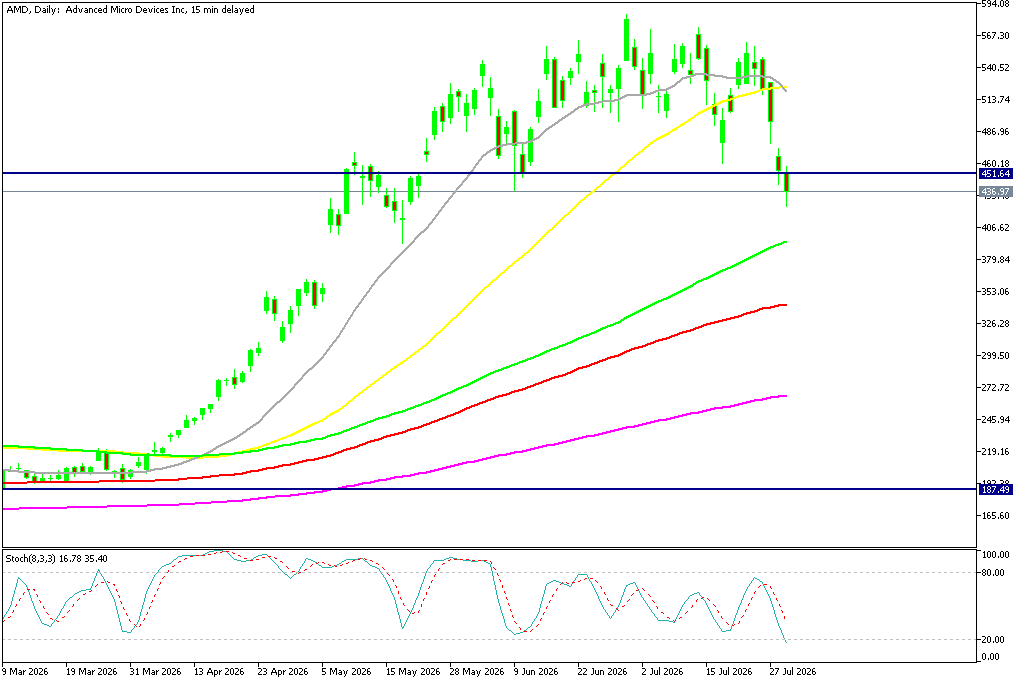
AMD shares fell sharply, sliding roughly 20% in January and pushing the stock below the $200 level. But the 100 SMA (red) acted as support on the daily chart. The price soared higher for three months, with the 20 daily SMA (gray) and reaching a high of $584 in late June before reversing lower and falling below $500 this week, breaking the 50 daily SMA as well, which opened the door for further declines toward $450 support, which was also broken today.
AMD Chart Daily – Heading to the 100 SMA
AI Spending Faces Growing Scrutiny
The AI investment boom has fueled much of AMD’s remarkable share-price appreciation over the past two years.
Cloud providers, hyperscale data-center operators, and major technology companies have committed hundreds of billions of dollars toward advanced processors, networking equipment, memory, cooling systems, and power infrastructure.
However, investor sentiment has begun shifting.
Recent earnings reports from several large technology companies revealed another wave of sharply higher capital expenditure plans.
Although those investments demonstrate confidence in AI, they also raise concerns about free cash flow, return on invested capital, and the length of time required before these projects generate meaningful financial returns.
AMD benefits directly from higher AI spending through demand for its Instinct accelerators and data-center products.
The problem is that much of AMD’s valuation now depends on customers continuing to spend aggressively for years.
Should hyperscale customers eventually moderate capital expenditure or delay projects, AMD’s long-term growth expectations could quickly be reassessed.
Intel’s Results Highlight Changing Investor Priorities
The semiconductor sector recently received an important warning following Intel’s earnings release.
Intel reported its fastest revenue growth in approximately fifteen years.
Despite the impressive top-line performance, investors focused instead on rising capital expenditure, ongoing foundry losses, and profitability concerns.
The market reaction demonstrated that revenue growth alone is no longer sufficient.
Investors increasingly want semiconductor companies to convert strong demand into expanding margins, sustainable earnings growth, healthy cash flow, and attractive returns on capital.
AMD now faces exactly the same challenge ahead of its earnings announcement.
Strong AI accelerator sales may not be enough if guidance suggests rising costs or slowing profitability.
Chinese Semiconductor Competition Intensifies
AMD is also navigating an increasingly competitive global semiconductor landscape.
China continues investing aggressively in domestic semiconductor development as part of its long-term strategy to reduce dependence on foreign suppliers.
Companies such as ChangXin Memory Technologies continue expanding production capacity, while reports that Apple is evaluating Chinese-produced memory components for devices sold domestically have increased investor concerns about the pace of China’s technological progress.
Although AMD does not compete directly in memory manufacturing, the expansion of China’s semiconductor ecosystem could eventually affect pricing dynamics and competitive conditions across multiple chip categories.
Government support, rising investment, and improving technology have strengthened concerns that Chinese companies could gradually challenge established global manufacturers over the coming years.
For investors, this represents another long-term uncertainty at a time when semiconductor valuations already remain demanding.
Broader Semiconductor Weakness Adds Pressure
AMD’s decline is occurring within a much wider selloff across semiconductor stocks.
Major Asian chipmakers, including Samsung Electronics and SK Hynix, have experienced heavy selling pressure, while numerous U.S. semiconductor companies have also retreated sharply.
The weakness suggests investors are reassessing the entire AI investment cycle rather than reacting to isolated company-specific developments.
Following one of the strongest rallies in technology history, markets are becoming less willing to reward companies based solely on future growth expectations.
Instead, attention is shifting toward profitability, operational efficiency, capital discipline, and sustainable returns.
That change in market psychology has created a much less forgiving environment for semiconductor companies carrying premium valuations.
Rising Costs Present Another Challenge
AMD also faces cost-related pressures across parts of its business.
Reports suggesting the company could increase prices for certain Radeon graphics products and graphics memory components reflect rising manufacturing and supply-chain costs.
Although higher selling prices could help protect margins, they may also weaken demand among price-sensitive consumers, particularly in the gaming market.
Balancing profitability while remaining competitive will become increasingly important if component costs continue rising.
AMD Enters Earnings Under Heavy Pressure
From both a technical and fundamental perspective, AMD faces one of its most important tests of the year.
The stock’s break below $450 has significantly weakened the chart, increasing the likelihood of further downside if earnings fail to exceed already ambitious expectations.
At the same time, investor confidence has become increasingly fragile.
Questions surrounding AI infrastructure spending, rising semiconductor valuations, expanding Chinese competition, and broader industry capacity continue weighing on sentiment.
The partnership with Core Scientific demonstrates AMD’s growing role in next-generation AI infrastructure, but it also illustrates the extraordinary financial commitments required to sustain that opportunity.
As the August 4 earnings report approaches, investors will be looking beyond headline revenue growth.
Management’s outlook for AI accelerator demand, customer spending, margins, profitability, and capital efficiency will likely determine whether AMD can stabilize after its recent decline or whether the stock continues extending losses below the critical $450 support zone.
Until the company proves that the current AI investment cycle can generate durable earnings growth rather than simply higher spending, AMD may continue facing a challenging environment as investors become increasingly selective across the semiconductor sector.
- Check out our free forex signals
- Follow the top economic events on FX Leaders economic calendar
- Trade better, discover more Forex Trading Strategies
- Open a FREE Trading Account
- Read our latest reviews on: Avatrade, Exness, HFM and XM

Related Articles
Sidebar rates

Related Posts
 Save
Save