Gold Price Forecast Today: XAU/USD Holds Above $4,060 as US-Iran Risks Meet NFP Week
Gold (XAU/USD) traded near $4,060 on Tuesday as investors balanced safe-haven demand from ongoing U.S.-Iran tensions against...

Quick overview
- Gold (XAU/USD) is trading near $4,060 as investors weigh safe-haven demand against rising Treasury yields ahead of key U.S. economic data.
- Geopolitical risks, particularly U.S.-Iran tensions, continue to support gold demand, while higher interest rates limit its upside potential.
- Central banks, including the Bank of Korea, are increasing gold purchases, reflecting a trend of reserve diversification amid economic uncertainty.
- The upcoming U.S. labor market reports will be crucial in shaping expectations for Federal Reserve policy and could influence gold's price trajectory.
Gold (XAU/USD) traded near $4,060 on Tuesday as investors balanced safe-haven demand from ongoing U.S.-Iran tensions against firm Treasury yields ahead of a crucial week of U.S. economic data. Markets are now focused on today’s JOLTS job openings, Wednesday’s ADP employment report, and Friday’s Non-Farm Payrolls (NFP), which could reshape expectations for the Federal Reserve’s September meeting. Reuters reported that traders remain cautious ahead of the labor-market data despite continued geopolitical uncertainty.
Gold remains supported by geopolitical risks and resilient central-bank demand, but higher interest rates continue to limit upside. This week’s U.S. employment data will likely determine whether Treasury yields and the U.S. dollar strengthen further or whether gold can resume its longer-term uptrend.
US-Iran Tensions Continue Supporting Gold
Geopolitical uncertainty remains one of gold’s strongest near-term drivers.President Donald Trump said discussions with Iran were continuing and described the current diplomatic efforts as Tehran’s “last chance.” Iranian officials, however, denied that formal negotiations were taking place, leaving markets uncertain about whether tensions could ease.
That uncertainty continues supporting demand for traditional safe-haven assets.However, the relationship is becoming more complex. Higher geopolitical risk has also helped keep oil prices elevated, increasing inflation concerns. Persistently high energy prices could encourage central banks to maintain restrictive monetary policy for longer, limiting gains in non-yielding assets such as gold.
Brent crude continues trading near the mid-$80s per barrel, suggesting energy markets still assign a geopolitical premium despite the absence of major supply disruptions.
Labor Market Data Takes Center Stage
After last week’s Federal Reserve meeting, attention has shifted entirely toward incoming U.S. economic data. Today’s JOLTS Job Openings report begins a critical series of releases that also includes Wednesday’s ADP Employment Report, ISM Services PMI, Thursday’s weekly jobless claims, and Friday’s Non-Farm Payrolls report. These reports will largely determine whether investors increase or reduce expectations for future Federal Reserve policy adjustments.
A softer labor market would likely weaken Treasury yields and the U.S. dollar, improving gold’s attractiveness. Conversely, stronger employment data would reinforce the higher-for-longer interest-rate narrative, increasing the opportunity cost of holding bullion. Reuters reported that investors remain reluctant to establish large positions before receiving this week’s employment data.
Central Banks Continue Providing Structural Support
While short-term price action remains driven by macroeconomic data, the longer-term demand picture continues improving. According to the World Gold Council’s Gold Demand Trends Q2 2026 report, total gold demand, including over-the-counter activity, reached 1,269 tonnes during the second quarter.
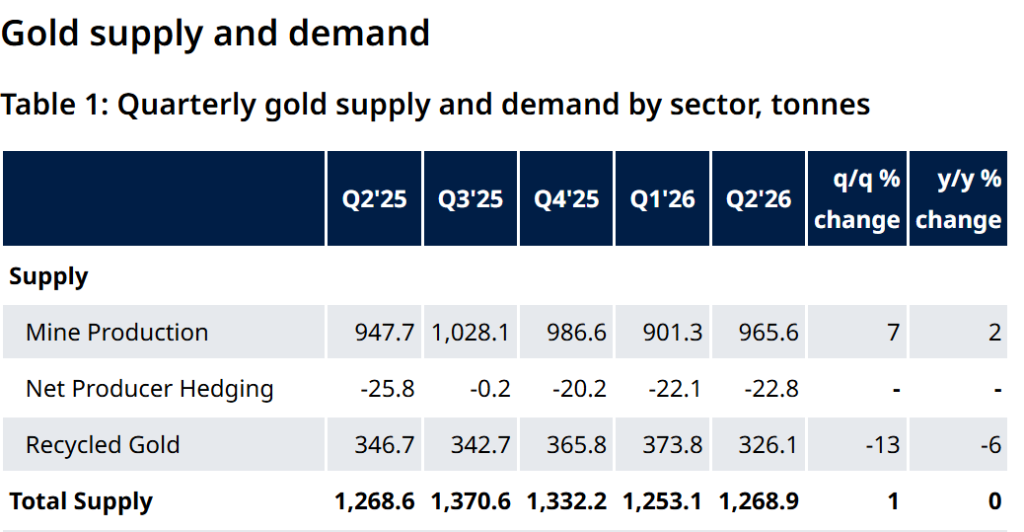
First-half demand increased 2% year over year to 2,522 tonnes, while the total value reached a record $380 billion due to elevated gold prices. Central banks purchased 289 tonnes during Q2, representing a 62% increase from a year earlier and marking the strongest second-quarter official buying on record. Poland added 51 tonnes, while China’s central bank purchased 33 tonnes, continuing the global trend of reserve diversification.
Meanwhile, physically backed gold ETFs recorded 45 tonnes of net outflows during the quarter, reflecting continued sensitivity to rising real yields and dollar strength.
The World Gold Council expects investment demand from Asia and OTC markets to remain an important source of support during the second half of 2026.
Bank of Korea Adds Fresh Support to Official Demand
Another positive development for the gold market came from South Korea. Reuters reported that the Bank of Korea will begin purchasing domestically produced gold for the first time in 13 years, using infrastructure operated by the Korea Exchange and Korea Securities Depository.
Although the purchases are relatively small in global terms, the decision reinforces the broader trend of central banks expanding and diversifying their gold reserves amid elevated geopolitical and economic uncertainty.
Gold Technical Analysis: $4,111 Breakout Could Trigger Fresh Rally
Gold continues trading inside a broad symmetrical triangle, with price holding above key support near $4,057. The metal remains close to the 50-period EMA, while the 100-period EMA around $4,120 continues acting as the primary resistance area.
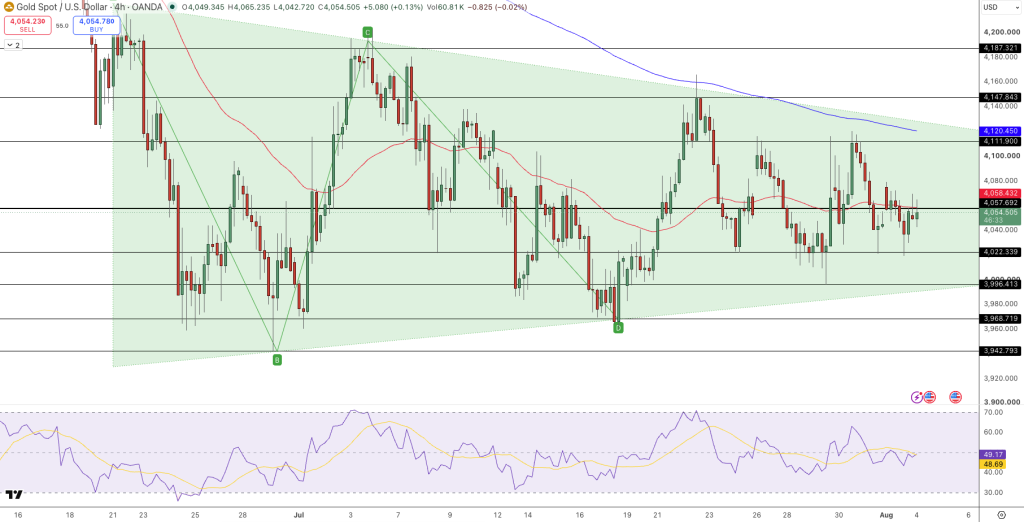
Momentum remains neutral, with the RSI near 50, indicating neither buyers nor sellers currently have a decisive advantage. A confirmed breakout above $4,111 would strengthen bullish momentum and expose $4,147, followed by $4,187. Failure to hold $4,022 would increase downside pressure toward $3,996, with $3,968 acting as the next major support.
Key Levels
Resistance: $4,111, $4,147, $4,187
Support: $4,022, $3,996, $3,968, $3,942
Trade Setup
Entry: Buy on a confirmed break above $4,111
Targets: $4,147, then $4,187
Stop Loss: Below $4,022
The outlook remains cautiously bullish while gold trades above $4,057, but a sustained move above $4,111 is needed to confirm the next leg higher.
Frequently Asked Questions
Why is gold holding above $4,060 today?
Gold is being supported by ongoing U.S.-Iran tensions and continued central-bank buying, while investors await key U.S. labor-market reports that could influence Federal Reserve policy expectations.
Why is this week’s Non-Farm Payrolls report important for gold?
The NFP report will help determine whether the U.S. labor market is slowing. Weaker employment data could reduce Treasury yields and support gold, while stronger figures would likely strengthen the U.S. dollar and weigh on bullion.
What are the key gold price levels to watch?
Immediate resistance is located at $4,111, followed by $4,147 and $4,187. Key support sits at $4,022, $3,996, and $3,968.
- Check out our free forex signals
- Follow the top economic events on FX Leaders economic calendar
- Trade better, discover more Forex Trading Strategies
- Open a FREE Trading Account
- Read our latest reviews on: Avatrade, Exness, HFM and XM

Related Articles


Sidebar rates

Related Posts
 Save
Save