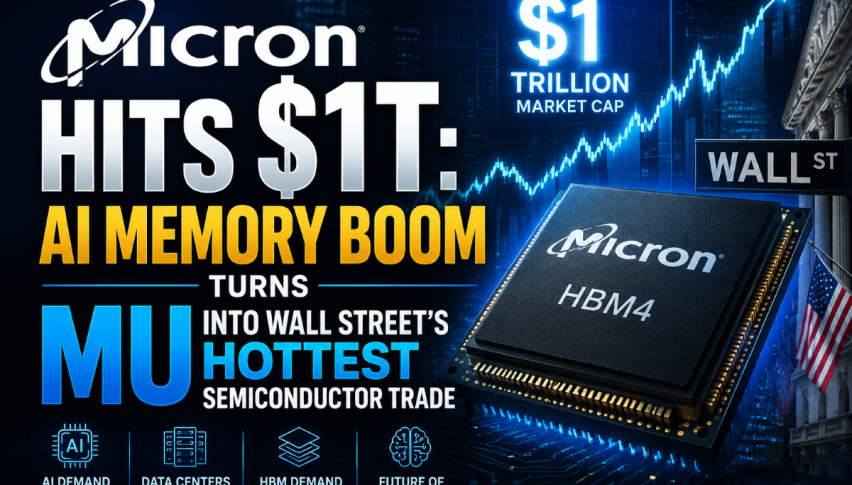
Micron Hits $1T: AI Memory Boom Turns MU Into Wall Street’s Hottest Semiconductor Trade

Micron tops $1T valuation as AI memory demand explodes. Can MU stock sustain its historic rally amid HBM shortages? What's next for Micron ?

Micron Hits $1T: AI Memory Boom Turns MU Into Wall Street’s Hottest Semiconductor Trade

Quick overview

  • Micron's stock surged nearly 20%, briefly surpassing a $1 trillion market cap, driven by increased demand for AI memory chips.
  • UBS raised its price target for Micron from $535 to $1,625, reflecting a shift in perception from a commodity chipmaker to a key player in AI infrastructure.
  • Micron's entire 2026 HBM supply is sold out, and the company is benefiting from tighter global memory supply and improved pricing power.
  • The stock's long-term outlook is positive as AI-driven demand transforms Micron into a critical player in the semiconductor industry.
MU shares have entered a new phase of the AI trade.

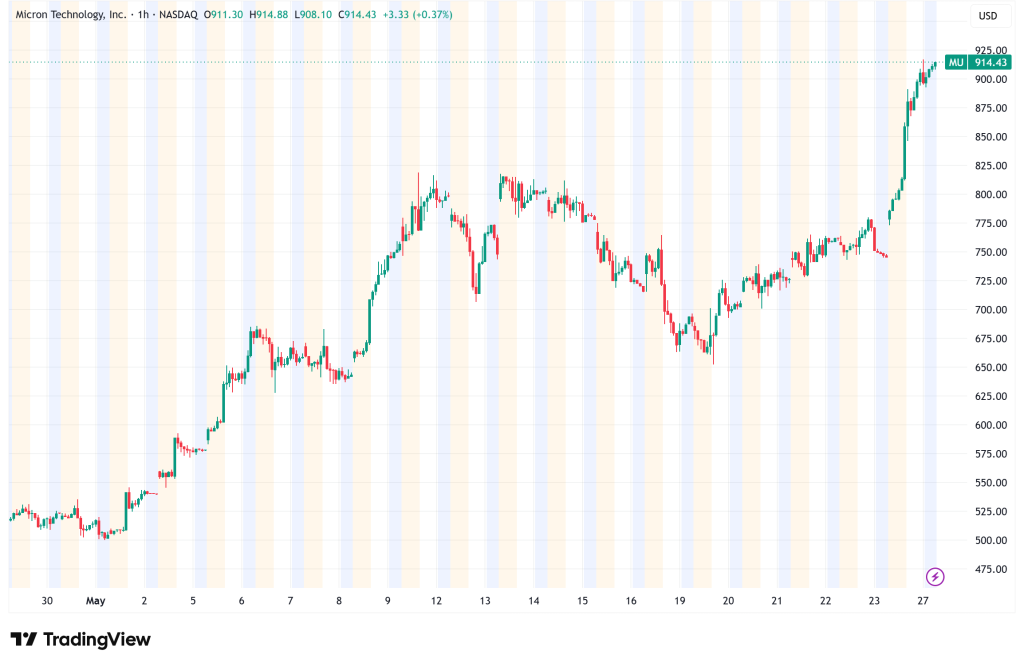
The memory-chip giant surged nearly 20% on Tuesday, briefly pushing its market capitalization above $1 trillion for the first time as investors aggressively rotated into AI infrastructure names beyond GPUs. The rally accelerated after UBS raised its price target on Micron from $535 to $1,625 — the highest target on Wall Street.

The move capped one of the most dramatic rallies in semiconductor history. Micron stock has climbed more than 840% over the past 12 months as explosive demand for AI memory chips reshapes the economics of the memory industry.

Unlike earlier AI cycles dominated by NVIDIA GPUs, the next wave of spending is increasingly centered on high-bandwidth memory (HBM), advanced storage, and data movement infrastructure — areas where Micron has emerged as a critical supplier.

AI Demand Is Rewriting the Memory Industry

For years, Micron was viewed as one of the semiconductor industry’s most cyclical companies.

That perception is changing rapidly.

AI training clusters and agentic AI workloads require massive amounts of high-performance memory to process, store, and transfer data efficiently. As hyperscalers race toward increasingly complex AI systems, memory intensity per server is rising sharply.

Micron now sits directly at the center of that shift.

Key developments driving the rally include:

  • Micron’s entire 2026 HBM supply is already sold out
  • Next-generation HBM4 chips have entered production
  • AI-driven memory shortages are tightening global supply
  • Pricing power has improved across DRAM and HBM markets
  • Customers are signing longer-term supply agreements

UBS analysts argued the market is beginning to treat Micron less like a commodity chipmaker and more like a structural AI infrastructure company.

That distinction matters.

Traditional memory cycles were heavily dependent on smartphone and PC demand. AI infrastructure spending is far more capital intensive and potentially longer duration.

Wall Street Is Repricing MU Stock Aggressively

The UBS target upgrade became the immediate catalyst behind Tuesday’s breakout rally.

The bank cited:

  • Structural changes in AI memory demand
  • Longer-term pricing visibility
  • Tight HBM supply conditions
  • Improved earnings durability
  • Expanding valuation multiples

The new target implies a potential valuation approaching $1.8 trillion.

Meanwhile, Micron still trades at roughly 8.4x forward earnings, according to Reuters data — well below the broader semiconductor sector and the S&P 500.

That valuation gap has become a major bullish argument among institutional investors.

Micron’s earnings profile is also changing rapidly as HBM margins improve and AI-related revenue becomes a larger portion of total sales.

Institutional positioning reflects that trend.

Regulatory filings showed more than 2,400 institutions opened new positions in Micron during the first quarter, including major global asset managers.

Samsung Risks Could Tighten Memory Supply Further

Another overlooked catalyst is supply disruption risk across the global memory market.

Samsung Electronics recently avoided a labor strike through a late-stage agreement with unions in South Korea. However, labor-related uncertainty continues lingering around the company.

Any significant production disruption at Samsung — the world’s largest memory-chip manufacturer — could tighten global memory supply even further.

That scenario would likely benefit Micron through:

  • Higher DRAM pricing
  • Tighter HBM supply
  • Improved contract negotiations
  • Margin expansion opportunities

The broader AI infrastructure race continues creating supply-demand imbalances across the semiconductor ecosystem.

Micron Hits $1T: AI Memory Boom Turns MU Into Wall Street’s Hottest Semiconductor Trade
Why is Micron stock surging today?

MU Technical Analysis: Micron’s AI Rally Remains Strong, but Volatility Is Rising

Micron remains in a powerful uptrend after breaking into new highs on massive AI-driven momentum.

Key Technical Signals

  • Shares trade well above the 20-day, 50-day, and 200-day moving averages
  • Breakout volume surged, confirming strong institutional buying
  • Momentum remains bullish across major indicators
  • AI semiconductor sentiment continues supporting the trend

The chart still favors buyers, but the rally has become increasingly extended after MU’s near-parabolic move.

RSI and MACD

  • RSI is approaching overbought territory, signaling elevated pullback risk
  • MACD remains firmly bullish with no confirmed reversal signals yet
  • Momentum still supports upside continuation, but volatility is increasing sharply

Key Support and Resistance Levels for MU Stock

Level Type Approximate Area
Immediate Resistance $950–$1,000
Psychological Resistance $1,100
Near-Term Support $820–$850
Secondary Support $700
Major Trend Support $535–$600

A clean breakout above $1,000 could trigger another momentum leg higher.

However, failure to hold the $820–$850 zone may lead to aggressive profit-taking after the stock’s historic AI-driven rally.

Long-Term Outlook: Micron Is Becoming a Core AI Infrastructure Company

Micron’s long-term story now depends on whether AI-driven memory demand proves structural rather than cyclical.

Wall Street increasingly believes it is.

Rising demand for HBM, AI inference, agentic AI, data centers, edge computing, and enterprise AI deployment is transforming Micron from a traditional memory-chip maker into a critical AI infrastructure company.

Key long-term growth drivers include:

  • HBM demand growth
  • AI data center expansion
  • Enterprise AI adoption
  • Edge AI computing
  • Autonomous systems

Micron also benefits from growing U.S. efforts to strengthen domestic semiconductor leadership against Asian competitors.

Risks remain significant. The stock’s valuation has expanded aggressively, and semiconductor cycles remain volatile. Any slowdown in AI spending, easing memory prices, or future HBM oversupply could pressure margins.

Still, momentum and AI demand trends continue favoring Micron. The market increasingly views MU as essential AI infrastructure, not just a cyclical chip stock.

ABOUT THE AUTHOR See More
Arslan Butt
Lead Markets Analyst – Multi-Asset (FX, Commodities, Crypto)
Arslan Butt serves as the Lead Commodities and Indices Analyst, bringing a wealth of expertise to the field. With an MBA in Behavioral Finance and active progress towards a Ph.D., Arslan possesses a deep understanding of market dynamics. His professional journey includes a significant role as a senior analyst at a leading brokerage firm, complementing his extensive experience as a market analyst and day trader. Adept in educating others, Arslan has a commendable track record as an instructor and public speaker. His incisive analyses, particularly within the realms of cryptocurrency and forex markets, are showcased across esteemed financial publications such as ForexCrunch, InsideBitcoins, and EconomyWatch, solidifying his reputation in the financial community.

Related Articles
HFM

HFM rest

Pu Prime

XM

Best Forex Brokers