AMC Stock Jumps 27% on Record Q2 Revenue as $2.50 Resistance Comes Into Focus
AMC Entertainment stock AMC jumps 27% after record Q2 revenue and a surprise profit, putting the key $2.50-$3 resistance zone in focus.

Quick overview
- AMC Entertainment shares rose nearly 27% after reporting record quarterly revenue of approximately $1.60 billion and an unexpected adjusted profit of $0.14 per share.
- The company's strong performance was driven by increased attendance, with about 71 million moviegoers and a 70% rise in adjusted EBITDA to approximately $321 million.
- Despite the positive results, AMC faces challenges including a heavy debt burden, high interest expenses, and ongoing share dilution that could impact future profitability.
- Investors are encouraged to monitor upcoming film releases and the company's ability to manage debt and cash flow as indicators of sustained recovery.
AMC Entertainment shares surged nearly 27% on Monday after the cinema operator reported record quarterly revenue, a surprise adjusted profit and sharply stronger cash generation.
AMC closed at $2.46 before edging up to $2.47 in overnight trading, extending one of the stock’s strongest sessions of 2026.
The earnings report provided investors with clearer evidence that stronger film releases can produce significant operating leverage across AMC’s fixed-cost theater network. However, the company’s heavy debt burden, interest expenses and continued share dilution remain central risks for investors.
AMC Reports Record Quarterly Revenue
AMC generated approximately $1.60 billion in second-quarter revenue, an increase of about 14% from the same period last year and the highest quarterly total in the company’s history.
The result exceeded Wall Street’s average estimate of roughly $1.47 billion.
Adjusted earnings reached $0.14 per share, compared with analysts’ expectations for a loss of approximately $0.06 per share. That earnings surprise was one of the main reasons AMC stock attracted heavy buying following the report.
The improvement was driven primarily by stronger attendance rather than substantial increases in ticket prices.
AMC welcomed approximately 71 million moviegoers during the quarter. Domestic attendance increased by about 12%, while international attendance rose close to 18%, as a broader range of successful releases brought consumers back to cinemas.
The domestic box office generated approximately $2.99 billion during the quarter, an increase of 10.7% from the previous year. It was the industry’s strongest second quarter in seven years and one of its largest quarters on record.
Operating Leverage Drives a 70% EBITDA Increase
AMC’s adjusted EBITDA rose almost 70% to approximately $321 million, pushing its adjusted EBITDA margin above 20%.
The sharp increase demonstrates the operating leverage built into the cinema business.
The company must pay many of its largest expenses—including theater rent, staffing, maintenance and equipment costs—regardless of how many customers attend. Once attendance rises beyond those fixed costs, a large percentage of additional revenue can flow into operating profit.
AMC added approximately $199 million in revenue from the previous year while generating roughly $132 million in additional adjusted EBITDA.
That means approximately two-thirds of the incremental revenue reached adjusted EBITDA.
The company also generated operating cash flow of roughly $235 million and free cash flow of approximately $190 million, giving management more flexibility to reduce debt and strengthen liquidity.
Cash and cash equivalents reached approximately $778 million at the end of June.
Blockbuster Film Slate Supports AMC’s Recovery
AMC’s results benefited from a stronger and more consistent film slate.
Six films produced domestic opening weekends above $75 million during the quarter, helping cinemas avoid the long gaps between major releases that had weakened attendance in previous years.
Christopher Nolan’s The Odyssey added further momentum after the quarter ended. The film generated approximately $124 million domestically and $264 million globally during its opening weekend, with IMAX accounting for a record $52 million.
AMC CEO Adam Aron said the company expects 2026 to become the strongest post-pandemic year for the domestic and global box office.
The upcoming release schedule includes high-profile films such as Spider-Man: Brand New Day, Dune: Part Three and Avengers: Doomsday. A sustained flow of successful releases would help AMC maintain higher attendance and benefit from its fixed-cost operating structure.
Major studios have also renewed their commitment to exclusive theatrical release windows, giving cinema operators more time to generate ticket and concession revenue before films become available through streaming platforms.
Theater Demand Looks Stronger, but Recovery Remains Uneven
The quarter supports the argument that consumers remain willing to pay for affordable, out-of-home entertainment.
Movie attendance competes with streaming, gaming, restaurants and other discretionary spending. Despite the number of entertainment choices available at home, a strong slate continues to attract consumers to premium screens and event-style releases.
AMC has also increased revenue per visitor through premium large-format screens, upgraded seating, branded concessions and food and beverage sales.
However, the recovery remains highly dependent on studios consistently producing films that audiences want to see.
The cinema industry has experienced several strong quarters since the pandemic, followed by periods of weaker attendance when production disruptions or thin release schedules limited the number of major titles.
AMC’s cost structure creates strong upside when attendance rises, but it can also work in reverse. A weaker film slate could quickly pressure EBITDA and free cash flow because rent and other fixed expenses remain.
Debt and Interest Costs Still Limit the Recovery
AMC’s operating improvement has not fully resolved its balance-sheet challenges.
Despite generating record adjusted EBITDA, the company still reported a GAAP net loss of approximately $11 million.
Interest expense of roughly $136 million absorbed a large share of the operating profit generated by the theaters.
AMC has reduced corporate borrowings and extended several important debt maturities, lowering the risk of an immediate refinancing crisis. The company says it has repaid approximately $1.7 billion in debt since the end of 2020.
However, total borrowings remain substantial, and interest payments continue to limit the amount of operating improvement that reaches common shareholders.
That distinction is important.
AMC’s theater business can recover while AMC stock remains constrained by financing costs, debt repayments and the possibility of further capital raises.
Share Dilution Remains a Major Risk for AMC Investors
AMC has repeatedly issued shares to raise cash, repay debt and improve liquidity.
The company completed a $150 million at-the-market equity offering in June, adding to its available cash but increasing the number of shares outstanding.
The diluted weighted-average share count increased sharply from the previous year, reducing the amount of earnings and cash flow attributable to each share.
Equity issuance has helped AMC survive a difficult period and strengthened its ability to participate in the box-office recovery. At the same time, repeated dilution means improving company-wide results do not necessarily produce the same improvement on a per-share basis.
Investors will therefore watch whether AMC can generate enough annual free cash flow to reduce its dependence on further stock offerings.
A stable share count, lower interest expense and sustained positive cash flow would provide stronger evidence that the operating recovery is beginning to reach shareholders.
AMC Technical Analysis: $2.50 Is the Key Breakout Level
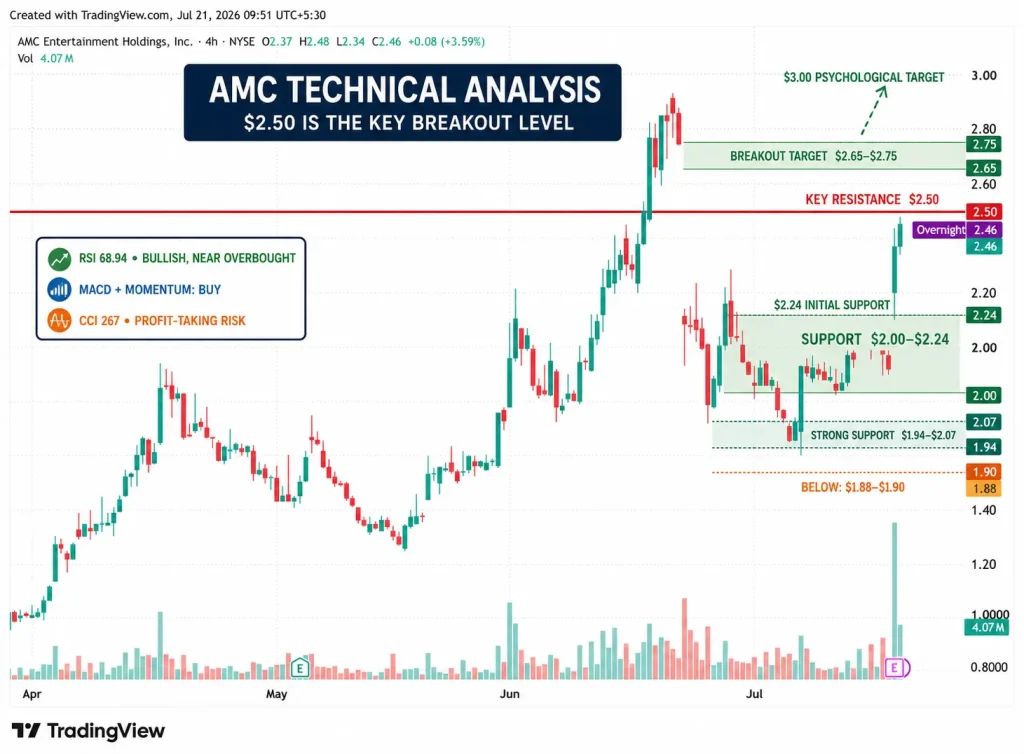
AMC’s 4-hour chart has turned bullish after Monday’s 26.80% surge.
The stock is trading above all major moving averages, with the 10 EMA at $2.12, 20 EMA at $2.04, 50 EMA near $2.00, VWMA at $2.07, and Hull MA at $2.24. Together, these levels create support between $2.00 and $2.24.
The immediate resistance is $2.50. A sustained breakout could open the way toward $2.65-$2.75, followed by the psychological $3.00 level.
Initial support sits at $2.24, then $2.12. A break below the stronger $1.94-$2.07 support zone would weaken the setup and expose $1.88-$1.90.
Momentum remains bullish but stretched. RSI is near overbought at 68.94, while MACD and Momentum show buy signals. However, CCI at 267.24 and Williams %R near −4.53 point to rising short-term profit-taking risk.
Is AMC Entertainment a Good Stock to Buy in 2026?
AMC’s second-quarter results were significantly stronger than expected.
Record revenue, higher attendance and a 70% increase in adjusted EBITDA show that the theater network can generate substantial profit when the film slate attracts customers.
The next challenge is proving that the performance can continue beyond one blockbuster quarter.
Investors should monitor the upcoming release schedule, free cash flow, interest expense, debt reduction and changes in the share count.
Technically, the stock has established support above $2.00, but the immediate test sits at $2.50.
A clean breakout could extend the rally toward $2.75 and $3.00. Failure to hold $2.20 could trigger a pullback toward the broader support cluster around $2.00.
AMC’s business recovery is gaining momentum. Whether that recovery creates lasting value for each share will depend on debt reduction, cash generation and management’s ability to limit further dilution.
- Check out our free forex signals
- Follow the top economic events on FX Leaders economic calendar
- Trade better, discover more Forex Trading Strategies
- Open a FREE Trading Account
- Read our latest reviews on: Avatrade, Exness, HFM and XM

Related Articles



Sidebar rates

Related Posts
 Save
Save