Verizon (NYSE: VZ) Earnings Preview: Can Broadband Growth Offset Wireless Competition?
Verizon Communications (NYSE: VZ) will announce its Q2 earnings before the U.S. bell rings on Tuesday, July 21. Analysts are watching...
Quick overview
- Verizon is set to announce its Q2 earnings on July 21, with analysts focusing on its ability to sustain wireless revenue growth and broadband customer additions.
- The consensus expectation for Q2 revenue is $34.9 billion and earnings per share of $1.22, indicating steady performance amid competitive pressures.
- Verizon's Fixed Wireless Access service is driving broadband growth, adding 339,000 subscribers in the first quarter as demand for faster connectivity increases.
- Investors are particularly interested in free cash flow guidance and the company's ability to maintain its high dividend yield amidst intense competition.
Verizon Communications (NYSE: VZ) will announce its Q2 earnings before the U.S. bell rings on Tuesday, July 21. Analysts are watching the outcome of the call to see if the U.S.-based network operator can sustain wireless revenue growth while also adding customers on its broadband side. The telecom’s stock has moved higher in a tight range of late as it has been helped by resilient subscriber base, improving free cash flow, and lower capital spending requirements, although the competitive pressures in the U.S. telecommunication space continue to put some limits on the operator’s growth potential.
While the tech sector is currently focused on the results of an ongoing wave of earnings reports driven by the artificial intelligence (AI) hype, Verizon investors would instead be more interested in the telecom’s recurring cash flows, its dividend and customer retention, as opposed to the company’s top-line growth.
Verizon Earnings: Wall Street Expects Stable Performance
The consensus analyst expectation for Verizon in its Q2 financial report is for revenue coming in at $34.9 billion and earnings per share coming in around $1.22 in an adjusted basis, which basically aligns with the narrative that the company will continue to put out steady quarterly results. The telecom will need to deliver better-than-expected data on:
- postpaid phone subscribers
- wireless revenue
- broadband subscribers
- adjusted earnings before interest, taxes, depreciation and amortization (EBITDA)
- free cash flow
- full-year guidance
Management’s outlook for consumer demand and pricing will likely be just as important as the quarterly numbers themselves.
Verizon Wireless: Continued Revenue Driver
Verizon’s wireless arm remains the operator’s largest revenue segment and highest-margin business. It continues to benefit from stable and recurring revenue from its consumer and business subscriber base, which is supported by premium unlimited plans and relatively limited churn. Although the operator has not been benefiting from the kind of growth rate as it did a couple of years ago when 5G was rolling out, Verizon has largely maintained that business stability by prioritizing revenue over subscriber acquisitions.
The company has kept a low churn rate while maintaining its relatively higher-margin unlimited plans and higher-value service offerings for individual and corporate customers, which is supported by the average revenue per user, device protection and enterprise connectivity.
Verizon FWA Helps Drive Broadband Growth
Verizon’s Fixed Wireless Access (FWA) is a growing service, as the company looks to tap into potential customers who have not been served by fiber-optic networks. The FWA is a wireless connection that uses a 5G or LTE network to offer the same service as wired broadband.
During the first quarter, the network operator announced that it added 339,000 broadband subscribers, driven by strong demand for FWA in areas where its fiber network is not available. Fios is still expanding in the markets it already serves. This has been another growth driver that is helping the operator generate more recurring revenue and lower customer churn as it expands on its network infrastructure.
The continued demand for broadband as more consumers stay at home, stream movies and AI applications require faster connectivity has provided Verizon the opportunity to expand on the customer base it has, rather than trying to aggressively add subscribers at the expense of margins.
Capital Spending: Lower Requirements for FCF
After several years of heavy investment in 5G infrastructure and spectrum acquisitions, Verizon is now in a phase where it could be more conservative in terms of capital spending. The company’s investment cycle is likely entering a slower period, which means the company will have to put in less capital to generate free cash flow.
The company has historically been a significant investor in wireless infrastructure and spectrum and it is likely to have to spend less in future years. As a result, management has more flexibility in terms of managing Verizon’s debt load, making future investments in networks and keeping its dividend intact.
Verizon Investors May Want to Watch Out for Free Cash Flow Guidance
Management usually offers an update on the company’s free cash flow guidance in earnings reports, and it is likely to be one of the highlights on the earnings call, which is why investors are expected to pay close attention to that in the Q2 report.
Verizon Enterprise Services: A Growth Segment for AI
Despite the competitive pressures in the consumer wireless market and slower growth as it ramps up fiber-optic deployment, Verizon’s enterprise services remains a potential growth area in the long term. Companies have started using the network operator’s private 5G infrastructure to help with things like manufacturing, supply chain and industrial use cases.
Although Verizon is not likely to provide any AI infrastructure, AI-powered software and semiconductor growth, Verizon is likely to benefit from a gradual increase in the use cases for private 5G networks and enterprise networking as companies begin to deploy AI applications and services across their business infrastructure.
The operator has been ramping up its 5G investment efforts in private networks to help companies across the manufacturing, logistics, healthcare and other sectors. While Verizon isn’t directly involved in providing AI services or chips, the operator could see higher demand from AI-related infrastructure as more business deployments take hold.
Dividend Remains a Key Attraction
Verizon offers one of the highest dividend yields of any large-cap U.S. stock. The recurring nature of its subscription-based business means operating cash flow tends to remain stable even when economic growth slows, which helps ensure that it’s able to maintain dividend payouts to shareholders. Investors will want to know whether a trend of improving free cash flow continues, as this strengthens dividend coverage and aids balance-sheet repair.
Competition Remains the Biggest Challenge
T-Mobile continues to aggressively pursue subscriber growth, while AT&T is continuing to invest heavily in both wireless and fiber-broadband offerings. The cable companies, including Comcast and Charter, have also launched mobile service.
The result: competition across the entire wireless industry is more intense than ever before.Verizon is continuing to pursue a strategy that involves a mix of subscriber growth and pricing discipline, instead of just trying to grow market share.
What Investors Should Watch
Investors should be looking at:
- Subscriber additions in postpaid
- Growth in broadband
- Growth in wireless service revenue
- Free cash flow
- Capital expenditure
- The ability of free cash flow to cover the dividend
- Full-year guidance for the year
Management’s comments on pricing and promotions will be one of the most important factors affecting the stock.
Verizon Fundamental Outlook
Verizon fundamentals look solid, with wireless revenue growing steadily, expansion in broadband a promising development and moderating capital expenditure helping to grow free cash flow. The biggest risks are slower subscriber growth, aggressive competition on pricing, high levels of debt and a maturing U.S. wireless market.
Better-than-expected postpaid subscriber growth with a steady outlook for the year would be a very positive development, further strengthening confidence in the company’s long-term cash-growth and dividend story.
Verizon (NYSE: VZ) Technical Analysis: Rising Trendline Keeps Bulls in Control Ahead of Earnings
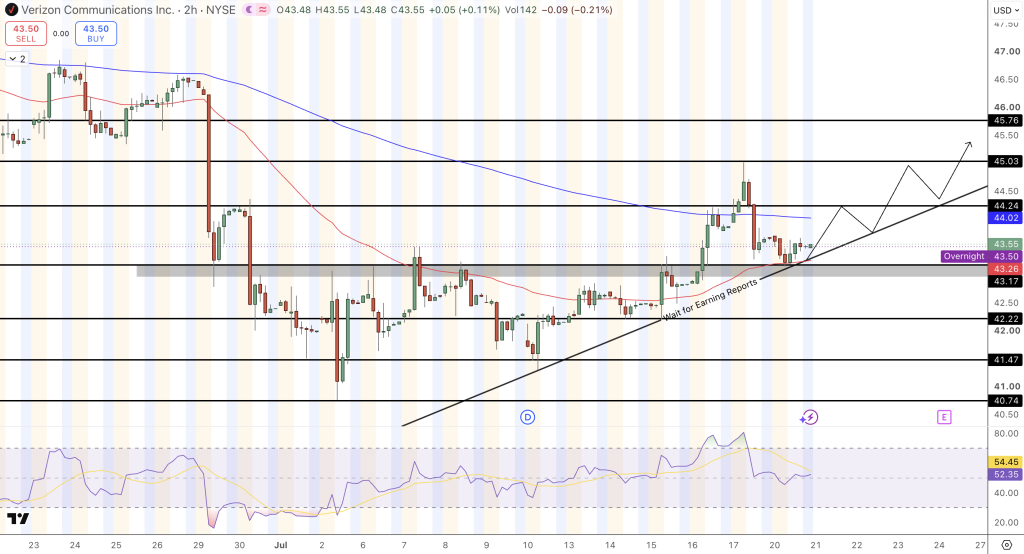
Verizon shares are currently trading near $43.55, remaining above a rising trendline that is supporting the recovery seen since the beginning of July. It’s still above the 50-period EMA, which currently stands at $43.26, with the relative strength index (RSI) measuring around 54, suggesting a modest bullish bias that isn’t currently overbought.
The first point of resistance is $44.24, which is in the same territory as the 100-period EMA, and a sustained move above that level would give bulls a chance to push Verizon toward $45.03 before targeting $45.76.
Support is currently at $43.17, as the rising trendline is providing support. However, a persistent drop below that would suggest the current recovery may have reached its end, and would open the way for Verizon to test $42.22 with $41.47 seen as a second level of support.
Verizon can be considered as being in a modestly bullish phase as long as it holds above $43.17. With earnings on Tuesday, it will be interesting to see if there is enough momentum to push Verizon higher toward $44.24.
- Check out our free forex signals
- Follow the top economic events on FX Leaders economic calendar
- Trade better, discover more Forex Trading Strategies
- Open a FREE Trading Account
- Read our latest reviews on: Avatrade, Exness, HFM and XM

Related Articles


Sidebar rates

Related Posts
 Save
Save