AMZN Stock Tests the Key Support Before $300 as Investors Question Costly AI Expansion
Amazon shares remain under pressure as rising AI infrastructure expenses, declining free cash flow, regulatory challenges, and shifting investor mood fuel concerns that the company's profitability forecast is becoming increasingly difficult to defend.

Quick overview
- Amazon shares are under pressure due to rising AI infrastructure costs, deteriorating free cash flow, and regulatory threats, raising concerns about the company's profitability outlook.
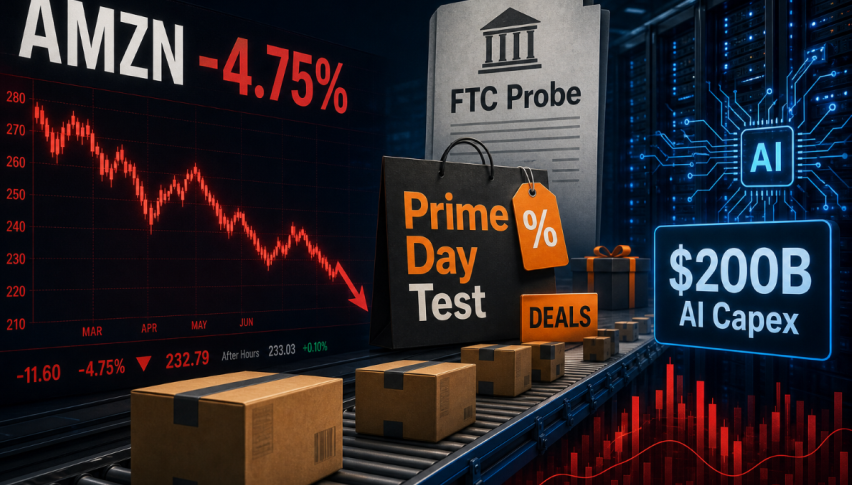
- The stock has recently declined nearly 5%, approaching a critical support level near $230, as investors rotate away from mega-cap technology companies.
- Regulatory scrutiny, particularly regarding Amazon's advertising division, poses a significant risk to its profitability, especially as free cash flow has sharply declined from $26 billion to $1.2 billion.
- Despite strong revenue growth and ongoing expansion plans, investor sentiment is shifting towards a focus on financial discipline and the need for substantial returns on capital.
Amazon shares remain under pressure as rising AI infrastructure expenses, declining free cash flow, regulatory challenges, and shifting investor mood fuel concerns that the company’s profitability forecast is becoming increasingly difficult to defend.
Stock Weakness Deepens as Investors Rotate Away From Mega-Cap Leaders
Amazon’s recent selloff accelerated after shares fell nearly 5%, pushing the stock toward a critical technical support zone near $230. The decline reflects a broader shift in investor sentiment as capital rotates away from some of the market’s largest technology companies and into newer growth opportunities and alternative sectors.
For much of the past two years, Amazon benefited from strong enthusiasm surrounding cloud computing, artificial intelligence, and digital commerce. However, investors are increasingly reassessing whether the company’s future earnings potential justifies its growing spending commitments.
The recent weakness has damaged the stock’s technical outlook, with traders increasingly focused on whether support near $230 can hold. A decisive break below that level could expose Amazon to a deeper correction toward the $200 area, a level that would represent a significant deterioration in market confidence.
Regulatory Threats Cast a Shadow Over a Key Profit Engine
One of the biggest concerns facing Amazon is the growing regulatory scrutiny surrounding its business operations.
Reports suggest that the Federal Trade Commission, along with several state attorneys general, is preparing additional legal action targeting Amazon’s advertising division. The segment has become one of the company’s most profitable businesses and an increasingly important contributor to overall earnings growth.
The possibility of antitrust investigations, operational restrictions, or financial penalties has unsettled investors because advertising has helped offset weaker profitability in other parts of Amazon’s business. Any disruption to this revenue stream could have an outsized impact on future earnings expectations.
The regulatory threat also comes at a particularly difficult time, as investors are already questioning whether Amazon’s massive spending initiatives will generate adequate returns.
Higher Interest Rates Continue to Pressure Valuations
Macroeconomic conditions have added another layer of pressure to Amazon’s outlook.
The Federal Reserve’s decision to maintain elevated interest rates has reinforced expectations that borrowing costs may remain higher for longer. Strong labor market data and persistent inflation have reduced hopes for aggressive monetary easing, creating a challenging backdrop for growth-oriented technology companies.
Higher interest rates tend to weigh on companies whose valuations depend heavily on future earnings growth. As discount rates remain elevated, investors become less willing to pay premium multiples for long-term growth stories.
This environment has contributed to a broader revaluation across the technology sector and has increased pressure on companies with large capital expenditure requirements.
AI Spending Boom Raises Profitability Questions
Investor focus has increasingly shifted toward Amazon’s rapidly expanding artificial intelligence investments.
The company’s recent decision to secure a $17.5 billion delayed-draw term loan highlighted the enormous financial resources required to compete in the AI race. Although management described the financing as supporting general corporate purposes, many market participants view it as a clear indication of escalating infrastructure spending needs.
Amazon continues to invest aggressively in data centers, cloud computing capacity, custom semiconductor development, networking infrastructure, and advanced AI services. While these expenditures may strengthen the company’s long-term competitive position, they are also placing significant pressure on near-term profitability.
The concern among investors is that spending commitments are growing faster than the financial benefits currently being generated.
Free Cash Flow Deterioration Raises Red Flags
Perhaps the most alarming development for investors is the sharp decline in Amazon’s free cash flow.
Trailing twelve-month free cash flow has fallen dramatically from nearly $26 billion to roughly $1.2 billion, reflecting one of the most significant shifts in the company’s financial profile in recent years.
The decline has been driven largely by a surge in capital expenditures, which have expanded by more than $59 billion as Amazon invests heavily across multiple business segments. Massive spending on AI infrastructure, cloud services, logistics facilities, warehouse automation, and semiconductor initiatives has dramatically increased cash demands.
While management argues these investments are necessary for future growth, investors are becoming increasingly concerned about whether returns on capital will be sufficient to justify such extraordinary spending levels.
Reversing After the Surge
Amazon entered 2026 hoping to rebuild confidence after a volatile finish to the prior year, but the opening weeks instead reinforced investor unease as AMZN fell below $200. But the 100 weekly SMA (green) held as support. Shares climbed for 6 consecutive weeks, pushing above the 50 weekly SMA (yellow) and gaining roughly 26% as sentiment improves and tech stocks rebound and on Monday AMZN popped again to reach a new high of $278 in early May before reversing lower to $233 today, testing the 50 SMA which will open the door for $200 if it gets broken.
AMZN Chart Weekly – Testing the 50 SMA

Expansion Continues Despite Growing Skepticism
Despite mounting concerns, Amazon continues to pursue aggressive expansion plans around the world. The company recently announced substantial investments in Europe, including major logistics projects in France as part of a broader multibillion-euro expansion strategy.
However, the market’s focus has shifted away from long-term growth opportunities and toward immediate financial discipline. Investors are becoming less willing to overlook declining cash generation simply because future opportunities appear attractive.
The debate is no longer centered on whether Amazon can grow. Instead, it is increasingly focused on whether that growth can translate into meaningful shareholder returns while maintaining healthy cash flow.
Market Focus Shifts Toward Financial Discipline
The dominant narrative surrounding Amazon is changing. For years, investors rewarded the company for prioritizing expansion over profitability, believing that scale would ultimately drive superior returns. Today, that assumption is being challenged.
With regulatory risks increasing, free cash flow deteriorating, and AI spending escalating rapidly, investors are demanding greater evidence that Amazon’s enormous capital commitments will produce substantial earnings growth in the future. Until the company demonstrates that its investments can generate stronger cash returns, the stock may remain vulnerable to additional downside pressure as markets place greater emphasis on profitability and financial discipline rather than growth alone.
Amazon Q1 Earnings Report
Revenue and Profit Growth
- Revenue rose 17% year over year to $181.5 billion, above estimates
- Operating profit increased to $23.9 billion from $18.4 billion
- Growth driven by strength across multiple business segments
AWS Momentum Leads Performance
- AWS sales climbed 28% to $37.6 billion
- Fastest growth since Q2 2022
- AWS contributes majority of operating profit despite ~20% of revenue
Heavy AI-Driven Investment Surge
- Capex reached $151 billion over 12 months (+$57.9 billion YoY)
- 2026 spending plan raised to ~$200 billion (+56%)
- Q1 capex jumped to $44.2 billion, above expectations
Cash Flow Pressure Intensifies
- Free cash flow fell to $1.2 billion from $25.9 billion YoY
- Expansion driven by data centres for AI-focused demand
Retail and Advertising Growth
- Online sales up 12% to $64.3 billion
- Advertising revenue rose 24% to $17.2 billion
- Ads increasingly support retail profitability model
- Check out our free forex signals
- Follow the top economic events on FX Leaders economic calendar
- Trade better, discover more Forex Trading Strategies
- Open a FREE Trading Account
- Read our latest reviews on: Avatrade, Exness, HFM and XM

Related Articles

Sidebar rates

Related Posts
 Save
Save