GOOGL Stock Slides 5% as AI Talent Exits, Capex Fears Test Alphabet’s $460B Cloud Backlog
Google stock GOOGL drops 5% to $348.78 as AI exits, capex fears and sell signals pressure Alphabet, while Cloud backlog supports bulls.
Quick overview
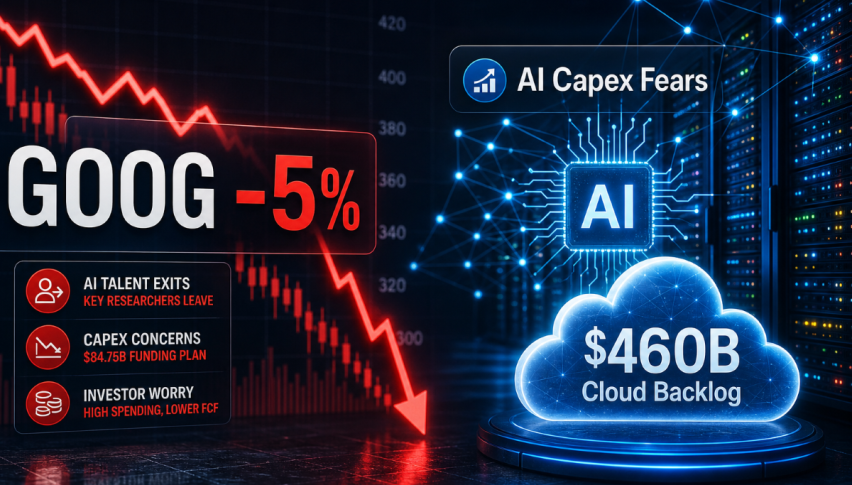
- Alphabet's stock fell sharply due to concerns over AI talent departures and heavy infrastructure spending, closing at $348.78 on June 22.
- The exits of key AI researchers have raised market concerns about Google's ability to compete in AI while monetizing it across various platforms.
- Despite the selloff, Alphabet's cloud backlog and strong revenue growth suggest long-term demand remains robust, with a contracted backlog of about $460 billion.
- Analysts maintain positive price targets for Alphabet's stock, indicating potential upside, but the market is seeking proof of effective AI investment conversion into revenue.
Alphabet stock fell sharply as investors reassessed Google’s AI position, heavy infrastructure spending and recent high-profile researcher departures, even as the company’s cloud backlog continues to point to strong long-term demand.
Alphabet Class C shares, GOOGL, closed at $348.78 on June 22, down 5.08%, with after-hours trading sliding another 1.00% to $345.30. The selloff pushed the stock further below short-term moving averages and raised the question traders are now asking: is this a buyable AI dip, or the start of a deeper reset?
AI Talent Exits Hit Google Sentiment
The latest pressure came after two major AI researchers left Google for rivals. Noam Shazeer, a vice president of engineering and co-lead of Gemini, reportedly left for OpenAI. John Jumper, a Google DeepMind vice president and Nobel Prize winner known for AlphaFold, is joining Anthropic.
The departures matter because Alphabet is trying to prove that Gemini can compete at the frontier of AI while also monetizing AI across Search, Cloud, YouTube, Android and Workspace.
One or two exits do not break Google’s AI machine. But they do feed a market concern that top AI talent is increasingly mobile, expensive and strategically important.
Capex and Dilution Fears Add to the Selloff in GOOGL Stock
Alphabet’s stock has also been pressured by concerns around AI infrastructure spending. According to the attached research note, Alphabet announced plans to raise $80 billion, later upsized to $84.75 billion, to support AI compute demand.
The market read that as a sign of three things: possible dilution, a reduced buyback story and a much heavier capex cycle.
Alphabet’s Q1 capital expenditures reportedly reached $35.7 billion, while full-year 2026 capex guidance sits around $180 billion to $190 billion. Free cash flow also fell sharply, with Q1 FCF at $10.1 billion, down 47% year over year.
That is the core bear case. Google’s business is not collapsing, but cash generation is being squeezed while the company races to build enough AI capacity.
Google Cloud Backlog Keeps the Bull Case Alive
The counterargument is strong. Alphabet’s Q1 results showed revenue of $109.9 billion, up 22% year over year, while Google Cloud revenue rose 63% to $20.0 billion.
The more important number is backlog. The attached note cites Google Cloud’s contracted backlog at about $460 billion, with roughly half expected to convert into revenue over the next 24 months.
That suggests Alphabet’s infrastructure spending is not speculative in the usual sense. The company appears to be building capacity for demand that already exists.
Search also remains resilient, with Q1 Search revenue reportedly rising 19% to $60.4 billion. Alphabet’s operating margin expanded to 36.1%, showing the core business is still highly profitable even during an aggressive AI investment cycle.
Analyst Targets Still Point Higher for Google’s Stock
Despite the selloff, analyst sentiment remains broadly constructive. The attached data shows major price targets including $450 from Goldman Sachs, $465 from Cantor Fitzgerald, $425 from KeyBanc, and a consensus target near $432.83.
That implies meaningful upside from the current $348-$349 zone, but the market is now demanding proof that AI spending will convert into durable revenue and margin strength.
The next major test will likely be Q2 results and any update on Gemini adoption, cloud backlog conversion, capex timing and free cash flow recovery.
GOOGL Technical Analysis: Sell Signals Build Below $360
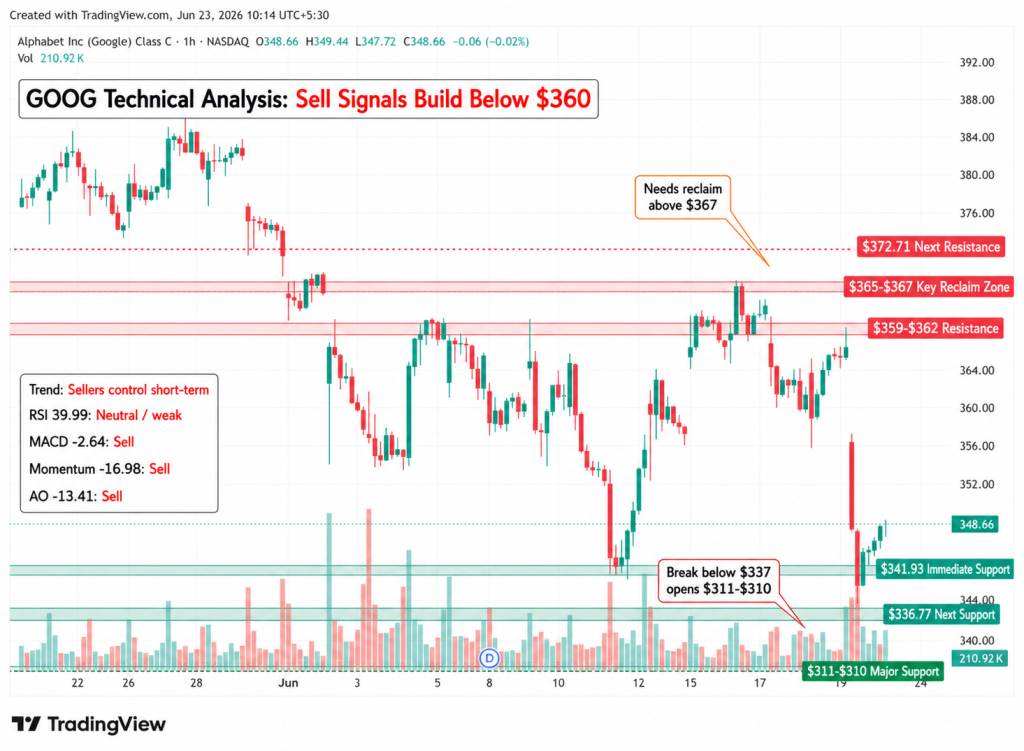
Technically, Alphabet has shifted into a weaker short-term setup. GOOGL is trading below nearly all major short- and medium-term moving averages, showing that sellers have taken control after the recent breakdown.
The 10-day EMA at $362.06, 20-day EMA at $365.39, 50-day EMA at $359.27, and VWMA at $365.92 are all above the current price, creating resistance between $359 and $367.
The RSI at 39.99 is neutral but close to bearish territory. The MACD at -2.64, Momentum at -16.98, and Awesome Oscillator at -13.41 are all flashing sell signals. That confirms the short-term trend has weakened.
However, the long-term trend has not fully broken. The 100-day EMA at $341.93, 100-day SMA at $336.77, and 200-day EMA near $310.24 remain key support levels.
Key levels to watch:
- Resistance: $359-$362, then $365-$367 and $372.71
- Immediate support: $341.93, then $336.77
- Deeper support: $311-$310
- Bullish breakout zone: above $367
If GOOGL reclaims $367, buyers could begin targeting the $372-$375 zone. But if the stock loses the $342-$337 support area, the next major downside zone sits near the 200-day averages around $310-$311.
Should You Buy the Dip in Alphabet (GOOGL) Stock? Be Patient
Alphabet’s selloff is not being driven by weak revenue. It is being driven by fear that AI investment, talent pressure and free cash flow compression may weigh on returns before the cloud backlog fully converts.
That makes GOOGL a more complicated trade than a simple tech dip. Bulls can point to Search strength, Cloud growth, a massive contracted backlog and unmatched AI distribution across Google products. Bears can point to capex pressure, dilution risk, researcher departures and technical weakness.
For now, GOOGL needs to hold the $342-$337 zone to avoid a deeper correction. A close back above $367 would be the first sign that the selloff is stabilizing.
- Check out our free forex signals
- Follow the top economic events on FX Leaders economic calendar
- Trade better, discover more Forex Trading Strategies
- Open a FREE Trading Account
- Read our latest reviews on: Avatrade, Exness, HFM and XM

Related Articles

Sidebar rates

Related Posts
 Save
Save