NFLX Stock Falls to 12-Year Lows, Testing the Last Support as Streaming Competition and Margin Concerns Intensify
Netflix, Inc. has fallen to its lowest level since 2014 as intensifying competition, weaker forward guidance, and fading investor confidence reshape the company’s growth narrative.
Quick overview
- Netflix's stock has fallen to its lowest level since 2014 due to intensified competition and weaker forward guidance.
- The company faces challenges from both traditional media giants and emerging digital platforms, impacting its growth narrative.
- Failed acquisition attempts have raised concerns about Netflix's ability to expand its content and distribution capabilities.
- Despite strong Q1 results, investor sentiment remains low due to disappointing future guidance and structural shifts in the streaming ecosystem.
Netflix, Inc. has fallen to its lowest level since 2014 as intensifying competition, weaker forward guidance, and fading investor confidence reshape the company’s growth narrative.
Netflix Slides to Multi-Year Low as Competitive Pressures Intensify
Netflix, Inc. has dropped to its lowest price level since 2014, reflecting a sharp deterioration in investor sentiment as the streaming leader faces a more crowded and fragmented entertainment landscape. The decline highlights growing concerns that the company’s dominance in subscription video is increasingly being challenged by both traditional media giants and new digital platforms.
The selloff comes at a time when competition for consumer attention has never been more intense. Legacy entertainment players such as The Walt Disney Company and Paramount Skydance Corporation continue to expand their streaming ecosystems, while short-form video platforms including TikTok, Instagram from Meta Platforms, Inc., and YouTube from Alphabet Inc. are steadily eroding overall viewing time across traditional long-form streaming services.
This shift in consumer behavior is increasingly weighing on Netflix’s growth narrative, as engagement becomes more dispersed across platforms that are not directly subscription-based.
Failed Expansion Moves Add to Strategic Concerns
Investor unease has also been reinforced by Netflix’s inability to secure major strategic acquisitions, including unsuccessful attempts to acquire Warner Bros. Discovery and Roku. Both assets ultimately moved into the hands of competitors, reducing Netflix’s ability to expand its content and distribution footprint through consolidation.
The failed deals have contributed to concerns that Netflix may be increasingly constrained in a consolidating industry, where scale and content ownership are becoming more critical to long-term competitiveness.
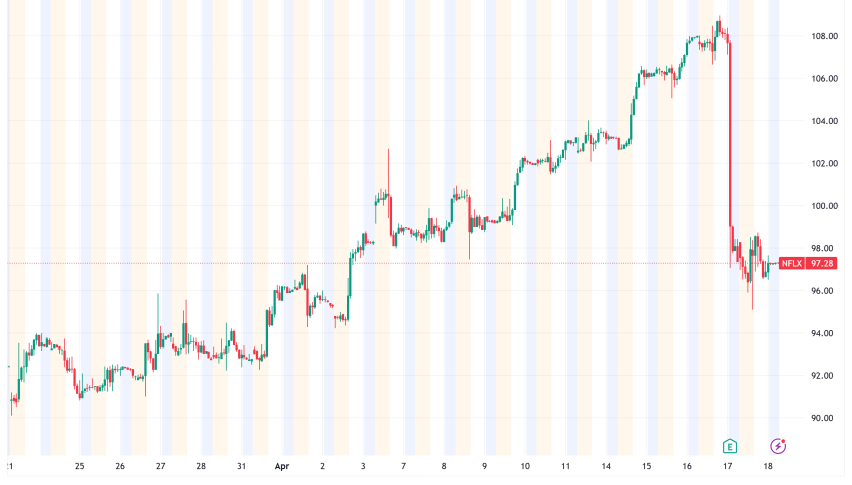
NFLX Chart Daily – Reversing after Failing at the 50 SMA

Shares of Netflix have been bearish for a year, falling to the $70 level, where they are facing the 200 weekly SMA in purple. Early in 2026 we saw a rebound, but failed to break above the 50 daily SMA (yellow) and reversed lower.
Strong Q1 Results Overshadowed by Weak Guidance
Netflix reported a strong first-quarter performance, beating expectations on revenue and earnings. Revenue reached $12.25 billion, while earnings per share of $1.23 exceeded consensus estimates. Operating income rose to $3.96 billion, supported by margin expansion and continued subscription growth.
However, much of the earnings strength was inflated by a one-time $2.8 billion termination fee, which masked softer underlying profitability trends. Excluding this benefit, performance was less impressive, leaving investors more focused on forward-looking risks.
The reaction to the report was sharply negative, with shares falling around 8% as markets turned attention to weaker-than-expected Q2 guidance. Revenue and EPS forecasts came in below consensus, while margins are expected to decline due to content amortization pressures.
Leadership Transition Adds to Uncertainty
Sentiment was further impacted by the announcement that co-founder Reed Hastings will step down from the board. Although Hastings had already transitioned out of day-to-day executive leadership, his final departure marks the end of a 29-year era for the company.
While operational continuity remains intact under co-CEOs Ted Sarandos and Greg Peters, the symbolic exit of Netflix’s long-time founder has added to the perception of a company entering a more mature and less dynamic phase of its lifecycle.
Growth Narrative Faces Increasing Scrutiny
Management reiterated full-year guidance of $50.7 billion to $51.7 billion in revenue and a 31.5% operating margin, but the lack of an upgrade disappointed investors who had expected stronger upward revisions following solid subscriber trends.
At the same time, Netflix raised its free cash flow outlook to $12.5 billion. However, the improvement was largely attributed to a one-time payment rather than structural operational gains, limiting its impact on long-term valuation expectations.
Competitive and Structural Headwinds Build
The broader concern facing Netflix is not a single earnings miss, but a structural shift in the streaming ecosystem. Short-form video platforms continue to capture increasing amounts of user attention, while global media companies invest aggressively in content libraries and bundled services.
Although Netflix continues to grow in select regions—particularly in Asia-Pacific—and its ad-supported tier is expanding rapidly, these developments are increasingly viewed as defensive rather than transformative growth drivers.
Outlook: Pressure From All Sides
Despite maintaining strong brand recognition and a leading position in global streaming, Netflix is now facing a more complex and less favorable operating environment. Competition is intensifying across both traditional and digital media, growth is becoming more uneven, and investor expectations remain elevated.
With weaker guidance, heightened competition, and fading acquisition opportunities, the stock’s decline to multi-year lows reflects a broader reassessment of its long-term growth trajectory. Until Netflix can re-accelerate sustainable growth or regain strategic dominance, sentiment is likely to remain under pressure in an increasingly fragmented entertainment landscape.
- Check out our free forex signals
- Follow the top economic events on FX Leaders economic calendar
- Trade better, discover more Forex Trading Strategies
- Open a FREE Trading Account
- Read our latest reviews on: Avatrade, Exness, HFM and XM

Related Articles

Sidebar rates

Related Posts
 Save
Save