Apple Stock Forecast: AAPL Drops 6.1% as MacBook and iPad Price Hikes Hit Sentiment
Apple stock AAPL falls 6.1% as MacBook and iPad price hikes spark demand fears; AAPL tests key $267-$276 support.
Quick overview
- Apple Inc. closed at $275.15, marking a 6.15% drop, its worst daily decline in over a year due to price increases on MacBook and iPad models.
- The company raised prices on several hardware lines, including significant increases for MacBook and iPad models, while keeping iPhone prices stable.
- Analysts express concern that rising component costs may pressure Apple's margins and weaken consumer demand for its devices.
- Technical indicators suggest a bearish outlook for Apple stock, with critical support levels around $267-$269 that could lead to further declines if breached.
Apple Inc. (NASDAQ: AAPL) closed at $275.15, down 6.15% on the day, after investors reacted sharply to price increases across several MacBook and iPad models. The stock recovered slightly after hours, rising 0.40% to $276.25.
The selloff marked Apple’s worst daily drop in more than a year, as traders weighed whether rising memory and storage costs could pressure margins or weaken consumer demand.
Apple Raises Prices as Memory Costs Surge
Apple raised prices on several hardware lines, including MacBook and iPad models, after warning that the AI data-center boom has created a severe shortage in memory and storage components.
According to the reference articles, price increases included:
- MacBook Neo rising from $599 to $699
- MacBook Air rising from $1,099 to $1,299
- MacBook Pro models seeing increases of up to $300
- iPad Air and iPad Pro models also moving sharply higher
Apple did not raise iPhone prices, which helped limit the broader damage to sentiment. Still, investors were surprised by the timing, as Apple rarely raises prices mid-cycle without launching new features or updated models.
Margin Pressure Meets Demand Risk
The core concern is that Apple may be caught between two pressures: higher component costs and weaker consumer appetite for more expensive devices.
Memory and storage prices have surged as suppliers prioritize high-bandwidth memory for AI servers. That has benefited chipmakers such as Micron, but it creates a problem for device makers like Apple, Microsoft, and console manufacturers.
Analysts warned that Apple’s price hikes may protect margins but could also slow unit demand, particularly for MacBooks and iPads, where consumers may delay upgrades.
AAPL Technical Analysis: Sellers Control Below $288
Apple’s daily technical setup has weakened sharply after the selloff.
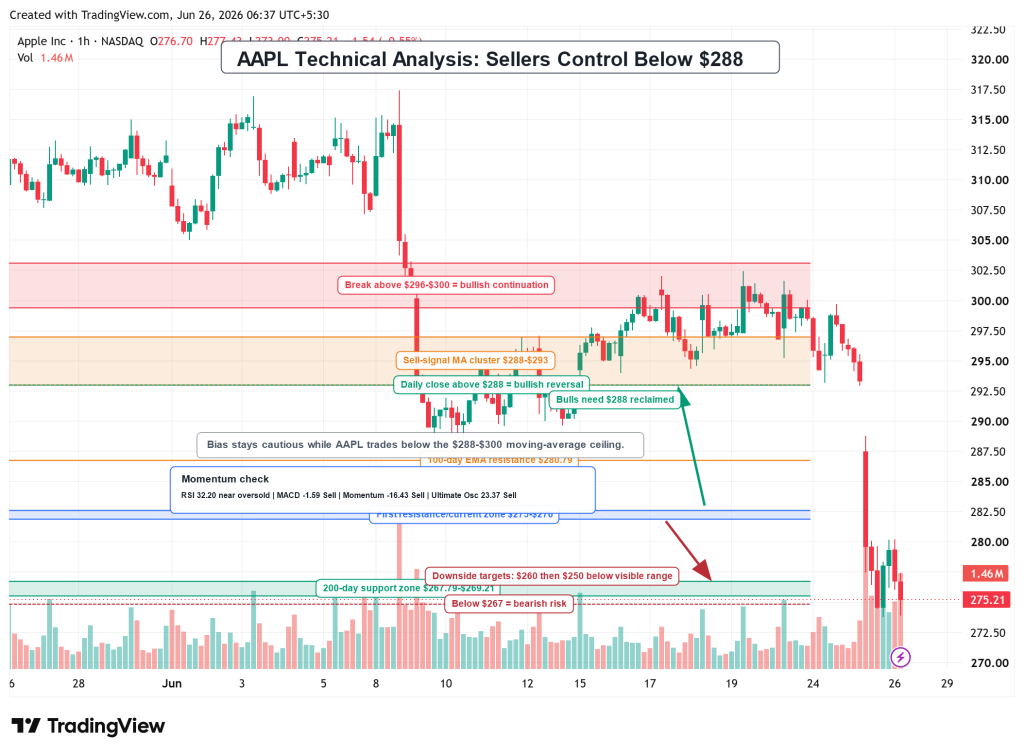
AAPL closed at $275.15, below nearly every major short- and medium-term moving average. The 10-day EMA at $292.63, 10-day SMA at $293.59, 20-day EMA at $295.44, 20-day SMA at $299.72, and Hull Moving Average at $288.05 all flash sell signals.
The broader structure is also under pressure. Apple is trading below the 50-day EMA at $290.26, 100-day EMA at $280.79, and 100-day SMA at $276.02. However, the stock remains above its 200-day EMA at $267.79 and 200-day SMA at $269.21, keeping the long-term support zone intact for now.
Momentum indicators remain bearish. The RSI at 32.20 is neutral but close to oversold territory, while Momentum at -16.43, MACD at -1.59, and Ultimate Oscillator at 23.37 all show sell signals.
Key Levels to Watch
- Resistance: $276.02, $280.79, $288.05, $290.26, $292.63, $295.44, $299.72
- Support: $269.21, $267.79, $260.00, $250.00
- Bullish reversal level: A daily close above $288
- Bullish continuation level: A break above $296-$300
- Bearish risk level: A drop below $267
What’s Next for Apple (AAPL) Stock?
If AAPL fails to reclaim the $276-$281 zone, sellers may keep pressure on the stock and retest the 200-day support area near $268-$269.
A break below $267 would weaken the long-term structure and could open the door to a deeper pullback toward $260 and then $250.
However, if Apple stabilizes above the 200-day moving averages and pushes back above $288, buyers could attempt to rebuild momentum toward $296-$300. For now, the technical bias remains cautious while AAPL trades below its short-term moving-average cluster.
- Check out our free forex signals
- Follow the top economic events on FX Leaders economic calendar
- Trade better, discover more Forex Trading Strategies
- Open a FREE Trading Account
- Read our latest reviews on: Avatrade, Exness, HFM and XM

Related Articles

Sidebar rates

Related Posts
 Save
Save