EUR/USD Price Forecast: $1.1354 Channel Floor Intact as Euro Area Core Inflation Counters Hawkish Warsh Regime
Primary reserve currency cross-rates are being compressed into the first-half seasonal close at a rate and degree not seen before...
Quick overview
- Primary reserve currency cross-rates are experiencing unprecedented compression as macro divergences are offset by rapid global risk pricing changes.
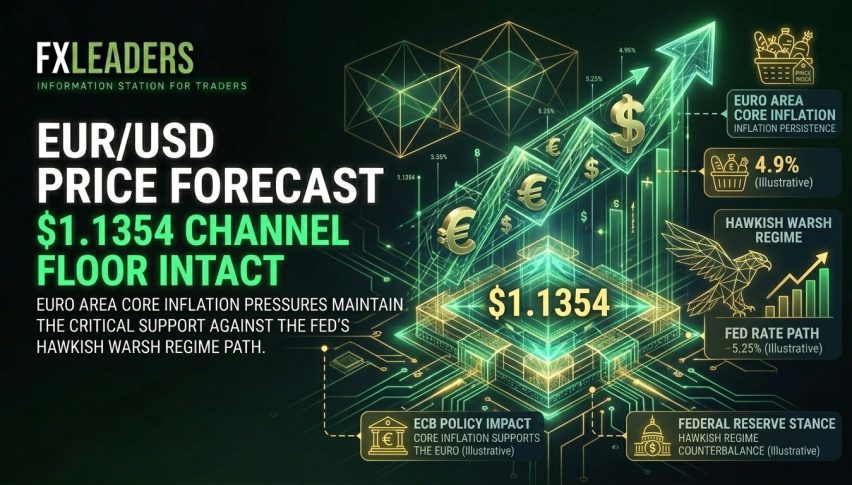
- The EURUSD currency pair is supported around $1.1394, bolstered by U.S. monetary policy divergence and strong Eurozone inflation metrics.
- The recent US-Iran trade deal is expected to benefit the Eurozone economy by lowering energy costs, aiding industrial profitability.
- A stable long-term outlook for EURUSD is suggested, with potential for a short-term rebound strategy based on technical indicators.
Primary reserve currency cross-rates are being compressed into the first-half seasonal close at a rate and degree not seen before, as a key macro divergent factor is offset by the rapid rate of change in the pricing of global risk. At 4:11 PM on June 30, 2026, the EURUSD currency pair found support around $1.1394. Automated G10 clearing desks and central bank portfolios are focused on absorbing the near term currency price action, which appears to be contained within a clear value range and supported by the ongoing dollar bid from domestic interest rate tightening.
Eurozone Inflation Metrics Are Strong
The most important factor supporting the EURUSD currency pair is the policy divergence between the U.S. Federal Reserve and the European Central Bank. Under the extremely hawkish monetary policy adopted during June 16–17, FOMC meeting (the first policy decision by recently appointed Federal Reserve Chair, Mr. Kevin Warsh), the U.S. dollar is trading with considerable strength in a vacuum. Faced with a hot 4.1% core CPI print and 3.8% headline inflation rate, Chairman Warsh is focused on domestic inflation pressures by eliminating dovish forward guidance and cancelling the expectation for an interest rate cut in the fall. As such, U.S. real yields are trading at a significant premium to other developed economy currency pairs, making alternative currency investment less attractive. However, the Euro is supported by the resilience in Eurozone inflation metrics, especially within core services and wages. As such, the ECB is following a slow and measured pace for monetary normalization, and investors should not be pricing a deep rate cut for the foreseeable future.
U.S.-Iran Trade Deal Supports Euro
Another key fundamental for Eurozone growth is the ongoing implementation of the US-Iran interim peace treaty, known as the Islamabad MoU, which was signed by U.S. President Donald Trump and Iranian President Masoud Pezeshkian on June 17, 2026, in Versailles, France. The 14-point framework successfully put an end to an active military conflict in the Gulf that began earlier this year. In accordance with the MoU, the U.S. Treasury Department’s Office of Foreign Asset Control (OFAC) has officially lifted the naval blockade against Iran in the form of a temporary General License X (GLX) that is valid through August 21, 2026. GLX will permit Iran to continue selling energy products on an insurance basis. With Iranian tanker traffic returning to around 85% seasonal levels in the Strait of Hormuz, the front-month price for Brent crude has declined sharply below the $73-per-barrel level. For a net-energy importing Eurozone economy, this will provide a welcome tailwind. Cheaper fuel inputs help trim direct input costs for core industrial manufacturing centers in Germany and France, supporting underlying corporate profitability and reversing the intense flight-to-quality capital inflows into the US dollar that have been a feature of the Middle East standoff.
Industrial Metrics Disparity Counterbalance Record Portfolio Flows Diversification
Though the reduction in energy costs provides considerable margin relief, industrial data across the Euro area continues to point towards a disparate pace of recovery by nation, with the wider industrial landscape in Germany contending with deep structural transitions and cost shifts against expensive debt financing that is curtailing capex outlays. Against that domestic backdrop though, portfolio flows remain stabilizing, with institutional money managers across both on-chain platforms and established clearinghouses diversifying sovereign holdings and treating the Euro as a cyclical diversification vehicle while global risk appetite normalizes following the implementation of the new treaty, creating a consistent underlying commercial bid that supports the currency pair, keeping the Euro well off from extreme levels and ensuring the pair remains in range even as the US Dollar Index moves to new highs.
EUR/USD Bounces Inside Structurally Complete Ascending Blue Channel
Rather than discussing further ECB dot plot speculation, EURUSD’s price action on the 2-hour timeframe suggests a well-defined and easily interpretable market structure. The EURUSD is currently defending its primary ascending blue channel support floor, with price consolidating near $1.1394 above $1.1354 and resisting pressure from a secondary red descending channel that started from its highs just several weeks ago.
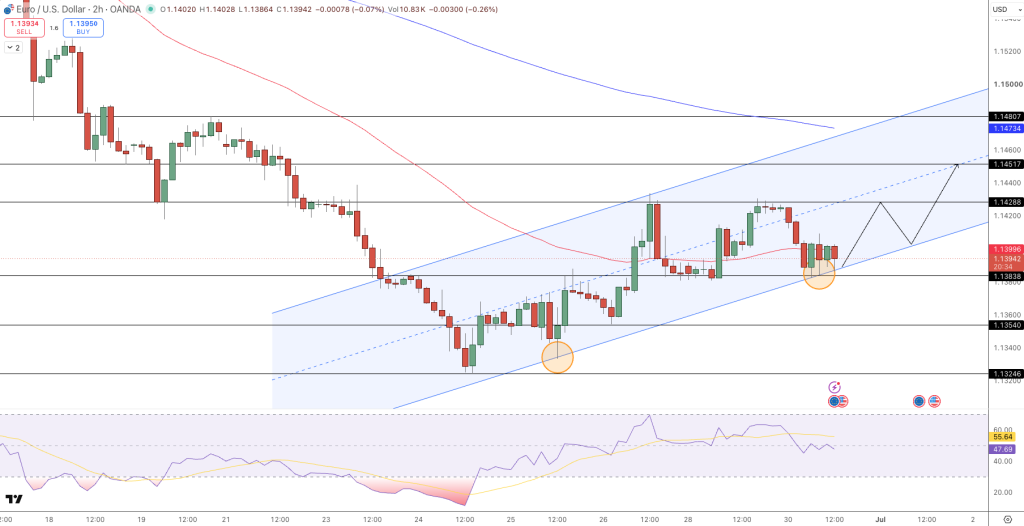
The 14-period RSI sits in a neutral at 47.69, confirming that recent selling pressure has fully played out and there is significant structural room for another up leg, with the MACD indicator’s histogram also flat near the zero line indicating that selling is losing steam along this key support floor.
EUR/USD Summary and Trade Idea
On balance, there appears to be a stable long-term outlook for the EURUSD as the recent benefit in energy input prices from the Islamabad MoU has helped offset the hawkish policy shift in the Fed under Chair Kevin Warsh. That said, the high cost of carry in the US remains a structural impediment to any major EURUSD rally, but the technical architecture of the pair continues to trade within a well-defined ascending blue channel, allowing for a continued rebound.
EUR/USD Short-Term Rebound Strategy
Go long on a successful 2-hour candle validation and bounce from the ascending blue channel support level at $1.1354, or a clean breakout close above the immediate descending trendline junction at $1.1429, keeping the stop-loss comfortably below the horizontal structural invalidation level at $1.1325, aiming to ride out a short-covering move back to $1.1473, with secondary upside targets reaching back to the $1.1481 resistance ceiling, which is a macro double-top level.
- Check out our free forex signals
- Follow the top economic events on FX Leaders economic calendar
- Trade better, discover more Forex Trading Strategies
- Open a FREE Trading Account
- Read our latest reviews on: Avatrade, Exness, HFM and XM

Related Articles


Sidebar rates

Related Posts
 Save
SaveAva

